Of late, many critics have suggested that the Niger Delta Development Commission (NDDC) should focus on turnkey projects, linkage projects, or difficult projects to create legacies in the oil region by doing what other layers of government in the regions may never do.
Now, such concept seems to be in place such as the Nembe Road project, Bonny Ring Road, the Okrika – Borokiri (Port Harcourt) Bridge, and electricity projects in all states of the region.
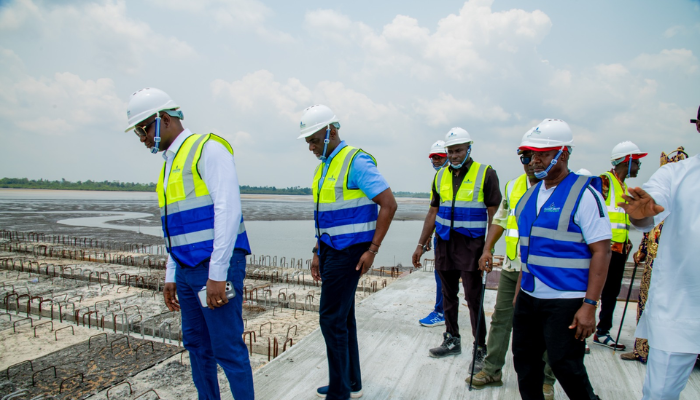
A big example of intervention or legacy project execution could be the Kaa-Ataba Bridge. For decades, the only way between Kaa in Khana Local Government Area and Ataba in Andoni LGA in Rivers State was by boat. Rain or shine, traders, farmers, students, and patients risked the river crossing, losing goods, time, and sometimes lives. That’s changing with the bridge in the concluding stages being built by the NDDC, one of the Commission’s most ambitious legacy projects.
The Kaa-Ataba Bridge is indicated as a 1.2-kilometre structure linking Khana LGA to Andoni LGA in Rivers State. It forms part of a 2km double-lane road with two bridges aimed at opening up the riverine communities of Ogoni and Andoni.
The project involves dealing with difficult marshy, swampy soil conditions, requiring significant dredging and specialised soil stabilisation techniques to build the foundations.
The multi-billion-naira project was revived and put on fast track by the current NDDC board. Samuel Ogbuku, the Managing Director, calls it “one of the most ambitious legacy projects of NDDC, which is presently the longest bridge in the Niger Delta region and one of the longest in the country.”
He affirmed the Commission was determined to make the Renewed Hope Agenda of the Federal Government a reality in the Niger Delta region, stating, “The President gave us a marching order to make a positive impact in the Niger Delta. The Board and Management are working diligently to meet Mr President’s expectations”.
Ogbuku affirmed that the Commission would do everything necessary to ensure the contractor completed the project on schedule, noting that the bridge is a key part of President Bola Ahmed Tinubu’s Renewed Hope Agenda, which aims to develop the Niger Delta region.
The NDDC Managing Director is said to be optimistic that the legacy project would be inaugurated by President Tinubu as part of activities marking his third anniversary in office.
This expected outcome will note come from talk but from action. The MD thus disclosed: “We have maintained effective engagement with the on-site engineers to ensure that standards, timelines, and specifications are strictly adhered to. With the level of commitment and professionalism demonstrated by the contractor, we are confident that the Kaa–Ataba Bridge will be delivered as scheduled and to the highest standards.”
Giving his impressions of the progress of work on the bridge, Chiedu Ebie, the NDDC board chairman, stated that the road project demonstrated the federal government’s determination to develop the Niger Delta region.
Ebie reaffirmed the Managing Director’s position that the project would be inaugurated this year (2026), stating that the contractor had given a firm assurance it would be delivered on schedule.
He stated, “We have been briefed by the on-site engineers, and they are as determined as we are to deliver the project on schedule.”
The cohesion in the present leadership of the Commission seems to be a very important factor of success rather than volume of funds. Many say it has never been so harmonious. What the MD tells the press on any single project is usually what the chairman tells the press these days.
Abubakar Momoh, Minister of Regional Development, also inspected the project and stated that it demonstrated the Federal Government’s determination to develop the Niger Delta region.
Momoh commended the NDDC board and management for responding appropriately to President Tinubu’s directives to deliver impactful projects in the Niger Delta region.
The Minister added that the effort to complete the bridge reflected the Tinubu administration’s desire to transform the Niger Delta region.
Engineering against the tides:
Building in the Niger Delta isn’t easy. Christian Emeozor, Project Manager, explained that irregular tidal conditions and adverse weather have repeatedly delayed the delivery of materials and the installation of the beam.
“We are committed to delivering on speed and quality,” Emeozor said, noting that additional manpower and equipment were deployed to compensate for reduced working hours. The host communities have also been credited for their support and cooperation on-site.
He promised that more men and materials would be committed to the project to ensure that it was delivered on schedule, declaring, “We are committed to delivering on speed and quality.”
Why it matters to the people:
For residents, the bridge is more than concrete and steel. It’s about safety, trade, and access.
“The bridge project will improve the quality of life of the people of Kaa and Ataba, as well as help transport farm produce, goods and properties from the rich agricultural area,” Emeozor said.
Benson Egwenre, king and paramount ruler of Ataba people, put it plainly: “We had almost lost hope on this project. We prayed for it to be completed. Seeing the NDDC here today has brought us joy.”
The monarch applauded the Commission for executing the project, noting it would enhance social and economic activities in the local communities.
“We are joyful because this project is so dear to our hearts. Most of the communities in Andoni are motorable except the Ataba community. Completing this project would be a big relief for economic and social activities. It will improve the lives of the Ataba people.”
In the same vein, Benjamin Ledor, the king and traditional ruler of Kaa in Khana, assured the NDDC that his people would cooperate with the contractor to ensure the project was completed on schedule.
“We are delighted because this project is so dear to our hearts. Completing it will be a significant boost for economic and social activities, improving the lives of our people.
“We assure the NDDC that we will cooperate with the contractor to ensure the project is completed on schedule,” he noted.
Obviously, the Kaa–Ataba Bridge is one of the NDDC’s most ambitious and enduring legacy projects. It will provide multiple gateways to Bony, in addition to the Bony-Bodo expressway.
Once completed, the bridge would reduce travel risk: no more dangerous canoe crossings; boost trade: farmers can move produce to markets in Khana, Port Harcourt, and beyond; improve access: students, health workers, and security agencies can reach communities faster and open new routes. The road provides an alternative gateway to Bonny Island, in addition to the Bonny-Bodo expressway.
With construction now in its final phase, the focus is said to be on completing the remaining beams and finishing works. Once open, the Kaa-Ataba Bridge is expected to stand as a symbol of what completing legacy projects can do for isolated communities.
For a region where infrastructure often stops at the water’s edge, this bridge literally bridges the gap. Beyond economic factors, the bridge is expected to strengthen regional security by improving access to coastal communities.
Sources in both communities told newsmen during the last inspection that the completion of such a sensitive linkage would prove that what the Willinks Commission set out to achieve in the 1960s has been accomplished: linking of riverine communities by roads and to the cities.

Join BusinessDay whatsapp Channel, to stay up to date
Open In Whatsapp