Nigeria’s banking sector has expanded credit allocation over the past five years, but the distribution of that lending shows where capital is being deployed and where financing gaps remain across the economy.
Data on the Deposit Money Banks’ (DMBs) credit to the private sector by the Central Bank of Nigeria (CBN) revealed that total credit rose to N730.2 trillion in 2025, representing a 173.4 percent increase from N267.1 trillion in 2021.
In 2022, it rose to N325.3 trillion; in 2025 (N432.8 trillion and in 2024 (N689,9 trillion), respectively.
The structure of lending shows concentration in oil and gas, financial institutions, manufacturing, trade, and government-linked exposures, while sectors such as education, mining, and real estate account for a smaller share.
This distribution matters because it reveals how banks are pricing risk, where capital is flowing, and how lending behaviour may shift as the banking sector exits regulatory forbearance and recapitalisation.
Oil and gas remain the largest destination for bank credit
Oil and gas accounted for the largest share of lending throughout the review period.
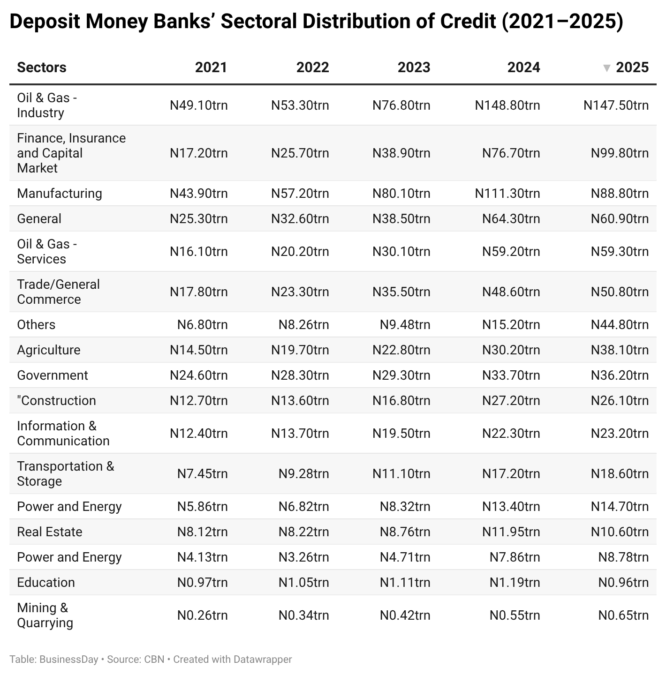
Credit to the oil and gas industry rose from N49.1 trillion in 2021 to N147.5 trillion in 2025, while oil and gas services increased from N16.1 trillion to N59.3 trillion over the same period.
Combined exposure to both oil segments stood at N206.8 trillion in 2025, representing approximately 28.3 percent of total banking sector credit.
Read also: Tier-1 banks grow deposits to N114trn as lending slows
Damilola Odesanya, research and insights analyst at Norrenberger, said oil and gas continues to attract the largest share of bank lending despite its credit risks because of its central role in Nigeria’s economy and the commercial appeal of the sector to lenders.
“Over the past five years, lending to oil and gas has averaged about 19 percent of total private sector credit, peaking at 22 percent in 2024 before moderating to 20 percent in 2025, still ahead of finance and manufacturing,” Odesanya said.
He noted that while oil and gas contribute only a small share of GDP, it remains critical to foreign exchange earnings and government revenues, making it strategically important to the financial system.
“Many oil and gas transactions are large-ticket facilities backed by export receivables, which makes them attractive to banks seeking to grow risk assets,” he said. “The sector also allows lenders to price risk more aggressively, creating stronger income opportunities despite its exposure to oil price volatility and foreign exchange shocks.”
For Matilda Adefalujo, a banking and fixed income analyst at Meristem Research, said that although the sector has historically accounted for a significant portion of industry non-performing loans, concentration levels will remain elevated in the near term.
“The removal of regulatory forbearance on some legacy oil and gas exposures has increased provisioning pressure across the industry and exposed underlying asset quality vulnerabilities that were previously moderated by regulatory relief measures. However, despite these risks, banks are unlikely to materially reduce exposure to the sector given its importance to FX liquidity, revenue generation, and overall system credit growth,” she said.
Nigeria’s real GDP grew by 4.07 percent in the fourth quarter of 2025, driven by a slight increase in the average daily oil production, according to the latest report released by the National Bureau of Statistics.
The latest figure represents an improvement over the 3.76 percent growth recorded in the corresponding period of 2024, compared to the 3.98 percent reported in Q3 ‘2025.
Financial institutions are absorbing a growing share of bank lending
One of the most significant shifts in the credit book is the increase in lending to finance, insurance, and capital market institutions.
Credit to this segment increased from N17.2 trillion in 2021 to N99.8 trillion in 2025, representing a rise of 479.4 percent.
Read also: Banking on confidence: What Nigeria’s recapitalisation says about investor trust
Its share of total lending rose from 6.5 percent in 2021 to 13.7 percent in 2025, making it one of the largest credit destinations in the system.
The growth is significant because it changes the composition of the credit book. Lending within the financial system may improve liquidity and transaction flow, but it does not necessarily expand financing for production, industrial capacity, agriculture, or infrastructure development.
Manufacturing credit declined after three years of expansion
Manufacturing remained one of the largest recipients of bank credit for most of the review period.
Lending rose from N44.0 trillion in 2021 to N111.4 trillion in 2024, before declining to N88.8 trillion in 2025.
That represents a 20.3 percent year-on-year decline, while manufacturing’s share of total bank lending fell from 16.1 percent in 2024 to 12.2 percent in 2025.
The reversal is significant because manufacturing has consistently been positioned as a key sector for industrial output, employment, domestic production, and trade balance improvement.
With lending rates elevated as a result of the Central Bank’s tight monetary policy stance, many firms are choosing to cut back on debt rather than commit to fresh loans that carry heavier repayment burdens.
The Manufacturers Association of Nigeria (MAN) warned that persistent high lending rates would continue to limit manufacturers’ access to affordable credit, particularly those in the small and medium industrial cadre.
MAN added that the challenge was compounded by structural bottlenecks such as poor infrastructure, high logistics costs, erratic electricity supply, soaring energy costs, and insecurity, which it said, cumulatively raise production costs and weaken competitiveness.
Real estate, education, and mining remain marginal despite the diversification policy
These sectors continue to receive little credit from banks despite contributing more to Nigeria’s gross domestic product in 2025,
Real estate credit rose from N8.1 trillion in 2021 to N12.0 trillion in 2024, before declining to N10.5 trillion in 2025. The sector accounted for approximately 1.4 percent of total lending in 2025. Despite Nigeria’s housing deficit, real estate remains a smaller portion of bank lending.
Read also: Nigerian banks’ shareholders funds rise to N27trn after recapitalisation drive
Education remained one of the smallest recipients of banking sector credit.
Lending increased from N971.8 billion in 2021 to N1.2 trillion in 2024, before declining to N956.5 billion in 2025. Its share of total credit was below 0.2 percent.
The figures suggest education financing remains dependent on non-bank funding sources, institutional capital, or direct investment rather than commercial lending.
For Mining and quarrying, credit rose from N264.5 billion in 2021 to N647.5 billion in 2025.
Despite percentage growth, the absolute value remains small. The sector accounted for less than 0.1 percent of total lending.
What recapitalisation could change
The bank post recapitalisation exercise, which required banks to significantly increase their capital base, comes at a time when the country is pursuing ambitious economic reforms under the administration of Bola Ahmed Tinubu.
At the heart of the policy is the goal of building a stronger, more stable banking sector capable of financing large-scale investments needed to grow Nigeria into a $1 trillion economy.
According to the CBN Governor, Olayemi Cardoso, “Sustainable economic growth is unattainable without a resilient financial system.” This recapitalisation ensures Nigerian banks can fund the scale of transactions needed to drive a $1 trillion economy.”
A well-capitalised banking system plays a key role in economic development. Stronger banks are better positioned to give out loans, absorb financial risks, and maintain public confidence, especially during periods of economic uncertainty
According to Fitch Ratings, in a recent report, Nigerian banks are expected to significantly increase lending in 2026 as stronger capital positions following the industry-wide recapitalisation exercise provide room for fresh credit expansion.
The global ratings agency said nominal loan growth in the banking sector is projected to accelerate to more than 20 percent in 2026 after slowing sharply to about 5 percent in 2025 due to tight monetary conditions, high interest rates, and the withdrawal of regulatory forbearance measures.
Fitch said the fresh capital raised by banks to meet the Central Bank of Nigeria’s new paid-in capital requirements has strengthened balance sheets and positioned lenders for business growth.
“All Fitch-rated licensed Nigerian banks have met the new paid-in capital requirements effective from the end of the first quarter (Q1’26), as have the majority of non-rated banks,” Fitch said.
What to expect going forward
The next phase of bank lending will be shaped by how quickly impairment pressures moderate, how recapitalised banks deploy capital, and whether sector concentration changes.
Adefalujo, the Meristem analysts added that what is more likely is a shift toward tighter underwriting standards, shorter loan tenors, stronger collateral structures, and an increased focus on obligations with stable FX-generating capacity.


Join BusinessDay whatsapp Channel, to stay up to date
Open In Whatsapp