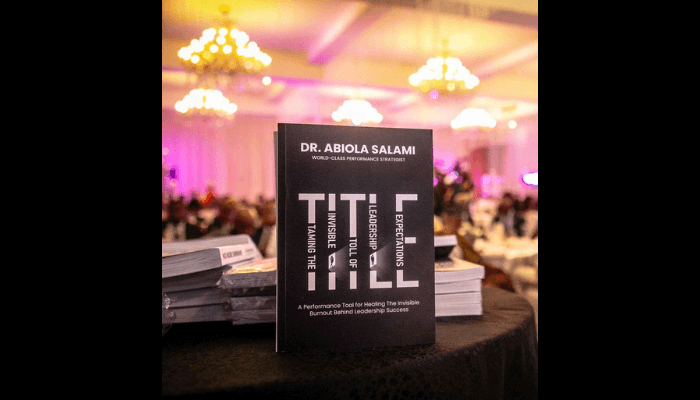
Author: Dr. Abiola Salami
Page: 289 pages
ISBN: 978-978-57044-7-1
Reviewer: JOHN SALAU
There are books that inspire. There are books that motivate. There are books that challenge old assumptions. Then there are books that diagnose a silent crisis and offer practical solutions.
Abiola Salami’s latest work, Taming the Invisible Toll of Leadership Expectations TIitle), belongs firmly in that last category. It is a thoughtful exploration of how senior leaders and board members in both public and private sectors can drive strategy without succumbing to burnout.
At a time when leadership is often celebrated through titles, corner offices, public applause, and visible achievements, Salami asks a more uncomfortable question about what leadership is costing the leader behind closed doors.
This question forms the heartbeat of a compelling and timely book that refuses to romanticise success. Across the 289 pages, the author and world-class performance strategist explored the hidden emotional, mental, relational, physical, and identity-based burdens that many responsibility executives, founders, public officials, entrepreneurs, clergy, and professionals shoulder.
Many books on leadership focus on how to gain influence, command teams, improve productivity, or scale performance. Salami’s work takes a different path. He assumes many leaders already know how to win externally. What they often do not know is how to win internally without burning out. And that is where this book becomes both relevant and refreshing.
From the opening chapters, the author makes it clear that most leaders do not need another motivational speech. They need systems. They need handles. They need tools that can be repeated under pressure. They need frameworks to reduce decision fatigue, manage emotional exhaustion, rebuild trust, preserve energy, and remain successful without losing self-respect.
That practical promise is what this book delivers.
Salami draws from more than two decades of coaching senior leaders, advising institutions, and studying human performance. His experience is evident throughout the text. The writing carries the confidence of someone who has sat across boardroom tables, listened to exhausted achievers, and helped high performers recover their edge.
One of the strongest contributions of the book is the Invisible Toll of Leadership Index™, a diagnostic tool created to help readers identify the hidden costs they are paying. Many leaders can detect declining revenue faster than declining joy. They can measure business output faster than emotional depletion. Salami challenges this imbalance by urging leaders to audit themselves with the same seriousness they audit performance reports.
The concept is simple yet powerful: if you cannot see the toll, you cannot manage it. The book is further structured around what he calls the Five-Pillar Framework, a thoughtful breakdown of the pressures leaders silently endure.
The first pillar, Cognitive Overload, addresses mental congestion caused by endless decisions, constant interruptions, shifting priorities, and overbooked schedules. In a world where many leaders pride themselves on multitasking, Salami argues that fractured attention is not a badge of honour but a tax on judgment.
The second pillar, Emotional Drain, explores the burden of carrying other people’s worries while suppressing one’s own emotions. Leaders are expected to remain calm, optimistic, stable, and encouraging even during chaos. Over time, this emotional labour can become exhausting.
Third is Relational Strain, the loneliness of leadership. Many leaders discover that the higher they rise, the fewer honest conversations they enjoy. Trust becomes thinner, candour becomes rarer, and relationships become more transactional.
Then comes Physical Depletion, a pillar many readers will instantly recognise. Chronic fatigue, poor sleep, skipped exercise, stress eating, dependence on stimulants, and endless work cycles often hide beneath polished appearances. Salami insists that no leadership model should require the destruction of the body carrying it.
Finally, Identity Fracture addresses perhaps the deepest cost of all: becoming successful at the expense of becoming yourself. This occurs when outward wins violate inner values, when applause replaces authenticity, or when achievement becomes disconnected from meaning.
These five pillars make the book highly relatable because they describe realities many leaders experience but rarely name.
Yet diagnosis alone is never enough. What separates Taming the Invisible Toll of Leadership Expectations from many business books is that Salami moves quickly from insight to implementation.
He does not merely tell readers to “rest more” or “set boundaries.” He offers practical mechanisms. Readers are introduced to scripts for difficult conversations, decision frameworks that reduce unnecessary meetings, micro-recovery rituals that fit into tight schedules, reflection prompts for self-awareness, and checklists that can be deployed immediately.
Each chapter closes with tools rather than theories. This design makes the book less like a lecture and more like a field manual.
Another strength of the work is its tone. Salami writes with authority but without arrogance. He avoids jargon-heavy language that often burdens management literature. His ideas are sophisticated, yet accessible. Whether the reader is a CEO, civil servant, startup founder, pastor, school proprietor, or mid-level manager, the lessons remain understandable and usable.
Environmental relevance
For Nigerian readers in particular, the book lands with sharp relevance. In many African contexts, leadership often carries layered expectations. One individual may be expected to lead an organisation, support extended family, maintain community obligations, respond to public scrutiny, and remain emotionally available to everyone else. Strength is celebrated; vulnerability is misunderstood. Endurance is admired; exhaustion is normalised.
In his book, Salami challenges this dangerous culture of silent suffering. He argues that sustainable leadership is not a weakness. Rest is not laziness. Boundaries are not selfishness. Reflection is not a luxury. Asking for help is not incompetence.
These are necessary corrections in environments where many talented people are praised until they collapse.
The author’s own credentials add weight to the work. As Principal Strategist of CHAMP, Salami has built a reputation in executive coaching, workforce development, performance advisory, and branding.
An alumnus of Harvard University, Lagos Business School, and the United States Government’s International Visitor Leadership Program, he combines global exposure with local understanding.
Yet perhaps more importantly, he writes as someone who understands people. Throughout the book, readers sense a deep respect for human dignity. Salami does not treat leaders as machines that must produce endlessly. He treats them as whole persons whose minds, emotions, bodies, relationships, and identities matter.
That perspective is urgently needed in today’s performance culture. If the book has one central message, it may be this: Success that destroys the person achieving it is too expensive. That statement alone makes the book worth reading.
The TITLE itself is excellent. Taming the Invisible Toll of Leadership Expectations captures both the problem and the promise. The toll may be invisible, but it can be named. It can be reduced. It can be managed and it can be tamed.
This is not a book for those seeking shallow inspiration or empty slogans. It is for serious people carrying serious responsibilities. It is for leaders who are productive but tired, successful but stretched, admired but internally drained.
It is also for rising professionals who want to build healthier patterns before crisis arrives.
By the final pages, the reader is left with a clear conviction: leadership should not require self-destruction. Great work and wellbeing do not have to be enemies. Ambition can coexist with sanity. Excellence can coexist with peace.
Salami has written more than a leadership book. He has written a rescue manual for achievers. In a society obsessed with visible success, he reminds us to examine invisible costs. Hence, he offers leaders one of the greatest gifts possible—permission to succeed without losing themselves.

Join BusinessDay whatsapp Channel, to stay up to date
Open In Whatsapp