Researchers at the University of Hertfordshire have secured $2.1 million (£1.68 million) in research funding from the United Nations to further develop an AI and solar-powered solution aimed at reducing food waste and tackling hunger in Nigeria.
The funding supports the HARVIST project, a consortium of 10 organisations across the UK and Nigeria.
Read also:Cold-chain investment could create 25,000 jobs in Nigeria, expert says
While agriculture is Nigeria’s largest economic sector, 72 percent of the country’s 60 million smallholders live below the poverty line.
This is largely due to unreliable power supplies and an inability to prevent produce from spoiling before it reaches the market.
To address this, the university has applied its technical expertise to enhance So-Cool (Solar Cooling), a product developed by its African partner, Kamim Technologies.
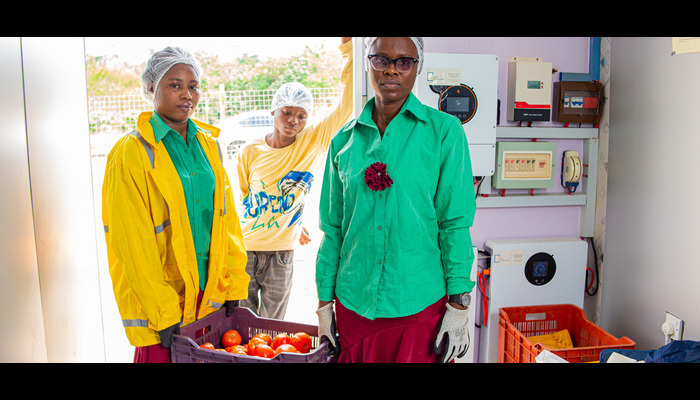
So-Cool provides solar-powered cooling and storage facilities located near urban smallholders to aggregate perishable goods. The system connects to a platform using machine learning to provide commodity price guides, allowing farmers to market their produce more effectively to bulk buyers.
The project is led by Hafiz Alaka, professor and director of the Big Data Tech & Innovation Lab and associate dean of Research and Enterprise at the University of Hertfordshire.
Alaka, who grew up in Nigeria, stated, “Unreliable power supply is a major problem for Nigerian businesses and causes severe consequences for agriculture. Our solution, which draws on farmers’ feedback, is not only reliable, but also cleaner and cheaper than fossil fuels, helping to meet Nigeria’s net-zero transition plan.
Read also:How five cold chain entrepreneurs are saving Nigeria’s fresh food markets
“It cannot be right that smallholders create 90 percent of all agricultural produce but can only sell 26 percent of it because it perishes before it can be purchased. As a result, Nigeria imports produce and 72 percent of Nigerian smallholders continue to live below the poverty line.
“As a Nigerian myself, I am delighted that our consortium approach has won this significant research funding to help level the playing field for urban smallholders and to tackle both poverty and food insecurity in the country.”
The University is collaborating with LMD Agro-Consultants, Kamim Technologies, and various stakeholders to coordinate smallholders, buyers, and the assembly of So-Cool units. Two units are currently operational in Lagos State.
Adekoyejo Kuye, managing director of Kamim Technologies, added:
“Every harvest season we meet farmers who did everything right but still lose income because the infrastructure isn’t there: power is unreliable, there’s nowhere to store produce, irrigation is limited, and markets are far away.
“Farmers don’t need another pilot that looks good on paper; they need power that stays on, cold rooms that preserve quality, and transparent market access. This funding lets us deliver that end-to-end system across Nigeria, scale what works, and keep more income in farming communities.”
The project is expected to benefit over 10,000 smallholder farmers, women, and young people. The UN funding will also support the construction of two additional 20-tonne storage hubs. The So-Cool system is designed for off-grid environments, ensuring it reaches those furthest from energy infrastructure.
Wendy Wills, pro vice-chancellor (Research and Enterprise) at the University of Hertfordshire, said:
“The University of Hertfordshire is committed to applied research that responds to real-world challenges. By combining renewable energy, digital technology, and a cooperative approach to managing food resources, So-Cool directly addresses the root causes of post-harvest losses and farmer poverty.”
The UN funding will allow the HARVIST project to continue until late 2028, with plans for a wider rollout thereafter.

Join BusinessDay whatsapp Channel, to stay up to date
Open In Whatsapp