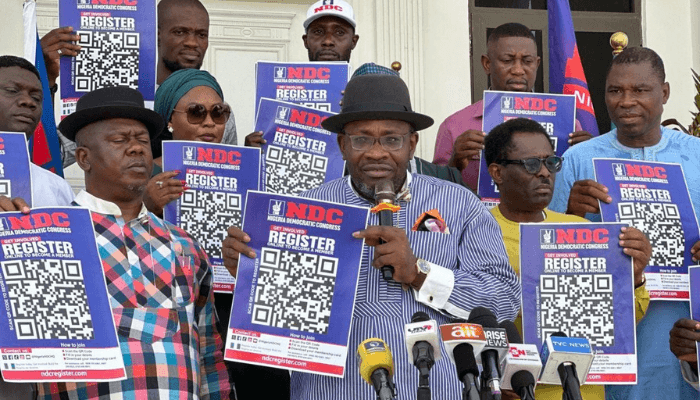
The Federal High Court in Abuja has scheduled May 25 for the hearing of a suit by the Nigeria Democratic Congress (NDC) challenging Sections 138 and 77(5) of the Electoral Act, 2026.
The case, before Justice Mohammed Umar, was fixed following the absence of the Attorney-General of the Federation (AGF) in court on Thursday, despite being served with the originating process and hearing notice.
The NDC, which was registered by the Independent National Electoral Commission (INEC) on February 5, filed the suit on March 27, marked FHC/ABJ/CS/635/2026.
The party is seeking a declaration that the contested sections are inconsistent with the 1999 Constitution (as amended).
The suit names the AGF and the Clerk of the National Assembly as first and second defendants, with Senate President and INEC included as third and fourth defendants.
Vincent Ottaokpukpu, representing the NDC, told the court that while all other defendants were represented, the AGF failed to appear.
He confirmed that the party had filed further affidavits and replies on points of law in response to the defendants’ preliminary objections.
Read also: Police storm SDP headquarters after Adebayo’s screening exercise
Representatives of the second and third defendants requested additional time to file their counter-affidavits, while INEC stated that it had responded on points of law and complied with all statutory requirements.
Justice Umar directed all parties to complete outstanding filings and ordered that the hearing notice be served on the AGF, adjourning the matter to May 25.
In its suit, the NDC argued that Section 138 of the Electoral Act, 2026, conflicts with several constitutional provisions related to qualifications for elective offices, while Section 77(5) imposes restrictions on party primaries not contemplated under the constitution. The party is seeking a court order to strike down the provisions and compel the National Assembly to amend the law.
Ezechi Adaobi, a litigation secretary with the NDC’s law firm, told the court that Section 77(5) limits primary election participation to party members on a digital register submitted 21 days before a primary, a provision she argued is inconsistent with the constitution.
INEC, in its counter-affidavit, maintained that the Electoral Act, 2026, was validly passed by the National Assembly and assented to by President Bola Tinubu.
The commission argued that the law does not violate citizens’ constitutional rights to join or participate in political parties and that the prescribed 38-day window for party primaries is compliant with the law.
Seriake Dickson, representing Bayelsa West Senatorial District, currently serves as the NDC’s national leader.

Join BusinessDay whatsapp Channel, to stay up to date
Open In Whatsapp