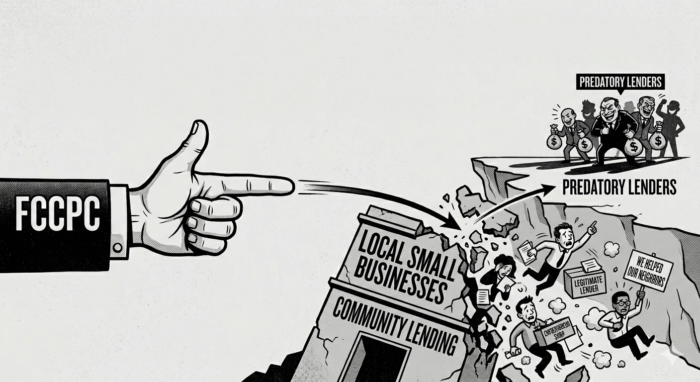
There is a pattern that anyone who has observed Nigerian regulation long enough will recognise. A genuine problem exists; a regulator steps in to address it; the intervention is broadly welcomed because the problem was real and people were suffering.
And then, somewhere between the policy announcement and the enforcement, the solution begins to create problems of its own, sometimes worse than the original disease. What is happening right now with the Federal Competition & Consumer Protection Commission’s (FCCPC) Digital, Electronic, Online, or Non-traditional Consumer Lending (DEON) regulations and the airtime credit services that millions of Nigerians depend on is a textbook case of this pattern.
Let me state what should not be controversial: the DEON regulations were introduced to address predatory digital lenders, and anyone who has followed the activities of these operators knows the intervention was necessary. Lending applications were accessing people’s phone contacts and sending threatening messages to their family members at midnight; interest rates were criminal; debt recovery practices were abusive. The regulatory response was not only appropriate, it was overdue.
The problem is not the existence of the DEON regulations. The problem is what has happened in their application. A regulatory framework designed to address predatory lending in digital loan applications has been extended to cover airtime credit services provided by telecommunications companies licensed by the Nigerian Communications Commission.
These are not the same thing. When a subscriber dials a USSD code to borrow two hundred naira worth of airtime, makes their call, recharges, and the advance is deducted, there is no interest rate; no debt collector is calling your mother; there is no application harvesting your contacts. To classify this alongside the loan sharks that were harassing Nigerians into depression is to confuse the pharmacy with the drug dealer because both of them handle substances.
The legal questions arising from this situation are before the courts, and I will not comment on matters sub judice. What I can comment on, as someone who has spent years thinking about the intersection of law and public policy in Nigeria, is the governance architecture that allowed us to arrive here in the first place, because regardless of what the courts eventually decide, the underlying structural problem will remain unless we confront it honestly.
That structural problem is the absence of a functioning coordination framework between Nigerian regulatory agencies. The NCC exists under the Nigerian Communications Act 2003; the FCCPC exists under the Federal Competition and Consumer Protection Act 2018. Both are legitimate statutory bodies with defined mandates. The difficulty is that when those mandates overlap, as they inevitably do when telecom companies offer services that resemble credit, there is no established mechanism for determining who leads, who supports, and how the two agencies work together.
What we get instead is one agency extending its enforcement into territory already occupied by another agency: no consultation, no memorandum of understanding, no inter-agency coordination of the kind that mature regulatory systems treat as a basic requirement of good governance.
This is not an abstract concern. The practical consequence is that millions of Nigerians have lost access to a service they depend on daily: the market woman in Oshodi who borrows airtime to call her supplier when her balance is empty; the dispatch rider in Abuja who needs to confirm a delivery before his next recharge; the student in Kano who borrows data to submit an assignment.
These are not people taking out predatory loans. These are people using a licensed telecom service that a regulatory dispute they did not cause and do not understand has taken away from them.
Nigeria is not unique in facing this kind of overlap. In Kenya, the Central Bank and the Communications Authority have an established framework for regulating mobile money; in the EU, electronic communications regulations explicitly address the boundary between telecom services and financial services.
These frameworks exist because the alternative, which is what Nigeria is experiencing right now, is chaos. What distinguishes the jurisdictions that handle convergence well from those that handle it badly is not the quality of the individual regulators: it is the existence of clear coordination protocols that prevent one agency from acting unilaterally in another’s territory.
I want to be careful here because active litigation means there are arguments I cannot and should not make in a newspaper. But I will say this much: the principle that a government agency must operate within the powers its enabling legislation grants is not a technicality that lawyers use to obstruct progress.
Ultra vires is not a Latin phrase designed to intimidate; it is a safeguard that exists to protect citizens from the arbitrary expansion of state power, however benevolent the stated intention. If we accept that one agency can absorb the jurisdiction of another simply because the cause it is pursuing is sympathetic, we have established a precedent that no regulated sector in Nigeria is safe from.
The FCCPC’s consumer-protection mandate matters; the NCC’s telecom-regulatory mandate matters. Both agencies serve essential functions, and neither should be weakened. But they need to learn to work together within their respective lanes, with clear rules for what happens when those lanes converge. Until that happens, Nigerians will continue to be caught in the crossfire of regulatory turf wars they did not start and cannot resolve. The people who can least afford to lose access to basic services will, as always, be the ones who suffer most.
Ilemona Onoja, a lawyer and public policy commentator, writes from the United Kingdom.

Join BusinessDay whatsapp Channel, to stay up to date
Open In Whatsapp