The issue of ethnicity in the Nigerian society appears to have been elevated to a fearful dimension. Nigeria also appears to have been balkanized by dangerous groups that masquerade as ethnic jingoists who go about whipping up ethnic sentiments for their own personal gain. The exaggeration of ethnic sentiment in Nigeria to the point that it moderates policies of government and to a large extent determines the behaviour and commitment of many citizens to the national project has been described as a dangerous trend that must be urgently checked.
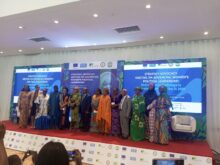
This concern was raised in Lagos Wednesday at the 2015 Aelex lecture, titled ‘African Countries: Politics,
Democracy and Ethnicity.
Bolaji Akinyemi, a professor and former minister of External Affairs; Ike Nwachukwu, a retired general and former minister of Foreign Affairs;Femi Okunnu, a former Federal Commissioner for Works and Housing;Sa’idu Ahmad Dukawa, a senior lecturer, Department of Political Science, Bayero University, Kano, and ‘Yemi Adamolekun, executive director, Enough is Enough (EiE), were among the leading voices that rose in condemnation of the inability of leaders to harness the benefits of multi-ethnicity in the Nigerian state.
Akinyemi, who was the guest lecturer, noted that, the fact that the majority of African states is multi-ethnic is one of the consequences of the European Berlin Conference of 1984. He listed several countries on the continent with diverse ethnic groupings, emphasising that successive governments in those countries have not really come to terms with how to manage the challenges they pose.
The guest lecturer noted that ethnicity is not only African problem; it has also remained a serious issue in other continents of the world.
According to him, “The main issue which confronts ethnicity in the electoral conundrum in Africa is how to build an inclusive electoral system which turns the ethnic kaelodoscopy into positive factor. Even though we tend to slide into the ‘one man one vote’ mantra when we think democracy, the practice of democracy worldwide is not based on one man one vote. Countries that practice the Presidential system come closest to the ‘one man one vote’ paradigm. But those countries which practice a joint presidential/parliamentary system, a straight parliamentary system and proportional representation are very far from the ‘one man one vote’ mantra but close to the Lincolnian definition of democracy as ‘government of the people, by the people and for the people.’”
Akinyemi further said: “I believe that a two-party, whether imposed by the constitution or evolving naturally is the best antidote to the invidiousness of ethnic politics. It has been really difficult to guage the level of attachment of people to ethnic politics as it appears that the political elite regard it as the equivalent of water faucet to be turned on and off to satisfy the whims and caprices of the political elite.”
Earlier in his opening remarks, Ike Nwachukwu, who was chairman of the occasion, said ethnicity was at the heart of the problems of African countries. He wondered aloud why many African countries have remained undemocratic despite series of interventions.
According to him, ethnicity is one of the banes of democracy.
“Our country is awash with conflicts. Africa ought to have grown beyond bitter resentments of one another. Unfortunately, this has not happened,” he said.
Saidu Dukawa and Yemi Adamolekun, first and second discussants, respectively said the problem with the country was not about ethnicity so to speak, but attitude of some individuals to national issues.
Dukawa proposed that there’s an urgent need to re-democratise Nigeria and that there should be reform of social infrastructure in the country.
On her part, Adamolekun noted that there had been threats by the federating units in the country to secede at one time of the other, saying it is an indication that all is not well with the country.
She called attention to the unity that exists whenever a Nigerian team wins an international match. She also alluded to Beauty Pageants competition where competing ladies adopt states other than theirs to represent. She noted that in such instances, ethnicity is never an issue as nobody ever protests.
According to her, it is only when it comes to politics that people begin to play ethnic card, which she noted does not augur well for the country.
Making his observation, Femi Okunnu said: “If Nigeria had remained as it was 30 or 40 years back, the country would have been truly the leader of Africa. We didn’t know what they called ethnicity at that time. There was no federal character. We have turned these ethnic groups into political parties and it should not be so.”
Okunnu, who went down memory lane, recollecting how some founding fathers of Nigeria contested and won elections outside their native homes, said it was unfortunate that Nigerians are today looking at one another as strangers even in their own country.
He urged Nigerians to always project the country and not their geo-political zones.
The lecture which started in 2005 has held for nine times, excluding the current one. In 2011, the topic was ‘Corruption: The thief in Broad Daylight’; in 2012, it was, ‘This House Must Not Fall; Constitutional Reform and the People’s Will’, and it was ‘politics, religion and Economic Development,’ in 2013.
Zebulon Agomuo

Join BusinessDay whatsapp Channel, to stay up to date
Open In Whatsapp