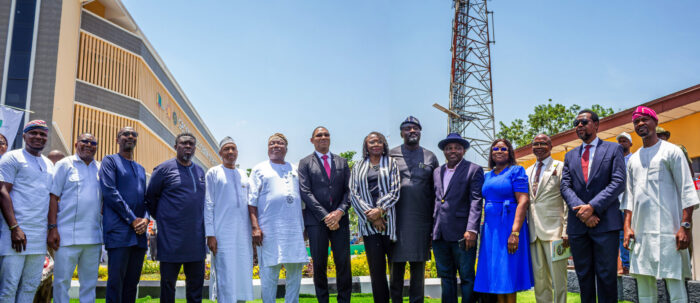
As part of efforts to tackle the disconnect between classroom learning and practical application, Folasade Ogunsola, the vice-chancellor of the University of Lagos (UNILAG), has highlighted the Geosciences Centre as a key driver of industry collaboration.
Ogunsola disclosed this during her speech at the official commissioning of the Geosciences Centre of Excellent building on Friday, when she explained that the centre, a collaborative effort funded by Nigerian National Petroleum Company, Shell Nigeria Exploration and Production Company Limited, and Nigeria Content Development and Monitoring Board, is a legacy positioned to enhance research, innovation and manpower development in the Geosciences and the allied disciplines.
“This state-of-the-art facility is a three-suspended floor, comprising the reception, workshops, laboratories, lecture theatre, lecture rooms, museum, simulation laboratory, library, offices, sit-out and convenience facilities.
“The project underpins the university’s drive for industry/academia collaboration to bridge the gap between classroom learning and practical application,” she said.
The vice-chancellor emphasised that the project traversed the tenures of four vice-chancellors from its initial conception in 2010 during the administration of Babatunde Sofoluwe. the 10th vice chancellor to Rahman Bello, the 11th vice-chancellor, who strengthened the conceptual framework by repositioning it as an industry–university linkage centre, to Oluwatoyin Ogundipe, the 12th vice chancellor when the design and scope were optimised for improved efficiency, feasibility, and alignment with institutional priorities till today in the time of the 13th vice chancellor, its doors will be opened for business.
“At UNILAG, we don’t give up or abandon legacies. We build on the works of previous managements. Each vice chancellor since the 10th has carried the vision forward, so you can rest assured that your investment is safe with us.
“The 14th, 15th and others coming behind us will continue to build on this investment too. This occasion represents the beginning of a transformative endeavour together,” she emphasised.
She reiterated that the university is delighted and honoured to be collaborating with SNEPCo to boost training in deep-water oil and gas exploration and specialised research and practical training for geosciences students.
“For us at the University of Lagos, the centre will serve as a vessel for interdisciplinary research, fostering collaboration across diverse fields of Geosciences, Engineering, Computer, Physics and Environmental Sciences. It will offer the opportunity to develop capacity to unlock new avenues of inquiry and empower our scholars to push the boundaries of knowledge.
“It will equip our students with the critical skills and forward-thinking mindset necessary to thrive through hands-on learning with advanced teaching technology, simulation laboratory and library facilities for research and knowledge sharing, as well as serve as a hub for studying fields such as reservoir modelling, seismic interpretation, and core analysis to prepare students for the energy industry,” the vice-chancellor noted.
Moreover, she revealed that the university, in liaison with the donor, has articulated a clear sustainability framework for the centre, incorporating long-term institutional funding commitments, strategic industry partnerships, periodic technology upgrades, and structured maintenance provisions to ensure the facility remains operationally efficient, academically relevant, and globally competitive over the long term.
“With our country in the forefront of petroleum and gas exploration in Africa, this centre will play a pivotal role in developing expertise by offering degree programmes, customised short courses, professional certifications, and executive training programmes tailored towards the needs of industry and government agencies that meet international standards.
“The centre, working across many disciplines and utilising the technology resources on the campus such as the AI hub and the soon-to-be-completed Sahara energy innovation hub, marine platforms, subsea engineering and the institute of maritime studies are all clustered to promote new knowledge and innovation,” she said.
The vice-chancellor emphasised that universities are the engine room of development, but their potential is only realised when industry challenges them by bringing its problems for solutions.
“I’m happy that the industry-university handshake is happening. For too long, we have kept apart, locking down the immense potential for accelerated growth and keeping Africa a consumer nation stereotyped as poor and needing of aid to solve its challenges.
“We must break that stereotype and create our own narrative. This collaboration is a welcome development and the right thing to do. Thank you for your trust in us. Today we begin together a journey of discovery; we cannot afford to fail,” she stated.
She applauded NNPC, SNEPCo, and NCDMB for making sure the Geosciences Centre of Excellence happened.
It is safe to say that the journey has just begun. The real work starts tomorrow as we join hands together, academia, industry and government to ensure that this centre becomes not only a reference point for impactful research and manpower development in the oil and gas sector but also a catalyst for National and African economic development.

Join BusinessDay whatsapp Channel, to stay up to date
Open In Whatsapp