Earlier this year, Standard & Poor’s (S&P), the global ratings agency, was reported in one of the daily newspapers (July 16, 2015) to have suggested that the Central Bank of Nigeria (CBN) will have no choice than to devalue the naira by more than 15 percent. According to the report, S&P claimed that local and foreign investors have seen a devaluation of the naira which has been battered by the recent fall in price of crude oil as long overdue. Furthermore, the agency stated that many investors are positioning for a devaluation of around 15 percent or more; derivatives used to hedge against future exchange rate moves reflect expectations of currency weakening; six-month non-deliverable forwards price the naira at 233 per US dollar, which is some 18 percent weaker than the CBN’s pegged rate of 196.95 during that period.
The CBN has categorically stated that it will not undertake a further devaluation of the naira because of the need to safeguard the Nigerian economy from the shocks and negative impact the depreciation will have on the economy. However, the continued call by some analysts for devaluation of the naira prompted this article.
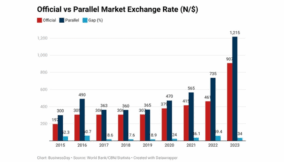
Agreed that the naira has at some point hit a record low of 242.5 against the dollar on the parallel market operated by dealers in bureau de change, the naira devaluations in November 2014 and February 2015 no doubt are responsible for the current position of exchange rate in Nigeria. It is wrong for S&P or any economic analyst that means well for Nigeria to advise the country to devalue her currency again at this time. There are certainly other policy options that are not devaluation.
What does devaluation entail for Nigeria?
“Devaluation” simply means the official lowering of the value of a country’s currency within a fixed exchange rate system, by which the monetary authority formally sets a new fixed rate with respect to a foreign reference currency.
Countries devalue their currencies only when they have no other way to correct past economic mistakes or problems forced on them by unforeseen circumstances. And the three key reasons why a country may choose to devalue her currency are to encourage exports; discourage imports; and correct balance of payment issues.
In the case of Nigeria, the steep decline in crude oil prices by more than 50 percent in recent times has significantly limited the amount of foreign currency that the country receives from the export of crude oil. And given that majority of the goods consumed in Nigeria are imported, the rate of demand for foreign exchange no doubt has overtaken the rate at which the
foreign reserve is being stocked up. However, the production of the country’s non-oil exports cannot be considerably increased in the short term to boost export earnings. Besides, to scale up exports requires an improvement in competitiveness relative to trading partners. Furthermore, the country is in a position to discourage importation of several goods which can be produced locally.
The effects of devaluation
For some weak currencies, devaluation is a process without end that leads to completely worthless currencies, which has been experienced in countries like Cambodia, Paraguay, Guinea, Indonesia, Iran, and Vietnam. Other negative effects that devaluation could create for the country include: (a) a costly import which will carry inflation into the country thereby increasing the price level and thus create a problem for the consumer; (b) increased foreign debt burden, which will be a big loss for a country like Nigeria and foreign debts will become more difficult to service; and (c) deterioration in terms of trade, since on one hand the country has to pay a greater amount of money for imports, while, on the other hand, she gets less money for her exports.
Prior to recent developments, official devaluation of the naira last occurred late in 2008, when the currency was under pressure from the effects of the global financial crisis. However, in the last quarter of 2014, the CBN announced the devaluation of the naira by N13, which fixed the exchange rate to the US dollar at N168 instead of the previous N155, as part of measures aimed at strengthening the nation’s economy. Similarly, in February this year, the CBN indirectly devalued the naira by scrapping its bi-weekly currency auctions and pegged the exchange rate at N198.
Of course, the freefall of the naira to major currencies that followed these rounds of devaluations, especially at the parallel market, should set the precedent for what to expect in the event that another forced devaluation occurs now. The economy has not dramatically improved after the last two rounds of devaluation! Rather, inflation is now sneaking towards the double digits.
The way forward
The CBN has recently introduced measures to curb access to foreign exchange at the interbank market for importers of some goods that we can produce locally, and this policy needs to be supported by all. What is now required for this policy to stimulate domestic production, which is its target, is for the Nigerian Customs Service to ensure a scrupulous and tight border/ports control, and as well by any means stop smuggling of restricted items into the country. In addition, Nigerians must now begin to patronize goods produced locally – this is time to readjust our taste for imported goods.
Devaluation is no cure-all, as there is a cadre of infrastructural, energy and transport deficiencies in the country that this policy measure cannot fix; it represents only an interim measure which is not necessary at this time. Further devaluation of the naira at this time will only impose innumerable hardship on Nigerians, as well as create an adverse effect on the social and political stability of the country.
Chris Okpoko

Join BusinessDay whatsapp Channel, to stay up to date
Open In Whatsapp