…Growth sectors of yesteryear have been neglected, observers say
There was a time when Nigeria’s economy carried the quiet confidence of a nation that produced much of what it consumed. From vehicle assembly lines in Kaduna and Lagos to textile mills in the North and rubber-fed tyre factories in the South, the country’s industrial map was both wide and ambitious.
That era, now often recalled with a mix of nostalgia and disbelief, has faded into a reality defined by imports, currency pressures, and a shrinking productive base.
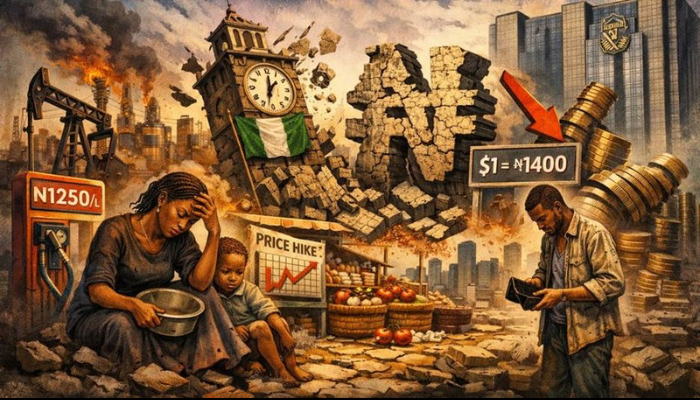
Today, Nigeria faces a convergence of economic strains, high unemployment and underemployment, rising poverty, fragile infrastructure, and persistent insecurity. These challenges endure despite a long history of reforms, from the Structural Adjustment Programme (SAP) to the latest policy shifts under President Bola Ahmed Tinubu.
The question is no longer whether reforms have been attempted, but why they have struggled to fundamentally alter Nigeria’s economic trajectory.
When industry defined the economy
In the decades following independence, Nigeria pursued an economic model built on state-led industrialisation and import substitution. The goal was clear: reduce dependence on foreign goods by producing locally.
Factories sprang up across the country. Automobiles were assembled domestically. Consumer goods, from refrigerators to footwear, were made in Nigeria. Agriculture fed both industries and households. The economy, though imperfect, had a tangible productive backbone.
But this foundation was more fragile than it appeared.
Much of the industrial activity depended on government protection, oil revenues, and imported components. Efficiency was often secondary to capacity. And as crude oil earnings surged in the 1970s, they gradually eclipsed other sectors, reshaping incentives across the economy.
When oil prices fell in the early 1980s, the vulnerabilities became impossible to ignore.
Reform without transformation
The response was swift but consequential. In 1986, Nigeria adopted the SAP, marking a turning point in its economic history.
The reforms aimed to liberalise the economy, devaluing the naira, removing subsidies, and opening markets to global competition. While these measures addressed immediate fiscal imbalances, they also triggered unintended consequences.
Local industries, long shielded from external competition, struggled to survive in a liberalised environment. Many shut down. Others scaled back. The industrial base began to erode.
Over the decades that followed, successive governments introduced new waves of reforms, privatisation, deregulation, banking sector restructuring, and fiscal adjustments. Yet, the core structure of the economy remained largely unchanged: heavy reliance on oil exports and growing dependence on imports.
For critics, this reflects a deeper institutional problem.
“Nigeria is not a developmental state; our ideology doesn’t underpin development,” a public affairs analyst said. “All the reforms introduced over the years are to serve the interests of the ruling elite and not to develop the country.”
A different reading of the present
Not everyone agrees with this bleak assessment. For Obafemi George, a political scientist, the current phase represents a necessary, painful reset.
“From 2023 up until now, we’ve seen strategic investment in infrastructure. We’ve seen a government that is working so hard to reposition the Nigerian economy from an import-dependent economy to an export-dependent economy,” he said.
George argues that expectations of rapid transformation are misplaced. Economic restructuring, he insists, is inherently gradual.
To make his point, he turns to China’s experience under Deng Xiaoping. Beginning in 1979, China embarked on a deliberate reform path, establishing special economic zones, attracting foreign investment, and steadily expanding its industrial capacity. The transformation took decades, not years.
“This thing cannot happen overnight. The president is not a magician. Even when miracles happen, miracles take process,” George said.
The cost of lost momentum
The consequences of this shift are visible across society.
Young Nigerians entering the labour market face limited opportunities. Businesses contend with high operating costs. Households grapple with rising prices and declining purchasing power.
Recent reforms under the Tinubu administration, particularly fuel subsidy removal and exchange rate liberalisation, have intensified these pressures in the short term. While policymakers argue that these steps are necessary to correct long-standing distortions, their benefits have yet to fully materialise for many citizens.
This gap between policy intent and lived experience continues to shape public perception.
Rebuilding, not reliving
Rebuilding Nigeria’s economic strength will require more than policy announcements. It demands a sustained commitment to: Industrial policy consistency, infrastructure development, human capital investment and institutional accountability.
Equally important is a shift in mindset, from short-term fixes to long-term nation-building.
The nostalgia for 1980 is not without merit, but it should not obscure reality. Nigeria’s past industrial base, while broader than today’s, was not fully resilient. The challenge now is not to recreate that past, but to build a more competitive, diversified, and sustainable economy.
For millions of Nigerians navigating daily economic hardship, the urgency is clear.

Join BusinessDay whatsapp Channel, to stay up to date
Open In Whatsapp