There is something revealing about the brands that survive for centuries. In food, survival is rarely about excitement. It is about consistency, trust, and the ability to remain useful across generations that eat differently, shop differently, and live differently. While trends come and go, a small group of food brands has stayed relevant by doing largely the same thing, well, for a very long time.
What stands out is not just their age, but the kind of products they make. Most of these brands are built around ingredients and essentials rather than finished meals. They sit quietly in kitchens, used daily, often without much thought. That steady presence is what has kept them in business for over a century, and in some cases, over three.
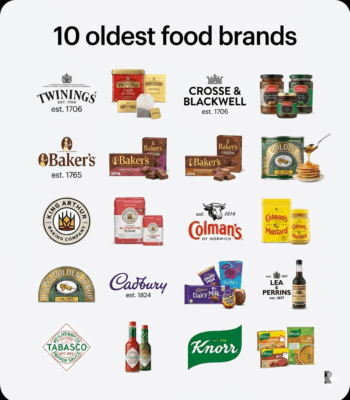
Twinings (1706, United Kingdom)
Founded by Thomas Twining in 1706, Twinings is one of the oldest continuously operating food brands in the world. The company began as a tea shop in London and still trades from the same location. Its logo has remained largely unchanged, making it one of the longest-used commercial identities. Tea, as a daily staple, has allowed the brand to remain relevant across centuries.
Crosse & Blackwell (1706, United Kingdom)
Established in the same year as Twinings, Crosse & Blackwell built its reputation on preserved foods such as pickles and sauces. These products were essential in an era before refrigeration and have continued to find a place in modern kitchens. The brand has changed ownership over time but remains in circulation.
Baker’s Chocolate (1764, United States)
Baker’s Chocolate was founded in 1764 and is one of the oldest food brands in the United States. It specialises in baking chocolate, a product tied closely to home cooking rather than direct consumption. Now part of a larger food group, it continues to be sold in its original category.
King Arthur Baking Company (1790, United States)
Founded in 1790, King Arthur Baking Company is the oldest flour company in the United States. Flour is a basic ingredient that underpins a wide range of foods, which has helped sustain demand. The company is now employee-owned and has expanded into baking education and related products.
Lyle’s Golden Syrup (1881, United Kingdom)
Lyle’s Golden Syrup, introduced in 1881, is known for maintaining one of the oldest unchanged product designs in the world. The green tin and its distinctive label have remained consistent for well over a century. The product itself, a simple sugar syrup, has not required reinvention.
Colman’s (1814, United Kingdom)
Colman’s began in 1814 and is best known for its mustard. It has held a long-standing reputation for quality and has supplied mustard under royal warrant. Its focus has remained narrow, centred on a single product category.
Cadbury (1824, United Kingdom)
Cadbury started as a small shop in 1824 and grew into one of the world’s largest chocolate producers. Unlike some others on this list, it has expanded significantly in scale and product range, but chocolate remains at its core.
Lea & Perrins (1837, United Kingdom)
Lea & Perrins introduced Worcestershire sauce in 1837. The product created and defined its category, becoming a standard ingredient in cooking around the world. Its recipe and positioning have remained largely unchanged.
Knorr (1838, Germany)
Knorr was founded in 1838 and focused early on producing dried soups and seasonings. These products addressed the need for convenience and preservation. today, Knorr operates globally and remains a major player in packaged food.
Tabasco (1868, United States)
Tabasco was established in 1868 and is known for its hot sauce made from aged peppers. The production process has remained consistent, and the product continues to be sold in nearly identical form. It has built global recognition without major changes to its core offering.

Join BusinessDay whatsapp Channel, to stay up to date
Open In Whatsapp