

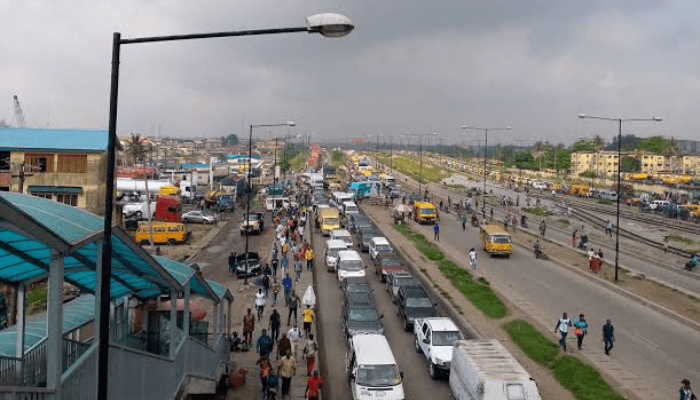
For motorists on the Lagos-Badagry Expressway heading from the Agbara-Badagry axis towards Orile, Apapa, and Lagos Island, Mile 2 has become a sore point where they groan and their vehicles bleed as they navigate ditches and gullies.
A visit to Mile 2 shows a vibrant enclave where the Lagos State government is in action, building a transport interchange hub that will transform the area into a modern, multi-level transport centre, integrating road, rail, and water transport.
Presently, Mile 2 serves as a key node for the Blue Line rail, where a massive and standard Train Station has been built side by side with a BRT corridor. And it is reported that the state has plans for organized bus terminals, passenger parking, and improved infrastructure to enhance commercial activity within that corridor.
Read also: OAU Students’ Union grounds academic activity over transport failures
But today, just on descent of the newly rehabilitated Maza-Maza Bridge, within the precinct of the magnificent Train Station, the expressway has collapsed, creating numerous ditches and gullies that make navigating through that portion a harrowing driving experience.
Vehicles move into those gullies and come out with screeching sound. At the same time, you notice the drivers gritting teeth and squeezing faces, betraying their inner pains. Some vehicles that are not strong enough get stuck, causing terrible gridlock that stretches, in most cases, beyond the Maza-Maza Bridge.
It is difficult to quantify the man-hours wasted at that collapsed portion of the expressway; the health implications on drivers and their passengers, and the wear and tear on the vehicle, which present enormous costs to their owners.
“This has been our experience on this road in the last six months or so. And it is getting worse because vehicles have continued to pass through. I am afraid that if the state government does not do something quickly, the rains will come and render it impassable,” a motorist. who introduced himself simply as Sadiq, told this reporter.
Sadiq noted that the collapse of the road just within the Train Station area is not good enough, as it seems as if the government is showing preference to train and BRT commuters and neglecting those who go by commercial (yellow) buses.
With the new status that Mile 2 has garnered by reason of the Train Station, and the transport interchange hub, which is under construction, that corridor is not supposed to have a collapsed road, not to mention gridlock as it is currently experienced there.
Lagos as a megacity and 21st-century economy, cannot afford to overlook anything that could affect its productivity. It should be a city in motion, bearing in mind some of the studies that have been done on traffic congestion and its effect on the state’s economy.
According to the Danne Institute for Research’s ‘Connectivity and Productivity Report’ of July 2023, traffic congestion costs Lagos about ₦4 trillion annually in lost productivity, wasted fuel, vehicle wear, and missed business opportunities. It could be worse today.
In June 2025, the Lagos State government reaffirmed the same figure, calling it a “massive economic drag” that slows growth and inflates living costs. To put that in perspective, ₦4 trillion represents roughly 4 percent of Nigeria’s GDP, which is a staggering productivity leak from one city alone.
Read also: Nigeria transport sector foreign investment jumps to record high
The report explained that an average commuter spends 2.21 hours in traffic daily, resulting in about 14.12 million productive hours lost each day. Car owners spend more than ₦133,978 annually on fuel; public transport users spend ₦79,039. When these are multiplied across millions of commuters, the picture becomes stark, showing an entire economy idling on the road. Mile 2 is part of this scenario at the moment.

Join BusinessDay whatsapp Channel, to stay up to date
Open In Whatsapp


