

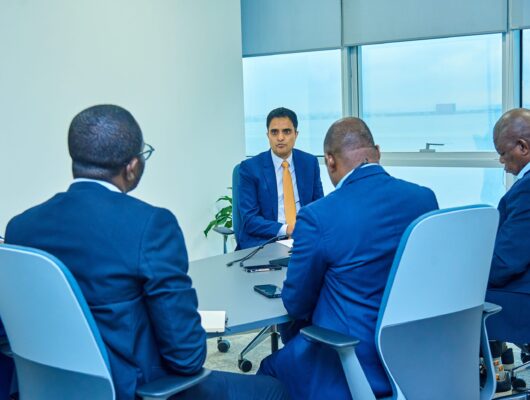
ExxonMobil has identified its Bosi deepwater development as the most technically and commercially challenging asset in its Nigerian offshore portfolio, with the oil major’s local chief warning that gas infrastructure gaps and geological complexity mean the project trails its peers in readiness despite carrying the largest resource potential.
Jadir Bax, chairman and managing director of Esso Exploration and Production Nigeria Limited, an ExxonMobil affiliate, said Bosi stands apart from the company’s other major deepwater bets, Owowo and Bonga Southwest, because it is fundamentally a combined oil and gas development rather than a primarily oil-focused project.
That distinction, he said, has historically been the source of its delays.
“It is not primarily an oil development,” Bax told BusinessDay in an interview. “It is an oil and gas development, and the gas component requires infrastructure and a value chain that has not previously existed at scale in Nigerian deepwater.”
Delivering Bosi’s gas volumes would require a dedicated pipeline to shore and a fiscal regime designed explicitly to make deepwater gas commercially viable, conditions that, until recently, were either absent or insufficiently defined to attract commitment from top-tier global contractors.
Bax said the project is larger than Owowo, which carries a capital cost estimate of $7 billion to $8 billion and a peak production potential of more than 100,000 barrels per day, with more reservoirs and greater geological complexity.
That scale means technical maturity, detailed subsurface modelling, contracting strategy and infrastructure planning, needs to be further advanced before any final investment decision can be responsibly considered.
Nigeria’s government has positioned deepwater developments as central to its ambition of pushing national output to between two and three million barrels per day, a target Bax described as arithmetically demanding given the natural decline rates eating into existing production every day. Bosi, if fully developed, could contribute meaningfully to closing that gap, but the timeline remains undefined.
The picture, however, has shifted. Nigeria’s 2024 presidential directives, numbered 40, 41 and 42, introduced an incentive structure that, for the first time, explicitly addresses gas developments alongside oil, a reform ExxonMobil views as material to Bosi’s long-term investability.
The contracting environment has also become more receptive, with international firms showing greater willingness to engage with complex Nigerian deepwater scopes than in previous years.
“Today, the incentive structure explicitly addresses gas, which it did not before,” Bax said. “The contracting environment is more receptive.” He declined, nonetheless, to offer a project timeline, saying the company would not manufacture a schedule it could not defend.
ExxonMobil is currently directing its near-term deepwater capital toward Usan infill drilling, a roughly $1 billion program expected to unlock up to 40,000 barrels per day of additional capacity using existing floating production infrastructure.
Erha infill drilling, estimated to add around 20,000 barrels per day, follows in sequence. Those campaigns, Bax indicated, are designed to protect current production while the larger greenfield projects are matured.
Bosi sits at the back of that queue, not from strategic indifference, Bax insisted, but because responsible capital allocation demands that each project reach genuine readiness before a final commitment is made. Rushing to a poorly optimised investment decision on a project of Bosi’s scale, he argued, would ultimately reduce the proportion of barrels available for government revenue sharing under Nigeria’s production-sharing contract structure.
“I will not manufacture a timeline that I cannot defend,” Bax said.

Join BusinessDay whatsapp Channel, to stay up to date
Open In Whatsapp


