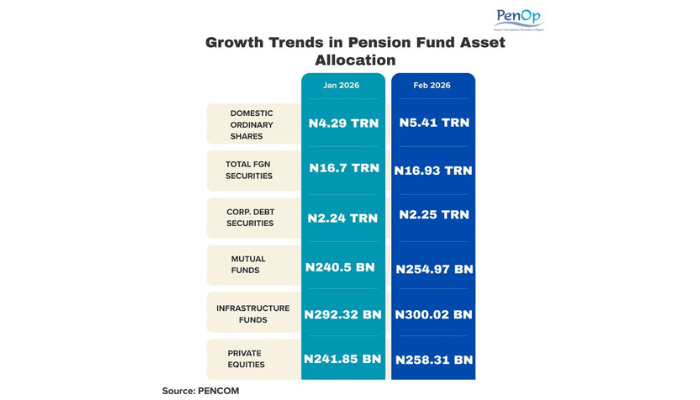
Nigeria’s pension fund managers are cautiously tilting portfolios toward higher-yield assets, ramping up exposure to equities while retaining a strong anchor in government securities.
Investments in domestic stocks surged by about 26 percent between January and February 2026, signalling a measured shift toward growth, even as allocations to Federal Government of Nigeria bonds edged up modestly, reinforcing their role as the system’s primary safety buffer.
The rebalancing underscores a delicate strategy, capturing returns in a rising market without compromising the stability that underpins the Contributory Pension Scheme (CPS).
According to analysts at Pension Fund Operators Association of Nigeria (PenOp), pension fund investments between January and February 2026 show a gradual shift toward growth, while still maintaining a conservative base.
Domestic equities saw the biggest increase, rising by about 26 percent, indicating a strong move by PFAs toward higher-return assets.
In contrast, investments in FGN securities grew slightly by about 1.4 percent, showing that government bonds remain the dominant and safest option.
Corporate debt recorded minimal growth of around 0.4 percent, reflecting continued caution in private sector exposure. Alternative investments also recorded steady gains. Mutual funds grew by about 6 percent, private equity increased by approximately 6.8 percent, and infrastructure funds rose by about 2.6 percent, showing a slow but consistent diversification into higher-yield assets.
Overall, the data suggests that pension funds are increasing their exposure to growth opportunities, especially equities, while still prioritising stability through government securities.
In Q3 2025, total contributions of N503.19 billion were credited to individual Retirement Savings Accounts (RSAs), underscoring continued compliance with statutory pension remittances across both the public and private sectors.
Of this amount, the public sector contributed N164.54 billion (32.7 percent), while the private sector accounted for a larger share of N338.65 billion (67.3 percent), reflecting the growing dominance and participation of the private sector in the pension system.
Public sector contributions declined by 26.5 percent, dropping from N223.95 billion in Q2 to N164.54 billion in Q3, largely attributable to seasonal and budgetary disbursement patterns typical within government cycles. Conversely, private sector remittances recorded a significant increase of 67.3 percent, rising from N202.47 billion to N338.65 billion. This sharp growth highlights improved compliance levels, broader pension coverage, and potentially stronger payroll activity within the private sector during the period.
Overall, the sustained inflow of contributions reflects the continued expansion and resilience of the CPS. This trend not only reinforces the scheme’s financial stability but also enhances its capacity for long-term investment, supports asset growth, and strengthens its ability to meet future retirement obligations.

Join BusinessDay whatsapp Channel, to stay up to date
Open In Whatsapp