…..gulf crisis threatens $113bn investment pipeline
Africa’s infrastructure and energy investment pipeline faces growing uncertainty as major Gulf economies reconsider funding commitments in response to domestic economic pressures triggered by the Middle East conflict, the World Bank has warned.
The potential shift in capital allocation threatens to delay or scale back critical projects across energy, ports and technology—sectors central to Africa’s long-term growth and trade expansion.
“As a result of the conflict, major Gulf economies might review their investment pledges to offset domestic economic shocks. Five key projects in energy, ports, and technology may face potential delays or funding reversals,” the World Bank said.
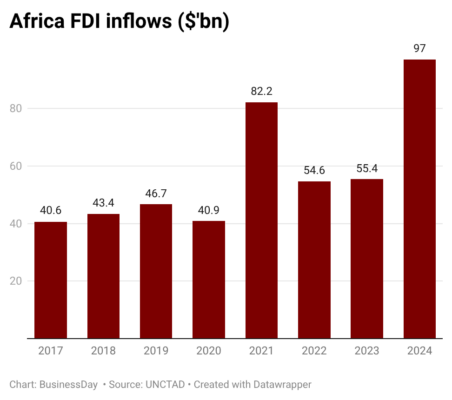
The warning comes as Gulf countries—led by the United Arab Emirates, Saudi Arabia and Qatar—have emerged as some of the largest sources of Foreign Direct Investment into Africa. According to the International Monetary Fund, GCC investment stock in the continent rose to nearly $50 billion in 2023, up from $3.2 billion in 2009, covering sectors such as energy, logistics, agriculture and infrastructure.
Between 2022 and 2023 alone, the UAE, Saudi Arabia and Qatar announced 156 greenfield projects worth an estimated $113 billion, spanning renewable energy, logistics, mining and agriculture.
Strategic sectors under pressure
Much of the investment pipeline is concentrated in high-impact sectors, including renewable energy projects such as hydrogen, solar and wind, as well as ports, warehouses and digital infrastructure aimed at improving Africa’s trade competitiveness.
“These pledged funds are being channelled primarily into renewable energy (including hydrogen, solar, and wind projects), infrastructure (ports, warehouses, and data centres), logistics, mining, and agriculture.”
The United Arab Emirates accounts for about $59.4 billion of these commitments, with a strong focus on mining—particularly gold and critical minerals such as copper, nickel and cobalt—and logistics to strengthen food and energy security.
Africa’s vast reserves of critical minerals have positioned the continent as a strategic partner for Gulf countries seeking to advance industrialisation and energy transition ambitions, particularly in electric vehicles and clean energy.
The UAE-based International Holding Company has taken a major stake in Zambia’s Mopani copper mines, while Saudi Arabia’s Public Investment Fund and state-owned mining firm Ma’aden have expanded their footprint through multiple deals.
In agriculture, Gulf-backed investments are supporting land acquisition, food production and logistics infrastructure across Africa—especially in West Africa—as part of long-term food security strategies.
Projects at early stages most vulnerable
However, projects in the planning or early implementation stages are most exposed to disruption, as Gulf governments shift fiscal priorities toward domestic stabilisation and defence spending.
For instance, Saudi Arabia’s proposed subsea digital connectivity project linking Africa to its western coast could face delays, while other large-scale commitments—including Qatar’s investment plans—are being reassessed.
Major Gulf economies are under increasing pressure to redirect resources internally as geopolitical tensions drive up energy costs, inflation and security spending.
Despite the risks, some sectors—particularly renewable energy—are expected to remain relatively protected due to their strategic importance in long-term economic diversification plans within Gulf economies.
Still, delays in broader infrastructure and logistics projects could have significant implications for Africa’s trade flows, industrialisation efforts and overall economic growth.
Wider spillover risks for Africa
The reassessment of Gulf investments also comes alongside a broader global “flight to safety”, with investors shifting capital toward safe-haven assets such as the US dollar and Swiss franc.
This trend is already putting pressure on African currencies and raising borrowing costs, compounding the risks posed by potential delays in long-term capital inflows.
At the same time, rising oil prices—driven by tensions involving the United States, Israel and Iran—have increased import costs for many African economies, feeding into inflation and eroding purchasing power.
While oil prices have recently eased following a ceasefire announcement, volatility in global energy markets remains high.

Join BusinessDay whatsapp Channel, to stay up to date
Open In Whatsapp