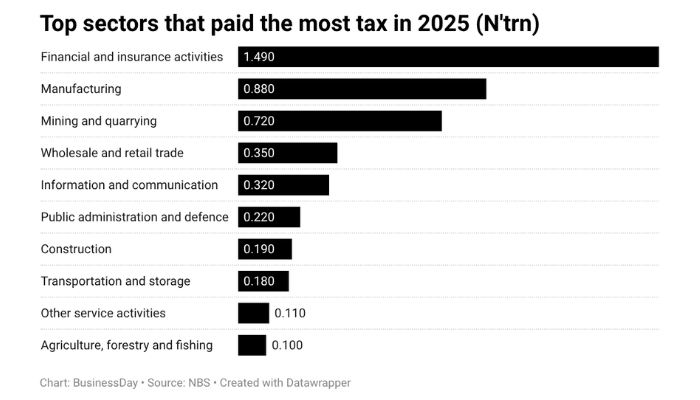
In 2025, ten major sectors in Nigeria paid in N4.57 trillion as Company Income Tax (CIT) to the Federal Government, raising more revenue compared to N3.09 trillion in the same quarter last year.
The sectors are Financial and insurance activities, Manufacturing, Mining and quarrying, Wholesale and retail trade, repair of motor vehicles and motorcycles, and Information and communication.
Others include Public administration and defence, compulsory social security, Construction, Transportation and storage, Other service activities, Agriculture, forestry and fishing.
According to data from the Nigeria Revenue Service (NRS) and reported by the National Bureau of Statistics (NBS), CIT for 2025 rose by 194.2 percent to N9.21 trillion from N3.13 trillion reported in 2024.
In the latest Q4 report released by the statistical body, CIT stood at N1.49 trillion, representing a decrease of 49.81 percent on a quarter-on-quarter basis from N2.96 trillion in Q3 2025.
However, on a year-on-year basis, CIT collections in Q4 2025 increased by 13.38 percent from Q4 2024.
“The domestic CIT received was N819.83 billion, while Foreign CIT Payment stood at N668.21 billion in Q4 2025,” the report disclosed.
CIT, also known as corporate tax, is a tax levied on the profits made by companies operating in Nigeria. It is regulated by the Companies Income Tax Act (CITA) under the supervision of the Nigeria Revenue Service (NRS).
Read also: Manufacturing, mining sectors paid highest Company Income Tax in Nigeria in Q3 2025
Here are the top 10 sectors that paid the most taxes in Q3 2024
Financial and insurance activities
This sector saw a 62.7 percent increase in its CIT contribution to N1.49 trillion in 2025 from N691 billion last year.
The sector alone accounted for roughly one-third of total CIT collections, underscoring the outsized profitability of banks and insurance firms in a high-interest-rate environment.
Elevated yields on government securities, wider net interest margins, and strong non-interest income streams boosted earnings across Tier-1 and Tier-2 banks, Mortgage banks, Microfinance banks and insurance companies, translating into higher tax obligations.
Manufacturing
The manufacturing sector contributed N881 billion to the federal government revenue compared to N663 billion in last year.
The latest data demonstrates the sector’s growing importance to Nigeria’s revenue base and its role in driving industrial activity.
Despite persistent cost pressures, particularly from energy, foreign exchange volatility, and logistics, many large consumer goods and industrial firms recorded revenue growth driven by price adjustments and volume resilience in essential goods.
The tax performance suggests that, while margins remain tight, top-line expansion has been strong enough to lift taxable profits.
Mining and quarrying
The mining and quarrying sector ranked third, contributing N723.3 billion, an increase from N520.3 billion a year earlier.
This reflects improved output and pricing in Nigeria’s extractive industries, particularly in oil and gas, where reforms, better pricing dynamics, and currency adjustments boosted naira-denominated revenues.
Wholesale and retail trade
Wholesale and retail trade recorded one of the most notable jumps, with tax payments rising to N347.2 billion from N160.9 billion. The near doubling points to improved formalisation, stronger compliance, and the pass-through effects of inflation, which lifted nominal revenues for large distributors and retail chains.
Information and communication
The information and communication sector saw a decline in tax contributions, falling to N323.3 billion in 2025 from N473.6 billion in 2024.
The drop may reflect increased operating costs, regulatory pressures, and currency-related challenges faced by telecom and tech firms, which have struggled with rising infrastructure and energy expenses.

Join BusinessDay whatsapp Channel, to stay up to date
Open In Whatsapp