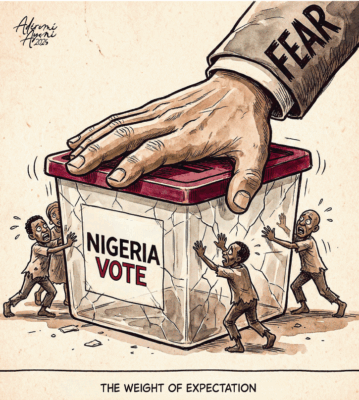
The health of any democracy depends not just on the strength of the ruling party but also on the vibrancy of its opposition. When ruling parties or their supporters resort to suppression rather than tolerance, they weaken the very foundation of governance and erode public trust in elections. Dr. Richard Ikiebe in his YSoT article of 4th March 2026 examined what political theory describes as the “politics of fear” – the deliberate production and amplification of fear to secure power, shape opinion, and justify political actions. That framing speaks directly to Nigeria’s present political climate.
At no point in recent years has this fear felt as palpable as it does now, especially as Nigeria moves towards the 2027 general elections. The political environment is already showing troubling signs of hostility. The burning of African Democratic Congress secretariats in Rivers and Edo States cannot be dismissed as isolated incidents. They are symptoms of a deeper malaise within the democratic process and early indicators of what could unfold if corrective measures are not taken.
This atmosphere is unfolding alongside an unprecedented consolidation of political power in Nigeria since transition to democracy in 1999, with the continuous defection of state governors and legislators to the ruling party. While defections are not new in politics, the current scale in Nigeria raises legitimate concerns about whether they reflect free political choice or a system shaped increasingly by pressure, incentives, and survival calculations.
Democracy cannot thrive where opposition parties are unable to organise, campaign, and operate freely. The growing hostility in political rhetoric and behaviour reflects a dangerous normalisation of elections as a “do or die” contest. When the mindset takes hold, the line between competition and coercion begins to blur.
The angst that the current scenario is creating amongst the populace is unhealthy, and you cannot blame the people if they feel anxious, apprehensive, or insecure. This is not the first time we have had this type of pre-election tension but the palpability this time is with a difference, and each side is accusing the other of one infraction or another. From the first republic, we have had mistrust between the parties and candidates that have shot up tension in the polity, and the end results have been chaos, riots, anarchy, military interventionism and even a civil war. Late last year, a state governor publicly warned a national leader of an opposition party against visiting the state without his permission, and months later when the party leader ‘dared’ to visit, armed hoodlums attacked his convoy, reinforcing fears about the shrinking safety of opposition activity.
Nigeria has seen where this path can lead and it is not a rosy road. Similarly, the annulment of the June 12, 1993, election demonstrated how undermining democratic processes can plunge a nation into prolonged uncertainty and crisis. These historical moments reveal that when political competition is replaced by coercion, instability follows.
However, amid these tendencies in Nigeria, a name has stood out as beacon on how to practice politics. Late Alhaji Waziri Ibrahim, the Presidential candidate of the Great Nigerian People’s Party in the 1979 elections, promoted what he described as “Politics Without Bitterness”, a philosophy that rejected hostility, tribalism, and rancour in favour of principled competition.
In a Daily Trust interview on 15th February 2015, his daughter, Hawwa Waziri Ibrahim, elaborated on the tenet of her father’s philosophy. As she explained: “Political engagement is not solely about winning, but about participating in a process where outcomes are accepted in good faith. Those who lose are not enemies, but participants who remain part of the same political community, while those who win assume responsibility rather than dominance.” Sadly, this stands in great contrast to the current situation in Nigeria and Nigerian politicians have a lot to learn from Waziri Ibrahim’s “Politics Without Bitterness”.
Security agencies have not been blameless in the way they have sometimes been seen to be part of the problem, rather than the solution. Their responsibility is not merely to maintain order, but to guarantee that the democratic process is protected from manipulation. There have been allegations and documented incidents where security personnel were accused of aiding electoral malpractice, including voter intimidation and disruption of ballot processes. When electoral actors lose trust in neutrality, the credibility of the entire process is weakened.
Equally troubling are reports from elections, particularly in states like Lagos, where political thugs have threatened voters against supporting opposition candidates. In several incidents, such intimidation occurred in public view; yet arrests and prosecutions remained limited. When electoral violence goes unpunished, it ceases to be an aberration and begins to function as an informal tool of political control. This must not be allowed to continue, as it undermines both participation and legitimacy.
Electoral violence is not a minor infraction; it is an assault on democratic rights. Perpetrators must be investigated and prosecuted. Where there is clear evidence of voter intimidation, ballot manipulation, or systemic disruption, responses should include legal consequences and the cancellation of compromised elections. Security agencies must remain non-partisan, as any perceived alignment undermines their legitimacy and the credibility of the process.
Governments must recognise that legitimacy depends on openness, while opposition parties must build resilient structures to withstand pressure. Civil society and the media must actively document and expose abuses. Nigeria’s democratic journey shows that how elections are conducted matters as much as the outcome. Politics grounded in tolerance strengthens democracy; one defined by suppression erodes it.


Join BusinessDay whatsapp Channel, to stay up to date
Open In Whatsapp