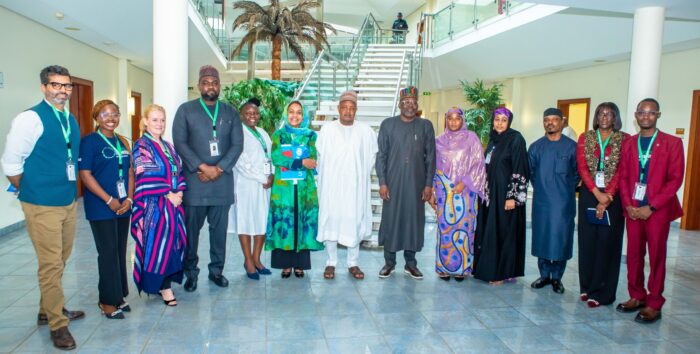
Nigeria has elevated its youth employment and skills development push to the highest level of government, launching a national coordination hub inside the presidency to accelerate job creation and digital inclusion for millions of young people.
The United Nations children’s agency, UNICEF, said the new Generation Unlimited Nigeria (GenU 9JA) National Secretariat, formally unveiled this week and housed within the office of the vice president of Nigeria, signals stronger political backing for tackling youth unemployment and skills gaps in Africa’s most populous country.
The secretariat will serve as a central coordination platform linking ministries, private sector players, development partners and young people, with a focus on scaling digital skills, entrepreneurship and employment pathways.
Read also: Calls heighten for climate-smart investment to drive youth employment
“This is a clear signal of government ownership and commitment to placing young people at the centre of Nigeria’s development agenda,” said Wafaa Saeed, UNICEF’s country representative in Nigeria, in a statement.
The move comes as Nigeria faces mounting pressure to create jobs for its rapidly growing youth population. With more than half of Nigerians under 25, economists say failure to translate demographic growth into economic opportunity could deepen poverty and social instability.
Since its launch in 2021, Generation Unlimited Nigeria has reached more than 11 million young Nigerians across all 36 states and the Federal Capital Territory, providing access to digital training, job linkages and civic engagement programmes. The initiative now aims to nearly double that number to 20 million by 2030.
Embedding the programme within the presidency could help address a long-standing challenge in Nigeria’s youth development efforts: fragmentation across agencies and weak coordination between public and private sector initiatives.
The GenU 9JA model is built as a public-private-youth partnership, co-led by the vice president’s office and UNICEF, and supported by more than 40 partner organisations. The new secretariat is expected to align policies, mobilise funding and track results more effectively.
UNICEF said it would continue to provide technical support, particularly in designing learning-to-earning pathways that connect education, digital skills and entrepreneurship to real job opportunities. The agency also emphasised a focus on young women and marginalised groups, who face higher barriers to employment.
For the government, the initiative is part of a broader strategy to harness digital technology as a driver of inclusive growth. Nigeria’s tech sector has expanded rapidly in recent years, but access to skills and opportunities remains uneven, especially outside major cities.
Read also: Neglecting youth employment in Nigeria could be dangerous!
By anchoring GenU 9JA at the centre of government, officials hope to close that gap and deliver programmes at scale.
Still, challenges remain. Funding constraints, infrastructure gaps and policy continuity risks could limit impact if not addressed. Experts also warn that digital skills alone may not be enough without broader economic reforms to stimulate job creation.
For now, the launch marks a shift in approach, from scattered interventions to a more coordinated, top-level strategy aimed at turning Nigeria’s youth population into an economic asset rather than a liability.


Join BusinessDay whatsapp Channel, to stay up to date
Open In Whatsapp