African nations are building their own small satellites for a fraction of past prices to watch crops, track floods and guard borders.
Yet every one of them must still pay what industry insiders call a ‘multi-million orbit tax’ to foreign rockets and sometimes foreign operators to reach and stay in space.
No country on the continent has an operating launch pad that can send satellites into orbit. All 69 African-owned satellites now in space, launched by 19 countries, rode foreign rockets, mostly SpaceX Falcon 9 rideshares from the United States, but also vehicles from China, Europe, Russia and Japan.
This dependence is expensive and frustrating. African agencies compete for spare seats on busy global launch lists. They accept whatever date the provider offers. They face export rules, security checks and extra fees that eat scarce foreign currency.
A basic CubeSat can now be built locally for under $53,000. Kenya’s Taifa-1, made by local engineers to monitor farms and forests, cost about $372,000 in total when it flew in 2023. Senegal’s GaindeSAT-1A followed the same path in 2024.
Read also: NIGCOMSAT denies $11.4m debt to Chinese Satellite Firm, says partnership remains strong
SpaceX charges $5,000 to $6,500 per kilogram. That works out to roughly $6,500 for the smallest CubeSat and $30,000 for a larger model. Chinese launch options are similar. These prices, once unthinkable, still drain budgets and leave governments with little say.
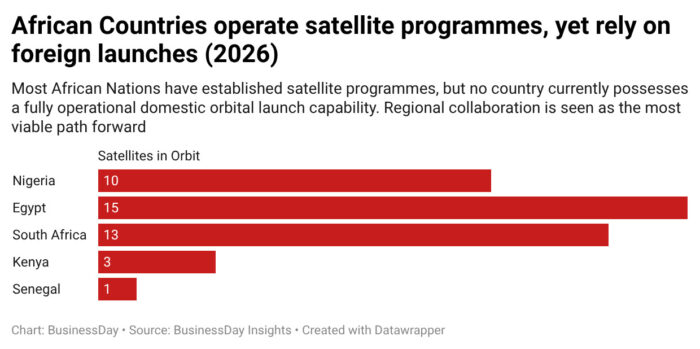
Nigeria, which has flown over 10 satellites, is learning this lesson the hard way, even after launch.
Its communications satellite NigComSat-1R, built and partly controlled with Chinese help, now faces a new threat.
In March 2026, China Great Wall Industry Corporation (CGWIC) sent a letter demanding $11.44 million for seven years of telemetry, tracking and command services from its ground station in Kashi, China. The company gave Nigeria 30 days to pay or provide a guarantee, warning that it could deactivate the satellite’s transponders and disrupt broadcasting, internet and security links.
Nigeria Communications Satellite Limited (NigComSat), speaking with BusinessDay, denies it owes the full amount and says the partnership remains strong.
But the public dispute, with the letter copied to president Bola Tinubu, shows how foreign control can continue long after a satellite reaches orbit.
A senior Nigerian space official told BusinessDay: “We emphasise capacity building from day one. All our satellites have trained Nigerian engineers. Today, the top expertise in space science and technology in Africa is in Nigeria.”
Nigeria is now pushing to break free. In 2025 its Centre for Space Transport and Propulsion successfully fired a test rocket from a boat on the Lagos lagoon. Plans are advancing for bigger rockets and launches from an Atlantic equatorial site that would need less fuel.
President Tinubu has backed four new satellites. Nigeria has also approved three high-resolution optical satellites and one radar satellite that can see through clouds, useful for security and farming.
Egypt leads with about 15 satellites. South Africa has 13. At least eight more African satellites are expected this year, including the joint AfDevSat climate project.
The new African Space Agency (AfSA), opened in April 2025 in Cairo, aims to help countries buy launch slots together, set common rules and one day share a launch site.
Experts say only joint action can cover the billions needed for a full launch complex.
Read also: Amazon can beam satellites over Nigeria, but can’t sell internet yet. Here’s why
Until then the gap remains clear. African teams now design and assemble much of the hardware themselves. They gain skills and produce useful data.
But the last few hundred kilometres to orbit and often the daily control of the satellite, stay under foreign schedules and at foreign expense.
The NigComSat case is a sharp reminder. Even a satellite that Nigeria operates still depends on a Chinese company for routine ground services, leaving the country open to sudden bills and shutdown threats.
A source close to Nigeria’s programme said local engineers are now ready to “design, develop and launch whatever satellite we want” once the final piece like sovereign launch and control, is in place.
CubeSats keep the dream alive. They train the next generation and keep Africa visible in space. But closing the launch-and-control gap has become a top continental goal.
AfSA officials hope pooling resources will cut costs by 10 percent to 20 percent at equatorial sites and give African governments real bargaining power. Until that day, the continent’s satellites will keep rising, and sometimes running, on borrowed wings.


Join BusinessDay whatsapp Channel, to stay up to date
Open In Whatsapp