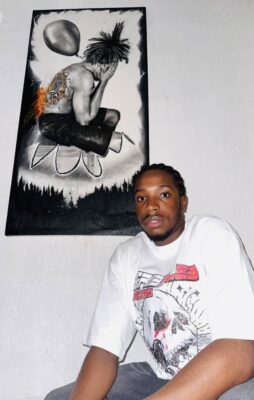
Favor Ileogben was sixteen and taught himself to draw when most of his peers had no idea what they wanted to do with their lives. He is twenty-three now, has exhibited on two continents, and built a global audience, almost entirely by going inward.
The work shows it. Eyes staring out from charcoal figures, geometric forms dissolving into shadow, light that reveals rather than comforts, it speaks directly to something the viewer already carries. “My goal is to allow viewers to define meaning for themselves, without words,” he has said, “and experience the work in a deeply personal way.” He draws from the most private reserves of human experience, then offers it back without instruction or prescribed feeling.
It did not always look like this. He started with graphite on paper — patient, observational, self-taught — before a single encounter changed the direction of everything. In 2020, he discovered Freud, and where most teenagers find psychoanalysis abstract, Ileogben found a language. Freud’s mapping of the subconscious, of repression and dream-logic, gave his work the vocabulary it had been reaching for.
From there, the honesty in his practice became deliberate. “My artistry reflects emotional experiences from childhood and an inner desire for self-healing,” he says, without the intellectual remove that contemporary art culture tends to reward. Self-healing sits unfashionably in a discourse where artists are expected to keep their motivations at arm’s length. Ileogben refuses that distance. The work is personal because the wound is personal.
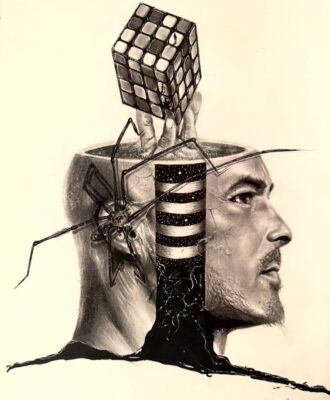
Charcoal became the natural medium; it demands you coax light out of darkness rather than impose it. Over time, his visual vocabulary sharpened: detailed eyes set in abstracted faces, geometric forms in tension with organic shapes, natural elements threaded through psychological tableaux. Surrealism, for Ileogben, is not a stylistic affiliation but a methodology, the only visual grammar capable of depicting what depression actually feels like from the inside, rather than what it looks like from the outside.
That specificity of vision needed an audience that could meet it on its own terms. The NFT space provided exactly that — where traditional gallery circuits rarely extend reach to young artists outside established hubs, the digital market let his collections find collectors directly, without intermediaries. The response confirmed that his work was resonating far beyond Abuja, and group exhibitions across Europe and North America followed.
The fullest expression of that vision came in 2024 with his debut solo exhibition, Dark Surrealism — at once a genre descriptor and an artistic manifesto. It was the first opportunity for audiences to encounter his work whole rather than in the fragmentary context of group shows. “For me, art is life — a blissful form of creative self-expression,” he has said. Not therapy, not protest, but the act of insisting that one’s interior experience has weight and form and deserves to be seen.
To stand before his work is to receive an invitation and a challenge at once — to look, genuinely look, at images that do not prettify what they depict, and to sit with whatever surfaces when you do. Ileogben is twenty-three, still searching, and whatever he is drawing from, it is not running out.

Join BusinessDay whatsapp Channel, to stay up to date
Open In Whatsapp