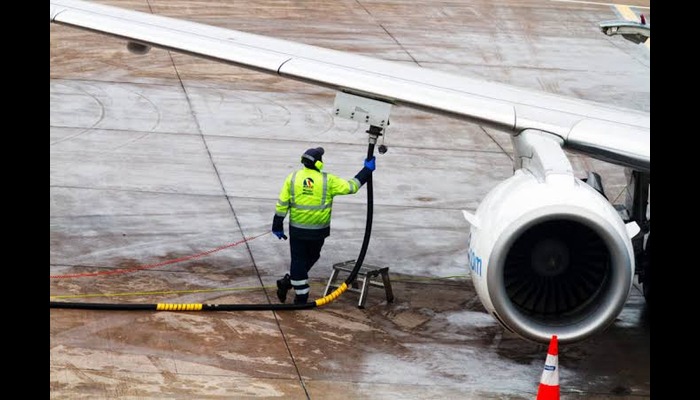
Despite global crude prices retreating slightly from previous peaks, the local cost of jet fuel has surged from approximately N90 per litre to nearly N1,800 per litre in a matter of days following the recent conflict involving Iran.
Reports indicates that aviation fuel now sells for between N1,803.19, N1,839.19, and N1,852.19 per litre at Lagos, Abuja, and Kano airports, respectively. This marks a more than 100 per cent increase from N900 per litre recorded on February 28, shortly after the outbreak of tensions between Israel, the United States, and Iran.
The spike has left domestic airline operators struggling to maintain their financial stability while attempting to shield passengers from immediate fare increases.
Read also:After US market, Dangote exports three cargoes of jet fuel to Saudi Arabia
Industry experts warn that while other costs like airport charges and insurance remain stable, there would be sharp increase in air fares.
John Ojikutu, an aviation expert, explains that fuel typically accounts for approximately 40 percent of an airline’s total operational budget. With the increase into the cost of jet fuel, that burden can shift to represent up to 70 percent of costs.
He explained that with little room to negotiate on fixed costs like landing and navigation fees, airlines will look inwards to find savings.
“There’s no way the increase in fuel price will not affect airfare… fuel is about 40 percrnt of the operational cost. If an airline is buying fuel at an increased cost, you can be sure that operational cost is going to be increased by that amount,” Ojikutu noted.
He noted that to avoid losing passengers entirely, airlines are expected to “rationalise” how they recover these costs. Rather than a blanket 100 percent increase on all tickets, Ojikutu suggest a tiered approach where premium travellers and last-minute flyers bear the brunt of the adjustment.
Read also:Ethiopian Airlines marks International Women’s Day with all women flights to 8 destinations
He noted that for example, business and First Class passengers may see increases of 20 percent to 30 percent.
Another thing to note is that passengers “rushing” to buy tickets on the day of travel could face hikes of up to 50 percent.
Ojikutu rationed that airlines may attempt to limit increases for early-booking economy passengers to roughly 10 percent to keep the market viable.
“What I suggest is that the airlines will look for aircraft that are consuming less fuel for the same distance… and do some little arithmetic, reducing food and so on. If they are serving food for about two or three times, they may probably reduce it,” Ojikutu suggested.
Despite the “astronomical” price of fuel reaching N1,800 per litre, the industry remains in a delicate balancing act, absorbing what it can to stay in the market while gradually passing on the “expected” costs to the flying public.
Read also:AfDB aviation finance platform targets Africa’s $25trn air travel opportunity
Airlines absorbing extra costs
Professor Obiora Okonkwo, the spokesperson for the Airline Operators of Nigeria (AON), described the situation as “astronomical” during a recent TV appearance. He noted that may airlines any be operating at a loss now as fuel now accounts for between 40 percent and 50 percent of total airline operating costs in the country.
He explained, “The price hike arrives during a traditionally slow period for the industry. Following the peak December travel season, passenger traffic typically drops by 40 percent to 60 percent. However, many airlines are currently “bleeding” financially, as they are unable to immediately pass these rising costs onto consumers due to regulatory requirements and low demand”.
“We are absorbing that extra cost right now… for the interest of Nigerian travellers,” he explained. “Any operator that is carrying 40, 60, or 70 per cent passenger load is carrying you at a loss.”
Beyond fuel, Professor Okonkwo highlighted several structural challenges stifling the industry, including:
High interest rates: Local operators face bank interest rates of approximately 30 percent compared to 2 percent or 5 percent for international competitors.
Taxation: Nigerian airlines are burdened by over 40 different taxes and charges.
Currency volatility: Revenue is earned in Naira, while most major costs, including aircraft acquisitions and maintenance, must be settled in USD
Read also:US carrying out rescue effort after military aircraft crash in Iraq – Reuters
Proposed solutions
To prevent a total collapse of the sector, he is calling for strategic government intervention. Okonkwo suggested that the government could broker a deal with the Dangote Refinery to provide crude at a special rate, which would result in a dedicated, more affordable price for aviation fuel.
Additionally, the body is seeking a “special window” for intervention funds. “Not free money, not a grant,” Professor Okonkwo clarified, “but a single-digit loan for us to have access to for our acquisitions and other operations. That would go a long way in reducing the financial pressure we are feeling.”
While international carriers have already begun adjusting their financial outlooks for 2026 due to the Middle East uncertainty, Nigerian operators remain in a delicate holding stance, hoping for a normalisation of fuel prices before the current situation becomes unsustainable.

Join BusinessDay whatsapp Channel, to stay up to date
Open In Whatsapp