Nigeria’s insurance sector is signaling a period of financial expansion as leading underwriters project stronger earnings for the second quarter of 2026, driven by stricter regulation, rising investment income, and the approach of a recapitalisation deadline set by the National Insurance Commission.
Forecasts released by SUNU Assurances Nigeria Plc, Linkage Assurance Plc, International Energy Insurance Plc, and Regency Alliance Insurance Plc show insurers strengthening balance sheets while combining underwriting growth with treasury-driven returns in a high-yield environment.
The projections highlight two defining forces shaping the industry. Regulatory enforcement is improving premium collection and liquidity, while investment income from financial instruments is becoming a larger contributor to overall profitability.
Regulation tightens revenue discipline
A central driver of the improved outlook is the continued enforcement of the “No Premium, No Cover” rule by the National Insurance Commission.
Insurers carried large volumes of outstanding premiums for years, effectively providing coverage for which payment had not yet been received. Strict enforcement of the rule has altered that structure by requiring premiums to be paid in full before protection becomes effective.
The shift has improved the quality of revenue across the sector and strengthened liquidity by ensuring that insurers collect cash before assuming risk.
It has also expanded the pool of investable funds available to insurers. With more cash on hand, companies are allocating capital to treasury bills and other short-term instruments to capture elevated interest rates.
Read also: Twenty insurers step up for NAICOM recapitalisation checks
SUNU pursues expansion through capital
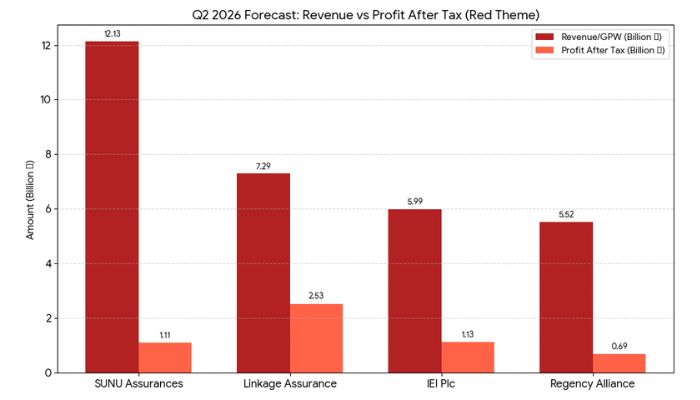
SUNU Assurances Nigeria Plc is projecting the largest premium volume among the four insurers. The company forecasts insurance revenue of about N12.13 billion for the quarter ending June 30, 2026, representing roughly 9.2 percent growth compared with N11.11 billion recorded during the same period of 2025.
Profit after tax is expected to reach about N1.11 billion.
The outlook is supported by a N9 billion share capital inflow that raises projected cash and cash equivalents to approximately N16.78 billion.
The capital injection reflects efforts by insurers to meet new regulatory capital requirements while strengthening financial capacity to underwrite larger corporate and infrastructure-related risks.
Linkage seen leading in profitability
While SUNU is projecting the largest revenue base, Linkage Assurance Plc stands out for profitability.
The insurer forecasts profit after tax of about N2.53 billion despite projecting insurance revenue of roughly N7.29 billion.
A key contributor to earnings is projected investment income of around N3.01 billion, highlighting the growing importance of treasury operations within the sector.
By allocating funds to short-term financial instruments and optimising reinsurance recoveries, the company is strengthening margins while limiting exposure to claims volatility.
The structure of Linkage’s forecast illustrates how investment returns are increasingly supporting earnings alongside traditional underwriting.
IEI and Regency focus on compulsory insurance
International Energy Insurance Plc and Regency Alliance Insurance Plc are projecting steadier growth, supported by demand for compulsory insurance coverage.
International Energy Insurance expects profit after tax of about N1.13 billion on gross premium written of roughly N5.99 billion.
Management identifies statutory policies covering buildings under construction and public buildings as key drivers of premium expansion as urban development continues across major cities.
Regency Alliance forecasts profit after tax of about N687.5 million from insurance revenue of approximately N5.52 billion.
The company’s projections include an insurance service result of about N452.5 million, reflecting cautious risk pricing and controlled operating expenses.
Macroeconomic conditions support the outlook
The positive outlook is also supported by broader economic indicators.
Olaolu Boboye, lead economist at CardinalStone Research, noted in the firm’s 2026 outlook that Nigeria entered the year from a relatively stronger position compared with recent cycles.
Boboye expects corporate profitability to improve as foreign exchange-related losses that affected companies in previous years begin to moderate. “The combination of macroeconomic improvements and strengthened investor confidence has set a promising path for the year.”
Similarly, Muda Yusuf, chief executive of the Centre for the Promotion of Private Enterprise (CPPE), projects economic growth of up to 4.5 percent in 2026, with financial services among the sectors expected to drive expansion.
Stronger economic activity tends to support insurance demand across construction, infrastructure, and corporate operations.
Recapitalisation deadline approaches
Beyond earnings projections, the second quarter carries strategic significance for insurers.
It represents the final full reporting period before the July 30, 2026, recapitalisation deadline set by the National Insurance Commission for non-life insurers to meet a minimum capital requirement of N15 billion.
The forecasts highlight different approaches to meeting the new threshold.
Some companies are raising capital from shareholders, as seen with SUNU’s N9 billion inflow. Others are strengthening internal reserves through disciplined underwriting and investment-driven earnings.
If realised, the projections could signal a turning point for the sector during the first half of 2026. Improved liquidity, stronger premium collection, and higher investment returns could also reinforce investor confidence in insurers listed on the Nigerian Exchange Limited.

Join BusinessDay whatsapp Channel, to stay up to date
Open In Whatsapp