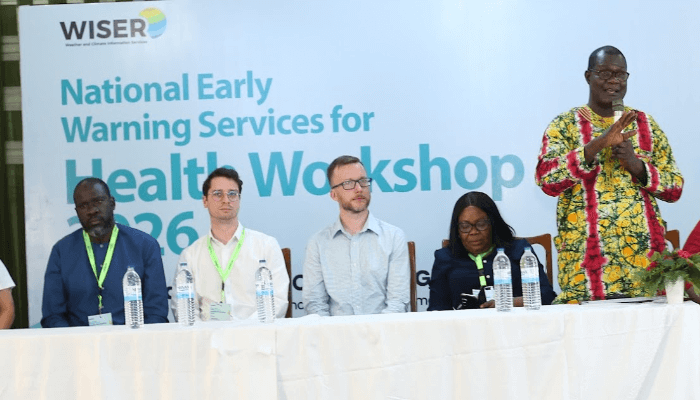
Key government agencies and international partners have begun efforts to establish a national early warning system aimed at protecting Nigerians from the growing health risks linked to climate change.
The initiative was highlighted at the National Early Warning Services for Health (WISER) workshop recently held in Lagos, where stakeholders gathered to begin developing a multi-hazard early warning system that integrates climate, environmental and health data.
The effort aligns with Nigeria’s third Nationally Determined Contribution (NDC 3.0), published in 2025, which commits the country to delivering “a national integrated climate change, health and environmental early warning system with implementation in at least 18 states by 2030.”
Experts say such a system has become increasingly necessary as climate change, pollution and ecosystem degradation continue to drive respiratory illnesses, water- and vector-borne diseases, food insecurity and disaster-related health risks across the country.
The workshop is being hosted by the Nigerian Meteorological Agency (NiMet) in collaboration with the Federal Ministry of Health and Social Welfare, the National Emergency Management Authority (NEMA), the National Hydrological Services Agency (NIHSA), and the National Orientation Agency (NOA).
Representatives from the Federal Ministry of Agriculture and Food Security, the Ministry of Budget and Economic Planning, and the Lagos State Government also participated.
Organisers say the programme emphasises cross-sector collaboration, bringing together climate, health, disaster management and development institutions to design an early warning system that will help authorities anticipate and respond to climate-related health threats.
Zakariya Mohammed, Director and Head of the Climate Change and Environmental Health Division at the Federal Ministry of Health and Social Welfare, said the workshop represents a key starting point for coordinated national action.
“With the integration of health considerations into Nigeria’s recently submitted NDC 3.0, this workshop provides an excellent starting point for collaborative efforts toward establishing an operational early warning system for climate and health in Nigeria,” he said.
The workshop is supported by several international organisations and development partners, including the United Kingdom government, the UK Met Office, the Rockefeller Foundation, the World Bank, the World Meteorological Organization, the World Health Organization and the UK Health Security Agency.
It forms part of the Weather and Climate Information Services for Health (WISER Health) initiative, a global programme co-funded by the UK and the Rockefeller Foundation and implemented by the UK Met Office.
Juliet Whitley, Head of Health at the British High Commission in Abuja, said the initiative demonstrates Nigeria’s leadership in strengthening climate resilience in the health sector.
“Nigeria is leading the way in developing an early warning system that will better enable its health sector to prepare for and respond to extreme weather. The UK is proud to support Nigeria’s commitment to building a health system that is more resilient to climate change,” she said.
Isa Abulkasir, Chief Disaster Risk Reduction Officer and Climate Change Desk Officer at NEMA, said the agency is committed to using climate information to reduce health risks and strengthen resilience in communities.
“As Nigeria integrates health into its NDC 3.0 framework, this workshop offers a timely opportunity to advance our collaborative efforts toward a climate-resilient health system. NEMA is committed to leveraging climate information and early warning systems to mitigate health risks, enhance community resilience, and reduce the impact of climate-sensitive diseases and disasters, building a safer, more resilient future for all Nigerians,” he said.
NiMet said it would continue to strengthen weather and climate information services as part of efforts to safeguard public health and support early action.
“Building an efficient early warning system is not just a scientific responsibility; it is a national imperative,” a NiMet spokesperson said. “Through collaboration with the health sector and strategic partners, we are working to ensure timely, accurate, and impact-based forecasts translate into early action that saves lives and safeguards livelihoods across Nigeria. Together, we can transform climate intelligence into resilience for healthier communities nationwide.”

Join BusinessDay whatsapp Channel, to stay up to date
Open In Whatsapp