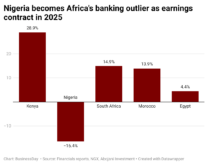
Against the back drop of global economic fragility, Oil prices touching new lows, exchange rate volatility and unconventional monetary policy in developed market as against hawkish stance in emerging markets, the Nigerian Banking Industry recorded a gross earnings of N3.3trillion in full year 2014, representing a 17.7 percent expansion relative to N2.8 trillion in full year 2013.
Industry Cost to income ratio moderated significantly from 82.0 percent in 2013 to 66.0 percent in 2014 despite the Central Bank of Nigeria (CBN)’s hawkish stance on Cash Reserve Requirement (CRR) and Monetary Policy Rate (MPR) during the year. Consequently, Profit Before Tax (PBT) expanded to N682.3billion (+31.6%) from N501.3billion in full year2013.
In its 2015 Nigerian Banking Sector Report, Afrinvest Securities Limited observed that the industry’s net margin settled at 20.0 percent, which was 2.0 percent below 22.0 percent average for countries in the BRICS category. Meanwhile, Tier-1 Banks continue to dominate the industry across performance metrics as players in the classification accounted for 66.0 percent of gross earnings (from 65.0% in 2013), 75.0 percent of PBT (from 88% in 2013), 70.0 percent of total assets (from 68.0% in 2013), 70.0 percent of total loans (from 69.0% in 2013) and 70.0 percent of total deposits in 2014.
Interest in the lending structure of Nigerian banks has been magnified by the plunge in global oil prices. The report revealed that the loan books of banks across both Tiers are mainly concentrated in the Oil and Gas sector (26.0%). Tier-2 banks are more exposed to the oil and gas sector, with players in the space allocating 27.4 percent of their gross loans to the sector in 2014 relative to Tier-1 banks’ 26.5 percent. Analysts at Afrinvest imagine that the preference is based on high revenue/profitability upside, stronger cash flow and developed supportive infrastructures that have lowered risk perception. However, the current challenges of lower crude oil prices has significantly weakened the assets quality of banks, with Oil and Gas related Non-Performing Loans (NPLs) contributing an average of 12.7 percent to NPL ratio across banks.
Allocation of credit to the oil and gas sector appears disproportionate to the sector’s contribution to the GDP (11.2%) suggesting a crowding out of other productive sectors of the economy. For instance, the Agriculture sector which contributed more than 20.0 percent to GDP is observed to receive only 4.4 percent of total credit allocation in 2014. Upon further analysis, it was observed that the structure of lending broadly differed across selected BRICS and MINT countries, mirroring dynamics of the stages of growth and development, economic structure, financial sector framework and banking regulations in the respective countries.
“Our prognosis is that lending structure in the next decade should reflect the changing economic structure in Nigeria, thus we expect banks to take advantage of the faster growth and expanding opportunities in the non-oil sectors of the economy. We believe banks will need to moderate credit to the mining/natural resources sector while directing to the utilities, manufacturing and services (including household, real estate, education, health, transport and communication) sectors in line with the overall macroeconomic outlook of the country and in furtherance of the recent drive to boost non-oil revenue by the new administration. Nigerian banking industry has mainly served the mining sector over the past one decade, we believe banking in the next decade should focus on re-allocating risk assets by tapping into lending opportunities in the non-oil oil sector”, the analysts said in the report.
HOPE MOSES-ASHIKE

Join BusinessDay whatsapp Channel, to stay up to date
Open In Whatsapp