Immediate past commissioners in Rivers State have pointed at where the present government led by Nyesom Wike could find the N60 billion proceeds from the sale of 70 percent of the state gas turbine projects.
This is in reaction to the government white paper that ordered the past governor, Chibuike Rotimi Amaechi and some of his cabinet members to refund about N100.3 billion.
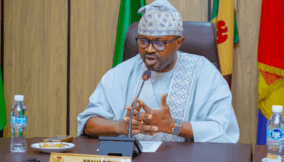
The former commissioner of information and communications, Ibim Semenitari, who addressed the media along with almost all the former commissioners, also explained why the Amaechi administration sold the power assets.
The former information boss pointed to the 2014 appropriation law (budget) under the clause, ‘sale of assets,’ where N33 billion was indicated, saying that was the initial earning from the sale, as the administration used it to execute clearly identified projects as the law provided.
On the compelling reasons for the sale, she said: “The Federal Government had commenced a privatisation process to unbundle the Power Holding Company of Nigeria (PHCN) to drive efficiency. The PHCN was not paying River State government for electricity contributed to the national grid.”
The state was spending heavily on purchase of gas from Shell Petroleum Development Company (SPDC) and Nigeria Agip Oil Company (NAOC) to fuel the plants, Semenitari said, saying “at this time the state was indebted to Shell and Agip to the tune of N7 billion. The state was spending over N1 billion yearly on maintenance of the plants without commensurate returns in the form of electricity supplies.”
The former administration said there was need to engender efficiency in the management of the power assets so that its benefits could be felt by the generality of the people of the state.
“The state government does not have the requisite manpower to manage the facilities. Need to augment revenue in the face of dwindling federal allocation to the state,” she said.
On the benefits of the sale, Semenitari said similar considerations informed the lease/concession of entities like RISONPALM, which before then had shut down for over 10 years, Supabod stores (Now SPAR), which was shut down since the 1980s and Olympia Hotel (Radisson Blu Olympia), which had ceased to function since 1993 and was being used as a Police barracks.
“These entities were leased and not sold as being mischievously peddled by some individual in Rivers State. At the end of the lease period, these revived assets will revert to the state government,” she disclosed.
On the next controversial subhead, monorail, the ex-commissioner said the decision to embark on it was made by the state executive council, adding that the present governor (Wike) and Tele Ikuru, who was then deputy to Amaechi, were part of the decision. In fact, she said Ikuru chaired a panel that recommended continuing with the project.
The ex-commissioner debunked all the other points of indictment in the government white paper and showed that bias was at the bottom of it all.
“It is illegal for a governor to set up a judicial commission of inquiry. While inaugurating the commission, Wike had charged the committee to among other things ‘investigate the illegal sales of the power plants.’ This statement by itself was evidence enough that a position had been taken by the Rivers State government,” she said.
She said the chairman of the commission itself had made statements that showed predetermined opinion, as every record needed to get to the facts of all the projects were made available through handover notes, saying the government was free to go to court to press its demands on the outcome of the panel.

Join BusinessDay whatsapp Channel, to stay up to date
Open In Whatsapp