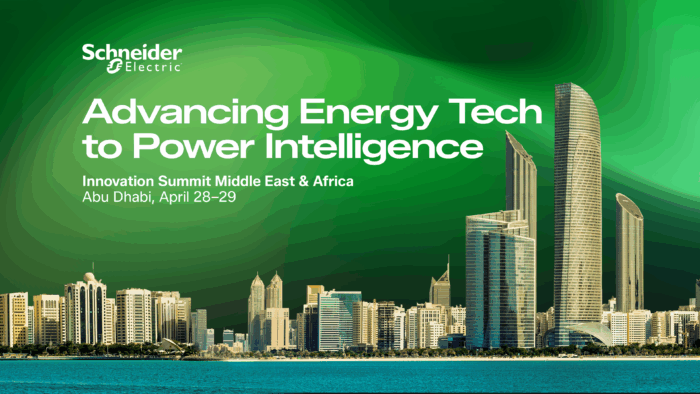
Schneider Electric will convene its second annual Innovation Summit Middle East & Africa in Abu Dhabi on April 28–29, gathering energy executives, government officials and technology leaders as the region confronts an electricity demand crisis fueled by artificial intelligence infrastructure and rapid urbanisation.
The Paris-based energy management and automation company is betting that the Gulf’s insatiable appetite for power, electricity consumption in the Middle East and North Africa has tripled since 2000 and is projected to climb an additional 50 percent by 2035, creates a durable opening for its integrated hardware and software stack. Cooling systems, desalination plants and a wave of government-backed giga-projects are straining grids already under pressure.
“Energy today is the foundation of national resilience and competitiveness,” said Walid Sheta, Schneider’s zone president for the Middle East and Africa, pointing to annual regional demand growth of 3 percent to 4 percent as evidence that conventional infrastructure cannot keep pace.
The timing is deliberate. Global electricity demand is forecast to expand at a compound annual rate of 3.6 percent through 2030, according to the International Energy Agency, while AI workloads alone are expected to drive a 160 percent surge in data center power consumption over the same period, according to industry estimates. Schneider is positioning itself to capture a share of what analysts project will be a $3 trillion wave of data center investment globally.
Abu Dhabi’s role as host reflects the emirate’s emergence as a regional anchor for both energy transition and digital infrastructure. The UAE has committed to net-zero emissions by 2050, and large-scale investments in power capacity and cloud infrastructure have made it a proving ground for the kind of intelligent energy management Schneider is marketing.
The summit’s agenda centers on a CEO Forum co-organised with Forbes Middle East, targeting roughly 100 C-suite executives, alongside keynote sessions featuring strategic insights from Bain & Company. An on-site Innovation Hub spanning 3,000 square feet will showcase live demonstrations of Schneider’s EcoStruxure platform, which the company says can compress grid fault recovery times from three hours to three minutes — a capability it is already deploying for Senegal’s national electricity utility.
Schneider will also use the event to highlight environmental milestones it says are relevant to the region’s decarbonization goals, including the complete elimination of sulfur hexafluoride, a potent greenhouse gas widely used in electrical switchgear, and carbon footprint reductions achieved for agricultural operations in South Africa.
The company plans to honor its regional distribution and implementation partners with 25 awards across categories including growth, efficiency, innovation and sustainability, a move analysts read as an effort to cement loyalty in a competitive channel market where rivals, including ABB Ltd. and Siemens AG, are also vying for energy-transition contracts.
Amel Chadli, president of Schneider’s Gulf cluster, framed the summit as a commercial inflexion point. “Public and private sector enterprises are racing to align with national visions for a decarbonised future,” she said, adding that the company aims to help customers move beyond basic electrification toward what she described as AI-driven, software-defined energy systems.
The framing reflects a broader strategic pivot Schneider has been telegraphing to investors: that the convergence of digital infrastructure and physical grid management creates a category the company calls “energy intelligence”, and that incumbents with both hardware and software capabilities are better placed to monetise the transition than pure-play software vendors or traditional equipment manufacturers.
Schneider Electric reported revenue of approximately €37.8 billion in its most recent fiscal year, with its energy management segment accounting for the majority of sales. The company has been expanding aggressively in the Gulf through partnerships with sovereign wealth funds and public utilities.


Join BusinessDay whatsapp Channel, to stay up to date
Open In Whatsapp