

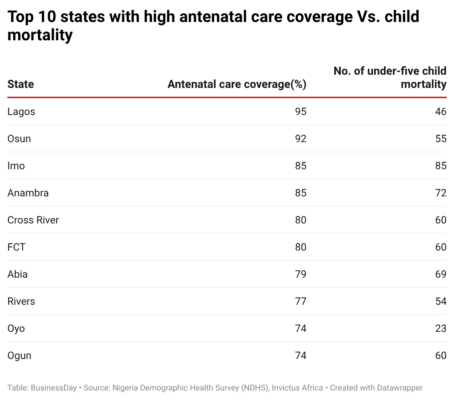
Lagos and Osun states have outperformed their peers in antenatal care coverage, with at least four visits by 2025, and have also recorded lower under-five mortality rates, according to the Nigeria Demographic and Health Survey (NDHS) 2024 report.
The two states recorded 94 percent and 92 percent antenatal care coverage respectively, exceeding the National Population Policy (NPP) target of 72 percent and the national target of 82 percent by 2030, indicating robust access to maternal healthcare, the report stated. Meanwhile, Sokoto (22.7 percent), Zamfara (21.5 percent) and Kebbi (14 percent) recorded the lowest antenatal care (ANC) coverage, far below the NPP national target.
This is also reflected in the under-five mortality rate, as states with higher antenatal care coverage recorded lower under-five mortality rates compared to states with low antenatal care coverage. For instance, Sokoto recorded 109 under-five deaths per 1,000 live births, Zamfara recorded 119 per 1,000 live births, while Kebbi, which has the lowest antenatal care coverage in the country, recorded a very high under-five mortality rate of 159 deaths per 1,000 live births, according to the NDHS.
On the other hand, Lagos and Osun states, with high antenatal care coverage, recorded lower under-five mortality rates of 46 and 55 deaths per 1,000 live births respectively.
Other states, including Ekiti (68.6 percent), Ondo (66.3 percent), Nasarawa (66 percent), Akwa Ibom (65.7 percent) and Edo (63 percent), are working towards the national target for antenatal care coverage, demonstrating moderate efforts to improve coverage. Meanwhile, Enugu (61.9 per cent), Ebonyi (61.7 percent), Borno (61.1 percent), Delta (60.5 percent), Kaduna (59.4 percent), Adamawa (56.4 percent) and Kogi (54.1 percent) require strengthened efforts to improve antenatal care coverage, the report noted.
WHO on ANC
According to the World Health Organisation(WHO), only 64 percent of pregnant women attended the WHO-recommended minimum of four contacts for antenatal care (ANC) globally in recent years, suggesting that much more work needs to be done to improve ANC utilisation and quality.
The global health organisation added that ANC reduces maternal and perinatal maternal and child mortality both directly, through the detection and treatment of pregnancy-related complications, and indirectly, through the identification of women and girls at increased risk of developing complications during labour and delivery, thereby ensuring referral to an appropriate level of care.

Join BusinessDay whatsapp Channel, to stay up to date
Open In Whatsapp


