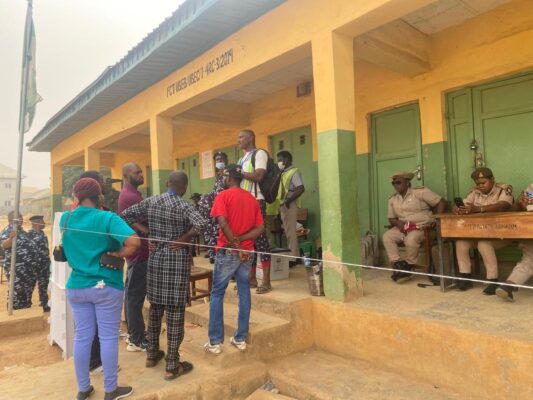
The outcome of the Federal Capital Territory (FCT) Area Council elections, in which the All Progressives Congress (APC) secured victory in five councils — Kuje, Kwali, Bwari, Abaji and Abuja Municipal Area Council (AMAC) — and the Peoples Democratic Party (PDP) retained Gwagwalada, has opened a new chapter for debate.
BusinessDay observes that the polls were marked by intense political scheming, negotiations and behind-the-scenes bargaining as parties sought to consolidate advantage ahead of the 2027 general elections.
One of the defining features of the contest was the active involvement of the FCT Minister, Nyesom Wike, whose role introduced a new dimension to the electoral contest.
Wike had publicly endorsed Christopher Maikalangu, the APC chairmanship candidate for Abuja Municipal Area Council (AMAC), who subsequently secured re-election. His influence was further underscored by the withdrawal of the PDP’s AMAC candidate, Zadna Dantani, who stepped down and openly urged his supporters to vote for the APC candidate.
Read also: Low turnout, voter apathy trail FCT council polls in Nyanya, Karu
In a letter to the Independent National Electoral Commission (INEC) dated February 18, 2026, Dantani said his decision followed consultations with family and associates and emphasised that it was voluntary. Yet, analysts are of the view that the timing and political context suggested a coordinated realignment that benefited the APC.
Less than a day earlier, the PDP’s Bwari chairmanship candidate, Julius Adamu, had also withdrawn and endorsed the APC’s candidate, Joshua Ishaku. These developments significantly reshaped the competitive terrain and strengthened the APC’s prospects across key councils.
The withdrawals also reinforced the perception that elite bargaining, rather than grassroots mobilisation alone, played a decisive role in determining outcomes.
Wike had earlier declared that candidates unwilling to support President Bola Ahmed Tinubu would struggle to win election. On election day, the minister toured polling units but expressed disappointment over the low voter turnout.
However, the African Democratic Congress (ADC) criticised his presence, alleging voter intimidation. Bolaji Abdullahi, its National Publicity Secretary, argued that Wike’s movement across polling units under the guise of monitoring was inappropriate, noting that as a cabinet minister and non-registered voter in the FCT, he had no constitutional role in the process.
In a dramatic reversal of earlier patterns, the APC chairmanship candidate in Gwagwalada, Mallam Usman Yahaya, withdrew from the race and endorsed the PDP’s candidate, Alhaji Kasim Mohammed Ikwa.
Yahaya’s decision, announced in a February 19, 2026 statement, followed consultations with political stakeholders and represented a rare shift against the dominant APC.
The move proved consequential. In the final tally, Ikwa secured 22,165 votes, defeating the APC candidate Yahaya, who polled 17,788 votes. Other parties trailed behind, with APGA recording 1,687 votes and ADC 1,366.
This outcome demonstrated that while elite realignments favoured the APC in most councils, local political calculations could still produce alternative results.
Read also: Confusion, late opening, low turnout mark FCT council polls as YIAGA Africa flag disenfranchisement
Scale of the electoral contest
The election was contested by 637 candidates from 17 political parties for 68 positions; six chairmanship seats and 62 councillorship seats.
Out of the 1,680,315 registered voters in the territory, 1,587,025 had collected their Permanent Voter Cards (PVCs) and were eligible to vote, according to INEC chairman, Joash Amupitan.
Voting took place across 2,822 polling units, with 4,345 Bimodal Voter Accreditation System (BVAS) machines deployed.
The Independent National Electoral Commission (INEC) had cleared 17 political parties to contest the elections. They are Accord (A), Action Alliance (AA) African Action Congress (AAC), African Democratic Congress (ADC), Action Democratic Party (ADP), All Progressives Congress (APC), and All Progressives Grand Alliance (APGA).
Others are the Allied Peoples Movement (APM), Action Peoples Party (APP), Boot Party (BP), New Nigeria Peoples Party (NNPP), National Rescue Movement (NRM) Peoples Democratic Party (PDP), Social Democratic Party (SDP), Young Progressives Party (YPP), Peoples Redemption Party (PRP), and Zenith Labour Party (ZLP).
Despite the large field, competition was effectively concentrated among a few dominant actors.
How the APC secured five councils
While APC candidates campaigned actively across the territory, analysts attribute their victories largely to a combination of incumbency advantage, organisational depth and access to federal political networks.
The APC leadership had framed the FCT elections as strategically important. During the inauguration of the campaign council, National Chairman Nentawe Yilwatda, described the contest as critical and expressed confidence in a sweeping victory.
The campaign council itself reflected the party’s national reach. It was chaired by Kwara State governor AbdulRahman AbdulRazaq, with governors Hope Uzodinma, Mai Mala Buni and Mohammed Umar Bago serving as co-chairmen.
Other influential figures, including Senate President Godswill Akpabio, Deputy Senate President Barau Jibrin, Speaker Tajudeen Abbas and Deputy Speaker Benjamin Kalu, were also involved.
According to Kalu, the party treated the contest with the seriousness of a national election. From the APC’s Situation Room in Asokoro, he said on the election day that the party had deployed monitoring teams to more than 2,000 polling units and relied on grassroots mobilisation as well as messaging centred on infrastructure delivery.
Observers say this combination of strong national backing and local campaign structures proved decisive as the final results confirmed the APC’s territorial dominance.
In Bwari, APC candidate Joshua Ishaku won with 18,466 votes, comfortably ahead of the ADC’s 4,254 votes and ZLP’s 3,515. In AMAC, Christopher Maikalangu, was re-elected with 40,295 votes, defeating candidates from the ADC (12,109 votes), SDP (2,185), NNPP (1,694) and PDP (3,398).
APC candidates Umar Abdullahi Abubakar in Abaji, Nuhu Daniel in Kwali and Danjuma Shekwolo in Kuje also secured victories after polling the highest votes in their respective councils.
Overall, the APC captured five of the six councils, while the PDP retained only Gwagwalada. However, the elections were marred by persistent structural issues, including low turnout, vote buying, late arrival of officials and logistical challenges.
Read also: APC wins five FCT councils, PDP secures Gwagwalada
EFCC arrests 20 suspectss, recovers N17m
However, operatives of the Economic and Financial Crimes Commission (EFCC) have disclosed that they arrested 20 suspects over alleged electoral offences during the polls.
The arrests, made on Saturday across several area councils, followed intelligence on vote trading and related infractions. EFCC spokesman, Dele Oyewale, said the suspects were picked up for alleged vote buying, vote selling and obstruction of law enforcement officers.
He disclosed that one of the suspects was intercepted in Kwali with N13.5 million concealed in a vehicle parked near a polling unit. Others were arrested in Abaji, Gwagwalada and Kuje during coordinated operations.
Reactions trail polls outcome
BusinessDay reports that the results triggered sharply contrasting reactions across the political spectrum. A faction of the Peoples Democratic Party led by Tanimu Turaki has inaugurated a legal team to challenge the results, citing alleged irregularities.
In a statement, spokesman Ini Ememobong said the team, headed by National Legal Adviser Shafi Bara’u, would pursue redress while urging aggrieved candidates to file petitions within the stipulated timeframe.
Former Vice President Atiku Abubakar, a prominent opposition figure, described the turnout as evidence of democratic decline. In a statement, he argued that the political environment had been shaped by intimidation and shrinking space for dissent, warning that when citizens lose faith in elections, democracy itself is endangered.
But Nentawe Yilwatda, the APC National Chairman, framed the results as a clear endorsement of President Tinubu’s reform agenda, saying the party’s performance in Abuja reflected growing public confidence in the administration’s Renewed Hope programme.
Election observer group Yiaga Africa, also described the polls as largely peaceful but noted concerns about vote buying, low turnout, early closure of voting in some polling units and confusion over newly created polling centres. These issues, it warned, undermine democratic credibility even when elections remain orderly.
Labour Party’s absence reshapes race
Another major factor that influenced the election was the absence of the Labour Party (LP) from the ballot. INEC’s final candidate list contained no LP nominees after court rulings upheld the party’s exclusion following internal leadership disputes and litigation.
In previous FCT elections, Labour Party candidates had cultivated notable grassroots support. Without the third-force presence, electoral competition narrowed, largely consolidating around the APC and PDP, with the ADC emerging as a secondary challenger.
Analysts say this structural shift contributed to the APC’s sweeping performance by reducing vote fragmentation among opposition forces.

Join BusinessDay whatsapp Channel, to stay up to date
Open In Whatsapp