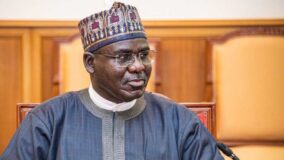
Hundreds of protesters converged at the National Assembly Complex, Abuja, on Monday to demand real time election results. The protest followed the passage of the Electoral Act 2022 (Repeal and Re-enactment) Amendment Bill, 2026 by the Senate last week. Central to the outrage was the removal of the phrase “real-time” from clauses relating to the electronic transmission of results, a change critics say opens the process to manipulation.
While the Senate has repeatedly maintained that electronic transmission was not discarded entirely, protesters insisted that the absence of “real-time electronic transmission” undermines transparency and allows for post-election interference.
Singing protest songs and displaying placards bearing messages such as “Our votes must count”, “No to electoral robbery” and “Protect democracy now”, the demonstrators marched from the Federal Secretariat toward the National Assembly.
The demonstration, tagged ‘Occupy the National Assembly’, was organised by members of the Obidient Movement alongside pro-democracy campaigners, who accused lawmakers of attempting to weaken electoral safeguards ahead of the 2027 general elections. Peter Obi, former presidential candidate of the Labour Party, joined them.
Read also: Obi joins protesters, occupy N’Assembly over e-transmission of election results
Their movement, however, was halted by a strong security presence comprising personnel of the Nigeria Police Force, the Nigerian Army and the Nigeria Security and Civil Defence Corps.
The operatives barricaded the main entrance of the complex, compelling protesters to stage the demonstration outside the premises.
Speaking to journalists at the protest venue, Obi warned against what he described as a gradual rollback of democratic progress, stressing that credible elections are essential to Nigeria’s stability and development.
“We must dismantle this criminality and prove that we are now a nation that shows light in Africa,” he charged.
Obi’s presence further energised the protesters, many of whom regard him as a key figure in the youth-led political mobilisation witnessed during the 2023 general elections.
Yunusa Tanko, National Coordinator of the Obidient Movement Worldwide, said the protest would persist until the National Assembly clearly reinstates real-time electronic transmission of results in the amended law.
He said, “If there is no electronic transmission of results, there will be no election. Our elections must be credible.”
Tanko noted that previous elections were often compromised during manual collation, a challenge electronic transmission was designed to address following reforms after the 2011 and 2015 polls.
Nigeria’s push for electoral reform intensified after the widely criticised 2007 general elections, regarded as one of the most flawed in the country’s history.
Read also: At least 48 killed in Cameroon post-election protests — report
Subsequent innovations, including the introduction of card readers in 2015 and the Bimodal Voter Accreditation System (BVAS) in 2022, were applauded as milestones for transparency, despite lingering implementation issues.
Civil society organisations had also strongly advocated electronic transmission of results during deliberations on the 2022 Electoral Act, arguing that it would curb human interference and rebuild public trust in the electoral system.
Randy Peters, a popular activist who addressed the protesters, accused the political elite of betraying democratic principles and vowed that the demonstrations would continue.
“Tomorrow, we will be back here until the Senate does the right thing. The current administration supported the June 12 campaign. It was about free and fair elections,” he noted.
Referencing the June 12, 1993 election, widely considered Nigeria’s freest and fairest, Peters questioned why elected officials would resist reforms aimed at ensuring credible polls.
He said, “Do we have Democrats who are afraid of losing elections? In 2027, our votes must count. The most important thing is that our votes must count. Tomorrow, they will meet us here again.”
Speaking in a separate interview with BusinessDay, Ireti Kingibe, a senator representing the Federal Capital Territory (FCT), countered claims that the Senate rejected key electoral reforms.
Kingibe, who is a member of the Senate Committee on Electoral Matters, said the current reports suggesting that the Senate reverted to the provisions of the 2022 Electoral Act are inaccurate, stressing that the legislative process on the bill has not been concluded.
In a statement on Monday, the senator said the National Assembly undertook an extensive and inclusive reform process throughout 2024 and 2025, involving public hearings, policy retreats and broad stakeholder engagement.
Read also: E-transmission of election results: NLC threatens mass boycott of 2027 elections
“As the Senator representing the Federal Capital Territory, and as a member of the Senate Committee on Electoral Matters, I consider it my duty to speak directly to Nigerians on the ongoing work surrounding the Electoral Reform Bill… an effort I have been actively involved in since 2024,” Kingibe said.
According to her, the reform process was driven by a joint committee of the Senate and the House of Representatives, with the Independent National Electoral Commission (INEC) participating consistently alongside civil society organisations that served as technical partners.
“Through rigorous debate, consultation, and consensus building, we produced a comprehensive report that reflected the aspirations and expectations of Nigerians for a stronger and more credible electoral system,” she said.
Kingibe said the committee’s report was anchored on three key pillars, including the electronic transmission of election results and real-time upload to the INEC Result Viewing Portal (IREV), recognition of direct, indirect and consensus modes of party primaries, and clearly defined election timelines that ensure orderly and credible elections.

Join BusinessDay whatsapp Channel, to stay up to date
Open In Whatsapp