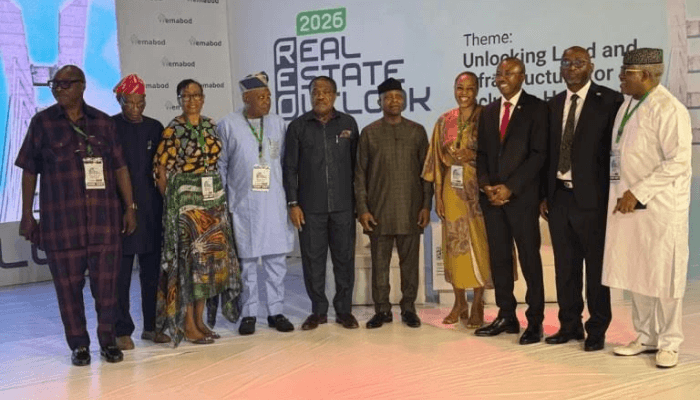
Yemi Osinbajo, former Nigeria’s Vice President, has advocated for structured public-private collaboration where governments provide land and trunk infrastructure, private developers bring capital and execution capacity, making mixed-income housing commercially viable.
Osinbajo, who spoke at this year’s WEMABOD Limited’s Real Estate Outlook with theme ‘Unlocking Land and Infrastructure for Inclusive Housing: A Regional Agenda for Sustainable Urban Growth,’ said that Nigeria’s long-standing housing deficit can be solved if governments demonstrate the political will to unlock land and deliver infrastructure through strong public-private partnerships.
The former VP, in his keynote address titled ‘From Bodija to the Future: Unlocking Land and Infrastructure for Inclusive Housing – A Regional Agenda,’ stated that the nation’s housing crisis was the result of weak political will and institutional failure rather than the absence of workable housing models.
At the meetin,g which brought together regulators, developers, financiers and industry experts, he stressed that inclusive housing would remain impossible if land and infrastructure were left entirely to market forces.
Describing housing as not just a commodity, but the cornerstone of socio-economic transformation, he pointed out that “housing is not simply a product for those who can afford it. It is the foundation of equity, collective prosperity and human dignity. If government does not intervene deliberately, inclusive housing simply cannot exist. Inclusive housing is achievable when planning, infrastructure and land governance are coordinated.”
On the historic Bodija Housing Estate in Ibadan, he stated that the “estate is not just a housing project; it was a development strategy. Land was assembled, infrastructure was provided first, and housing followed. That model proved that affordability and social mix are possible when government leads with vision.”
While lamenting that failure was not in the Bodija model itself, but in its non-replication across the South-West and Nigeria, he said: “If similar estates had been developed consistently across the region, we would today have networks of inclusive communities instead of fragmented, exclusionary developments,” he added.
The former VP, however, pointed out that land scarcity in South-West cities is “institutional, not physical,” pointing to fragmented ownership, slow titling processes and speculative land banking as major barriers to affordable housing.
Saying that government controls land and can provide infrastructure, he added that “if the political will exists, states can deliver affordable housing for Nigerians.”
He identified infrastructure failure as the biggest cost driver, adding that “infrastructure is the hidden subsidy of affordable housing, when households must provide their own water, roads, drainage and power, affordability collapses.”
Charles Diji Akinola, managing director/chief executive officer (MD/CEO) of South-West Development Commission (SWDC), in his presentation at the event, said the campaign for corridor-driven urban development planning has begun in the region, listing affordability, integration, and sustainability as key advantages.
According to him, corridor-driven urban development addresses solo efforts by states and developers, which produce fragmented and unsustainable urban projects, the SWDC will help align multi-state infrastructure corridors and transit systems with planned urban growth nodes to foster connected development, thereby making it economically productive and environmentally more sustainable.
While emphasising that the commission is out to foster integration of state efforts, not to replace them, explained that it would help multiply impact and achieve desired sustainable urban development.
Akinola cited instance of the growth along Lekki-Epe and the Free Trade Zone belt in Lagos, which has successfully sustainably developed the area saying proper regional rail development would produce the same results.
“The mistake we often make is to plan housing and real estate first and then try to retrofit infrastructure later. That model is costly and unsustainable.
A better model is corridor-led planning—where major transport routes, logistics networks, industrial clusters, and mobility systems are mapped first, and then housing, commercial centres, and social infrastructure are deliberately located around growth nodes along those corridors
“This approach produces three benefits. First, it connects housing to jobs and markets, which improves affordability in real life, not just on paper. Second, it allows bulk infrastructure to be delivered more efficiently at scale. Third, it prevents the emergence of isolated estates that later become socially and economically stressed.”
“From a regional standpoint, sequencing matters: infrastructure first, then large-scale development—not the reverse. That is how cities grow in a way that is financially viable, socially inclusive, and environmentally durable.
“If we coordinate better, plan regionally, and deliver infrastructure ahead of growth, the Southwest can become a model of integrated and inclusive urban development,” he said.
Stressing that upfront planning of trunk infrastructure at the corridor scale reduces cost and improves infrastructure quality and environmental resilience, he posited that “when trunk infrastructure is planned and financed upfront at a corridor or regional scale, two things happen. Costs drop because of economies of scale, and quality improves because infrastructure is designed as a system, not as an afterthought.
Bashir Oladunni, Managing Director, Wemabod Limited, in his welcome address, stated that Nigeria’s housing challenge is not just about supply but about access and affordability, saying “we see housing not just as buildings, but as the foundation of productive
Cities and inclusive economic growth
“At the heart of this challenge are two structural constraints: land and infrastructure. Without accessible, properly titled land, housing remains
expensive. Without enabling infrastructure, roads, rail, power, water, and social services, housing cannot scale, and cities cannot thrive.
“This is where Regional Development Commissions become critically important. These commissions were created to unlock regional potential,
coordinate infrastructure, and drive development beyond administrative boundaries. Today, they represent one of Nigeria’s strongest institutional platforms for land aggregation, infrastructure-led growth, and inclusive housing delivery.
“They are uniquely positioned to: Aggregate large land assets across regions, coordinate infrastructure at scale, de-risk greenfield and corridor-based housing developments, and align housing delivery with regional economic priorities
In effect, they provide the missing link between land, infrastructure, and
scale.
For inclusive housing to succeed, Oladunni stressed that development must increasingly shift from congested city centres to well-planned regional corridors, saying these corridors are anchored by transport infrastructure, economic activity, and coordinated land-use planning, this is precisely the development logic regional commissions were established to deliver.
“For developers and investors, this opens new opportunities for infrastructure-backed, master-planned communities. For the government, it aligns housing
with job creation and balanced regional growth. For financiers, it creates bankable, scalable housing pipelines supported by institutional governance.
The Wemabod boss, however, stated that the company believe that inclusive housing cannot be delivered by any single stakeholder.addjng that It requires collaboration between government, regional development institutions, the private sector, Financiers, professionals, and communities.
The 2026 theme -‘Unlocking Land and Infrastructure for Inclusive Housing,’ he said, signals a shift from managing challenges to building enduring solutions and recognises that housing is not merely a social obligation, but a foundation for economic productivity, social stability, and sustainable urban growth.
Nureni Oladipo Adisa, an engineer and chairman, Wemabod Limited, in his speech said, “We stand at a pivotal moment in our urban narrative. Across our region, we witness a paradox: vibrant economic growth alongside deepening housing inequality; vast urban sprawl straining against inadequate infrastructure; and land, our most fundamental asset, often trapped in frameworks that limit its potential for the broader good.
“Unlocking Infrastructure means recognising that a home is not an island. It is about synchronizing housing development with transportation, water, energy, and digital networks from the outset. It is about building not just houses, but connected, resilient, and liveable communities. So, the Regional Agenda is our crucial lens. Housing markets and urban challenges do not respect municipal boundaries. We must think, plan, and act regionally, fostering collaboration between cities, towns, and states to create a balanced, equitable, and efficient urban ecosystem.”
Bimbo Ashiru, Group Chairman, Odua Investment Company, in his address, advocated for better policies, stronger public/private collaboration to drive housing development and make houses available for millions of Nigerians.
Ashiru also said that there was also need to attract more capital to the real estate market, ultimately, homes that Nigerians can afford, access, and sustain.
“These challenges are policy-driven and require solutions coordinated across public and private sector participants. Housing every Nigerian family does not only put a room on all of our heads, it will improve the economy, build capacity and transform society. Let us create a movement that starts the change we all desire and deserve to see.
“Our theme this year is deliberate. Unlocking land speaks to reforming land administration, improving titling systems, reducing transaction inefficiencies, and restoring confidence in land administration process. So, to unlock infrastructure means to build the foundational networks that make housing affordable, accessible and livable. These investments can transform the property market, expanding the economic potential of every naira spent on property development and create positive capital momentum.
“Inclusive housing not only challenges us to move beyond aspirational rhetoric toward delivery models that work, but also improves the capacity to leverage low- and middle-income Nigerians access to housing to improve overall market capacity.
Saying that the outlook aims to move the conversation beyond rhetoric and identify pathways towards a more vibrant real estate market, he pointed out, that at WEMABOD, “we are acutely aware that the future of real estate in Nigeria will be defined not by isolated projects, but by system thinking; that is, how land, infrastructure, finance, regulation, and governance align to modernise, standardise and expand the real estate market in Africa’s largest country.

Join BusinessDay whatsapp Channel, to stay up to date
Open In Whatsapp