Outrage is spreading across the country over the incessant failures of Nigeria’s electricity grid, as businesses and households reel from persistent and deeply hurtful blackouts. Nigeria recorded two grid collapses in January 2026 alone—on January 23 and January 26—barely three days apart. In 2024, the grid collapsed almost monthly, with 12 recorded incidents, marking one of the worst years in the sector’s troubled history. Although 2025 saw a modest reduction, the system still suffered four major disturbances—on February 12, March 7, September 10 and December 29—hardly evidence of resilience. In this still-young year 2026, the national grid has collapsed—or tripped, depending on official preference—with unsettling regularity, raising fundamental questions about governance, accountability, and the dangerous gap between technical explanations and lived reality. Three collapses in one month are not technical hiccups; they are symptoms. And symptoms, when recurrent, demand diagnosis beyond excuses. The pattern is unmistakable: failure may fluctuate in frequency, but it never truly recedes.
Perhaps, it would have been good news to Nigerians if what seems endless is the collapse of national greed, not the national grid. But the wires keep snapping, transformers keep sighing, and the nation keeps rehearsing darkness with monk-like discipline. The canvas is crowded with cables and excuses, and the verse – though endlessly revised – never really changes: where greed overloads the system, the grid must fall… or, in the preferred official euphemism, must merely trip.
This is not simply an energy crisis. It is a crisis of meaning. Electricity has become the most eloquent metaphor of Nigeria’s body politic, exposing how power is generated, transmitted, distributed—and distorted. Each blackout is a paragraph in a longer text about governance. Each system failure is a footnote to a grander narrative of misrule. In this country, the politics of power has steadily hollowed out the power of politics, leaving citizens to grope in darkness while leaders argue over definitions of failure. In Nigeria’s power sector therefore, even darkness now comes with footnotes.
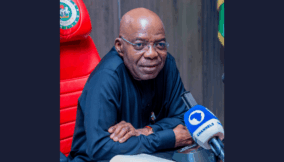
Sometime in 2024, at the height of public frustration over incessant blackouts, the Minister of Power found it necessary to step forward, not with light, but with language. Nigerians, he suggested, had been getting it wrong all along. What they had been calling “grid collapse” was, in fact, “grid tripping.” The grid, he implied, had not collapsed; it had merely stumbled. Not a fatal fall, just a technical misstep, just like the mischievous Turkish metal, which engineered a presidential stumble, but ended up investing Mr. President with a’ great shape’ toga! A semantic rescue mission was launched in the middle of a blackout.
And one is tempted to ask: in a country where refrigerators melt into cupboards, factories grind to silence, hospitals hum nervously on generators, and children read by candlelight, what exactly is the experiential difference between collapse and tripping? Is darkness less dark when it is grammatically refined? The Transmission Company of Nigeria later doubled down on this lexical distinction. In a formal statement, TCN insisted that there had been no national grid collapse in 2025. Reports suggesting otherwise were described as “mischievous and misleading.” What had occurred, TCN clarified, was line tripping—specifically on the Omotosho–Ikeja West 330kV line—compounded by a scheduled outage on the Benin–Egbin 330kV line. The result was a “cascaded outage” affecting Abuja, Lagos, and Osogbo axis, though other parts of the country, we were told, remained “fully intact.”
Here, at last, is the technical gospel. A grid collapse, we are taught, is a system-wide failure—a catastrophic loss of frequency and voltage stability that plunges the entire interconnected network into darkness. Line tripping, on the other hand, is a protective reflex: an automatic shutdown of specific lines to prevent wider damage. Tripping is the sneeze; collapse is the pneumonia. But this is where the parable begins to bleed into politics.
For the Nigerian on the street, the artisan in Mushin, the trader in Onitsha, the factory owner in Aba, the nurse on night duty in Ilorin, both sneeze and pneumonia feel the same when the lights go out. Whether the grid collapsed theatrically or tripped politely, the lived outcome is identical: silence, heat, loss. Semantics does not refrigerate insulin. Syntax does not power looms. Grammar does not run dialysis machines.
What the Minister and TCN offered Nigerians was not illumination but insulation, i.e., linguistic insulation against accountability. By downgrading collapse to tripping, failure is reframed as misfortune, and responsibility is diluted into jargon. The grid did not fail; it merely protected itself. Darkness, therefore, is not a governance problem; it is a technical episode. The blackout is transformed from an indictment into an inconvenience.
This is the politics of power at its most refined: when language is deployed not to explain reality but to soften its blow. When words become circuit breakers, tripping public outrage before it overloads the system of patronage. And so, the grid-greed metaphor deepens. Nigeria’s national grid has become not just an electrical infrastructure but a linguistic battlefield. On one side are citizens who speak in the blunt vocabulary of experience: no light. On the other side is the state, fluent in acronyms and abstractions: system disturbance, cascaded outage, line tripping. Between them yawns a gulf where trust used to live.
At the heart of this dysfunction lies a grid burdened with more than electrons. It carries its phonetic flip side – greed. It carries inflated contracts disguised as infrastructure. It carries abandoned projects whose plaques outlive their usefulness. It carries political appointments masquerading as technical competence. It carries budgets that arrive at substations emaciated by the time they escape the capital. No grid can survive such excess greed load. The result is a system where everyone explains failure, but no one owns it.
And so Nigerians improvise. A parallel republic of generators thrives. Diesel engines cough in courtyards, petrol generators growl in alleyways. Nearly 14 gigawatts of electricity—more than the grid reliably supplies—are privately generated at ruinous cost. The generator has become the unofficial coat of arms of the Nigerian state: noisy, expensive, and indispensable. This is where the grid-greed flip becomes most cruel. The national grid, originally designed to equalise opportunity, now equalises suffering. Darkness is democratic; light is elitist. Those with means draw inspiration from gubernatorial defectors to ‘defect’ from the national grid entirely, embracing home-grown grid generated, transmitted, and distributed by solar panels and inverters. Those without means remain tethered like Christmas goat to a system that rewards loyalty with blackouts.
And yet, politicians still speak of the national grid with reverence. Serial defectors routinely justify their political migrations with a curious refrain: the urgent need to connect our state to the national grid. It is presented as an act of altruism, a sacrificial crossing in the interest of development. But the metaphor no longer holds. To rush to connect to a grid that trips and collapses with ritual regularity is either tragic irony or deliberate misdirection. Unless, of course, “connection” is not about electricity. In that case, the urgency makes perfect sense.
To connect to the national grid, in political terms, is to plug into federal patronage. It is to access contracts, influence, appointments, and protection. It is to step closer to the socket of national greed. The grid here is not electrical; it is political. And unlike the power grid, this one hardly ever collapses. This is why the semantic obsession with tripping versus collapse matters. It is not a neutral technical clarification; it is a discursive strategy. By insisting that the grid has not collapsed, the state insists that the system itself is intact. What has failed, we are told, are components, lines, moments. Never structure. Never intent. Never governance.
But Nigerians know better. They experience the grid not as engineers but as citizens. And from that vantage point, the distinction collapses. Tripping that cascades into multi-city outages is collapse by another name. Darkness that requires generators is failure by any standard. It would truly have been good news to Nigerians if what was endlessly collapsing was national greed. It would have been Uhuru if corruption networks tripped, if rent-seeking circuits shut down automatically to protect the public interest, if there were cascaded outages of impunity, spreading from Abuja to Lagos to Enugu, until accountability was restored nationwide. But that is hardly the case. So, until then, the wires will keep snapping – whether from collapse or tripping. The grid will keep failing, whether system-wide or selectively. And officials will keep reaching for better words to describe worse realities.
The tragedy is not that the grid collapses or trips. The tragedy is that governance itself has been wired to excuse failure; that language is deployed to manage anger rather than fix systems; that ambition hums louder than transformers; that Nigerians are taught new definitions of darkness instead of being given light. So, the verse remains unchanged, etched stubbornly on the canvas of cables and contradictions. When greed overloads the system, the grid must fall – or at least, it must trip often enough to remind citizens who bears the cost of semantics. And so we return, inevitably, to words because in Nigeria, words matter, not as ornaments, but as instruments of power. They matter in how failure is named, how darkness is defended, how collapse is rebranded as tripping and greed is masked as governance. They matter in connecting the dots between policy and pain, between rhetoric and reality, between the politics of power and the power of politics. On this vast national canvas, electricity is only the visible stroke; language is the hidden pigment. When leaders choose euphemism over honesty, semantics over solutions, they redraw darkness as misunderstanding and suffering as mislabeling.
Nonetheless, the people read the picture differently, not with technical glossaries but with daily experience. Until words are restored to truth-telling, until they illuminate rather than obscure, heal rather than hedge, the grid will remain a metaphor for a nation miswired. For in the final verse on Nigeria’s canvas, it is not only transformers that must be fixed, but meanings; not only cables that must be rewired, but the moral language of power, which invokes the metaphorical entailment of national grid: national greed. The foregoing explains why words matter in connecting dots and verses on the canvas of national grid and greed.
Agbedo, a professor of Linguistics, University of Nigeria Nsukka, Fellow of Netherlands Institute for Advanced Study, is a public affairs analyst.

Join BusinessDay whatsapp Channel, to stay up to date
Open In Whatsapp