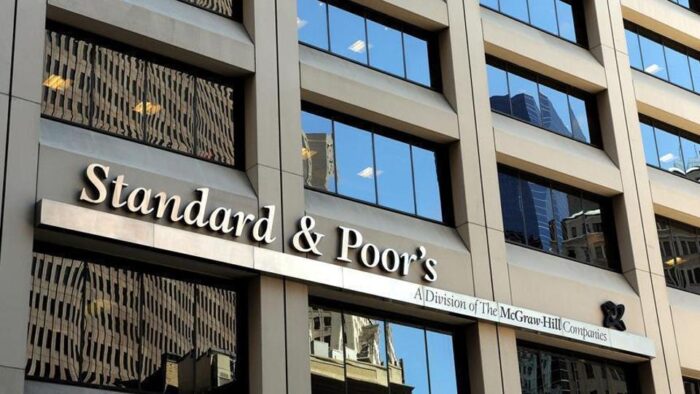
Nigerian banks will face pressure in 2026 from tighter regulation, higher capital requirements, and easing interest rates, though lenders are expected to remain profitable, according to a report by S&P Global.
The ratings firm said that the end of regulatory forbearance, higher capital requirements, and easing interest rates will weigh on asset quality and net interest margins across the sector.
Despite these challenges, banks are forecast to preserve earnings, supported by growth in net interest income, mainly from transaction fees and commissions, and a still-elevated but easing cost of risk.
“We anticipate Nigerian banks will prove resilient and capable of preserving positive profitability in 2026 despite regulatory headwinds,” S&P Global said in its Nigerian Banking Outlook 2026.
S&P Global expects the sector’s average return on equity to fall to between 20 percent and 23 percent in 2026 from an estimated 25 percent in 2025. Return on assets is projected to edge down to about 3.0 percent to 3.1 percent from 3.3 percent in 2025.
“Profitability will normalise as capital issuance increases equity bases, while margins come under pressure from lower interest rates,” the report said.
Although borrowing costs have begun to decline, interest rates are expected to remain high enough to support margins. S&P forecasts an average margin drop of 50 to 100 basis points in 2026, with banks still benefiting from strong yields on government securities and access to low-cost customer deposits.
Fee and commission income is expected to remain a key earnings driver as retail banking expands and transaction volumes rise.
“Growth in net interest income will be primarily driven by fees and commissions linked to digital payments, retail services, and the expansion of agency banking,” S&P Global said.
Read also: Five things to know to start your day
Operating expenses remain elevated, driven in part by regulatory charges. The Asset Management Corporation of Nigeria levy, set at 0.5 percent of on- and off-balance sheet assets, is estimated to account for 15 percent to 20 percent of banks’ total operating costs.
BusinessDay analysis reveals that Nigeria’s biggest banks are grappling with rising costs tied to the Asset Management Corporation of Nigeria (AMCON) levy, which surged to a combined N442 billion in the first half (H1) of 2025, even as profits weakened under mounting funding costs and slower loan growth.
Zenith Bank Plc, United Bank for Africa (UBA), and six other Nigerian banks saw a 34 percent rise in AMCON levy from N330 billion recorded in the same period of 2024, even as the sector contends with a sharp decline in revaluation gains, which slashed earnings.
On capitalisation, S&P expects buffers to strengthen as banks complete major capital-raising programs to meet new regulatory thresholds introduced by the CBN.
Under the new rules, effective March 31, 2026, banks with international licenses must holda minimum capital of N500 billion, while national lenders are required to maintain 200 billion naira, a sharp increase from the previous N25 billion requirement.
Read also: Nigeria caught in borrowing web as deficit surges 984% in 11 years
Rated banks have collectively raised about N2.3 trillion so far, close to S&P’s estimated total need of N2.5 trillion. Of the 10 rated commercial banks, which represent roughly 80% of system assets, nine already meet the new capital standards.
The firm expects some smaller lenders to pursue mergers or adjust their business models to comply.
The capital boost is expected to improve loss-absorption capacity, with most banks maintaining strong buffers above regulatory minimums under the Basel II framework.
“We expect banks to continue to meet their regulatory capital requirements over the next 12 months, supported by earnings and recent capital raises,” the report said.

Join BusinessDay whatsapp Channel, to stay up to date
Open In Whatsapp