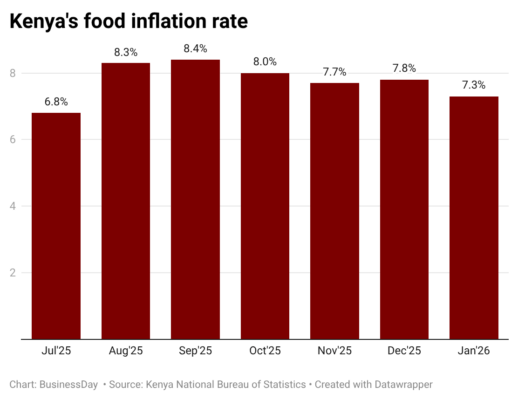
Kenya’s annual food inflation slowed to a six-month low of 7.3 percent in January 2026, down from 7.8 percent in December, helped by falling prices of key staples despite a worsening drought, official data showed on Friday.
The easing was driven by price declines in sugar (-3.0 percent), mangoes (-3.2 percent) and cooking oil (-0.1 percent), which helped offset increases in other food categories, according to the Kenya National Bureau of Statistics.
The moderation in food prices comes even as the East African country grapples with its shortest October–December rainfall season since 1981, exacerbating food insecurity across large parts of the country. It’s broader inflation picture, however, remained benign.
According to Trading Economics, food inflation in the country has averaged 9.28 percent between 2010 and 2026, peaking at 26.2 percent in October 2011 and falling to a record low of -1.15 percent in August 2018.
Headline inflation also edged down to 4.4 percent from 4.5 percent, keeping price growth at the lower end of the five percent midpoint preferred by the Central Bank of Kenya since June 2024.
On a monthly basis, consumer prices rose 0.6 percent, unchanged from December. The overall consumer price index increased to 148.96 in January from 148.02 a month earlier, the statistics agency said.
Inflation in housing, water, electricity, gas and other fuels accelerated to 2.2 percent from 1.6 percent, reflecting higher utility costs. Transport inflation slowed to 4.8 percent from 5.2 percent, driven by a 1.9 percent drop in inter-town bus and matatu fares, alongside modest declines in petrol (-1.1 percent) and diesel (-0.6 percent) prices.
Over the year, price pressures were largely driven by food and non-alcoholic beverages (7.3 percent), transport (4.8 percent), and housing, water, electricity, gas and other fuels (2.2 percent). Together, these categories account for more than 57 percent of the total weight in Kenya’s consumer price index basket.
The deepening drought crisis is expected to worsen through February and March 2026. Following the failed October–December 2025 short rains season, drought conditions have intensified, particularly in arid and semi-arid regions such as Mandera, Wajir, Garissa, Marsabit, Turkana and Tana River.
More than two million people are facing severe food insecurity, with water sources drying up and trekking distances to water points stretching as far as 7.6 kilometres. Livestock losses are mounting as pasture and water supplies shrink, a situation largely driven by persistent La Niña conditions that have brought below-average rainfall and higher-than-normal temperatures.

Join BusinessDay whatsapp Channel, to stay up to date
Open In Whatsapp