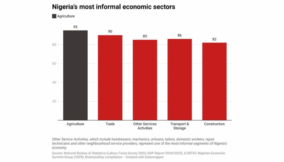
Nigeria’s economy is projected to expand at its quickest pace in more than a decade this year and in 2027, supported by a steady expansion in the services sector and the rebound of agricultural output after productivity slowed to the lowest in 40 years.
“Growth in Nigeria is forecast to strengthen to 4.4 percent in both 2026 and 2027—the fastest pace in over a decade,” the World Bank said in its newly released annual Global Economic Prospect report.
Read also: Nigeria’s tax-to-GDP ratio seen rising in 2026 as reforms kick in
“This further firming of growth is anticipated to be underpinned by a continued expansion in services and a rebound in agricultural output, with a modest acceleration in the non-oil industry.”
According to the Washington-based lender, Nigeria’s ongoing economic reforms, including the commencement of a newly structured tax system, along with continued prudent monetary policy, are expected to continue supporting growth prospects.
Nigeria implemented some painful but necessary reforms nearly three years ago, including phasing out costly fuel subsidies and floating the naira, making it market-driven rather than artificially pegged.
Read also: Sectors that will power Nigeria’s 4.4% GDP projection in 2026
Those policies, despite spiking prices and deepening poverty levels, have put the country in its best fiscal position in more than a decade, with the economy expanding for the three quarters reported in 2025 and inflation continuing its downward trend to 14.45 percent in November.
The naira also recorded its best outing in about 13 years, posting a gain of 7.5 percent last year compared with a loss of 41 percent in 2024. That stability witnessed in 2025 is expected to continue this year too, on sustained reforms.
The market reforms, the lender said, are also expected to improve investor sentiment and reduce inflation further, while higher oil output is expected to offset lower international oil prices this year, helping to boost fiscal revenues and strengthen the external balance.
Read also: World Bank seeks trade reset to cut Nigeria’s poverty
The World Bank says Nigeria’s annual growth edged up to 4.2 percent in 2025. That’s a remarkable jump from 3.38 percent recorded in 2024 post rebasing and 3.04 percent in 2023 but lower than 4.32 percent in 2022.
The increase, the Bank said, was driven by expansion in the services sector—especially the finance and information and communication technology sectors—a modest recovery in agriculture, and the country’s emergence as a net exporter of refined petroleum products.

Join BusinessDay whatsapp Channel, to stay up to date
Open In Whatsapp