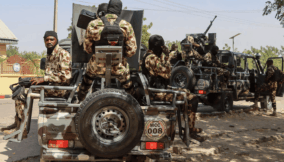
Kayode Egbetokun, Inspector General of Police (IGP), has directed all Commissioners of Police across the country to prioritise intelligence-led operations as security agencies intensify efforts to rescue abducted children and protect vulnerable communities.
Egbetokun issued the directive on Thursday during a high-level press briefing at the Force Headquarters in Abuja, attended by Commissioners of Police from the 36 states and the Federal Capital Territory.
He declared that the Nigeria Police Force would “not rest until every abducted child is safely reunited with their family,” adding that all intelligence activities must remain lawful, ethical and professionally executed.
The IGP said recent coordinated operations in Nasarawa and Kwara States, which resulted in arrests and the rescue of victims, highlight the effectiveness of well-planned joint security efforts.
Read also: Bandits abduct 24 farmers, maim blind man in fresh attacks on Niger communities
According to him, security operatives acted “swiftly, professionally, and with tactical clarity,” supported by state governments, community structures and the Office of the National Security Adviser.
Egbetokun warned that disjointed approaches to security only embolden criminals, stressing that collaboration was already yielding measurable results nationwide.
He pledged stronger partnerships with the military, intelligence agencies and state authorities to dismantle insurgent, terrorist, bandit and kidnap networks.
“To stay ahead of criminal strategy, we must constantly evaluate, adapt and reinvent,” he said, calling for expanded intelligence reach, improved protection of soft targets and the restructuring of patrol systems to prevent attacks before they occur.
He insisted that policing must shift from a reactive posture to a proactive, intelligence-led model capable of disrupting criminal networks at early stages.
As part of the new directives, Commissioners of Police are to deepen engagement with markets, transport unions, student groups, farming communities, artisans, religious institutions and local observers to build actionable grassroots intelligence.
Commands are also to establish community safety forums and rapid information channels designed to alert police units before criminals consolidate their positions.
On operational deployment, Egbetokun ordered that commands be reorganised into micro-policing sectors with structured foot patrols, surveillance teams, highway patrol units and tactical vehicle squads to ensure visible security presence across communities.
He further tasked commands, especially those in frontier states such as Katsina, Niger, Sokoto and Kebbi, to intensify joint operations with the military and intelligence services.
The IGP also directed all police formations to reinforce security around schools, markets, worship centres, major roads and other sensitive locations.
He emphasised that lawful mobile checkpoints and coordinated patrols remain essential tools for disrupting criminal movements.
“These measures are proven policing fundamentals. When executed properly, they reduce crime, restore public confidence and disrupt criminal planning cycles,” he said.
Reaffirming that public safety requires unity of purpose, Egbetokun urged officers to deliver tangible results.
“Security is a shared responsibility. Our duty is the protection of our people, the defence of our communities and the preservation of public order. This is not just policy; it is a patriotic necessity,” he added.

Join BusinessDay whatsapp Channel, to stay up to date
Open In Whatsapp