Introduction
The African Continental Free Trade Area (AfCFTA) creates a unified market across 54 African states. It offers major opportunities for Fast-Moving Consumer Goods (FMCG) businesses, especially in Algeria.
Algeria’s industrial reforms and logistics position it as a key north-to-south trade hub. AfCFTA enables tariff-free access and supply chain efficiency for FMCG firms. However, West Africa’s legal landscape is split between Anglophone (common law) and Francophone (civil law) systems.
These systems differ in company registration, product conformity, and supervision. Navigating them is essential for successful market entry and scaling.
This article compares Nigeria and Côte d’Ivoire’s regulations for FMCG entry. It explores AfCFTA and ECOWAS harmonisation strategies and outlines practical steps for legal compliance and cross-border expansion.
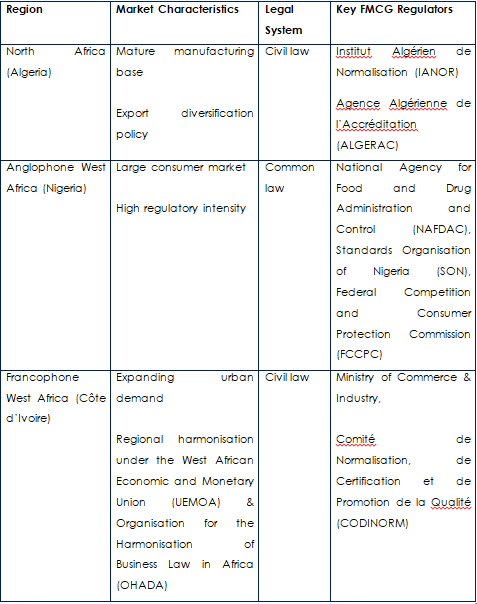
Comparative Overview of FMCG Regulatory Environments in Africa
The table below summarises the contrasting legal, market, and regulatory characteristics across North Africa and key West African markets relevant to FMCG expansion:
The AfCFTA Framework and Continental Market Dynamics
AfCFTA provides the legal foundation for intra-African trade, aiming to cut tariffs on 90% of goods, ease the movement of services and businesspersons, and promote industrial diversification.
The 2025 Intra-African Trade Fair (IATF2025) in Algiers highlighted this momentum, generating $48.3 billion in deals across 2,000+ exhibitors from 132 countries.
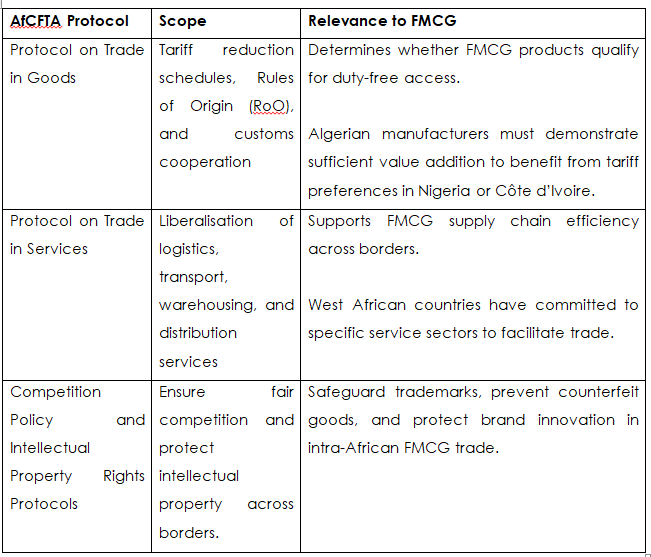
Key AfCFTA Protocols and Implications for FMCG Businesses
The following table highlights the key AfCFTA protocols and their relevance to FMCG market operations and compliance obligations:
Market Integration Potential for FMCG
AfCFTA is projected to increase intra-African trade by over 50% by 2035, with consumer goods and light manufacturing as the leading sectors for growth. For Algerian businesses, it offers access to West African markets like Nigeria and Côte d’Ivoire through tariff cuts, streamlined customs, and digital trade tools.
The Legal Pathway: Entry into West African Markets
North African FMCG businesses seeking to expand into West Africa under the AfCFTA must navigate a blend of continental commitments and domestic regulatory systems. AfCFTA creates preferential access for qualifying products, but market entry requires documentary precision, regulatory alignment, and operational sequencing across jurisdictions.
1. AfCFTA Qualification
Exporters must meet AfCFTA Rules of Origin to qualify for tariff preferences and obtain a Certificate of Origin, confirming procedures with Algeria’s competent authority before shipment.
2. Market Entry Planning and Regulatory Compliance
After establishing AfCFTA eligibility, production, packaging and documentation, appoint a local representative, prepare a harmonised dossier (specifications, Certificates of Analysis (CoA), Good Manufacturing Practice (GMP) certificates where applicable), and verify submission requirements via regulator portals. In Nigeria, FMCG entry typically requires registration with the National Agency for Food and Drug Administration and Control (NAFDAC) and conformity with the Standards Organisation of Nigeria (SON) regime (including SON’s Conformity Assessment Programme (SONCAP) for many regulated product categories). Respect NAFDAC labelling and dossier rules to avoid delays.
In Côte d’Ivoire, CODINORM sets standards and handles certification, while ministries (Ministry of Commerce / External Trade, Ministry of Health, Ministry of Agriculture) approve products (food, medicine, agrochemicals). OHADA harmonises business law but does not issue product registrations.
3. Certificates and Tests
Certificates of Analysis (CoA) and GMP certificates are commonly requested in both jurisdictions; exporters should confirm whether local re-testing or acceptance of foreign lab reports applies (practices vary by product and perceived risk).
4. Trade Facilitation and Logistics
Once regulatory approval is obtained, leverage AfCFTA certificates and the ECOWAS Trade Liberalisation Scheme (ETLS) for preferential tariffs and smoother customs processing, and use digital inspections and certified assessors (e.g., SONCAP) to expedite clearance.
5. Intellectual Property & Consumer Protection
Protect brand assets through regional or national IP registration (African Regional Intellectual Property Organisation (ARIPO) and national IP offices) and include IP and compliance clauses in distribution contracts.
6. Dispute Resolution & Remedies
Contracts should include a choice of law and arbitration clauses, using venues like the Lagos Court of Arbitration, OHADA Common Court of Justice and Arbitration (CCJA), or AfCFTA mechanisms as aligned with business strategy.
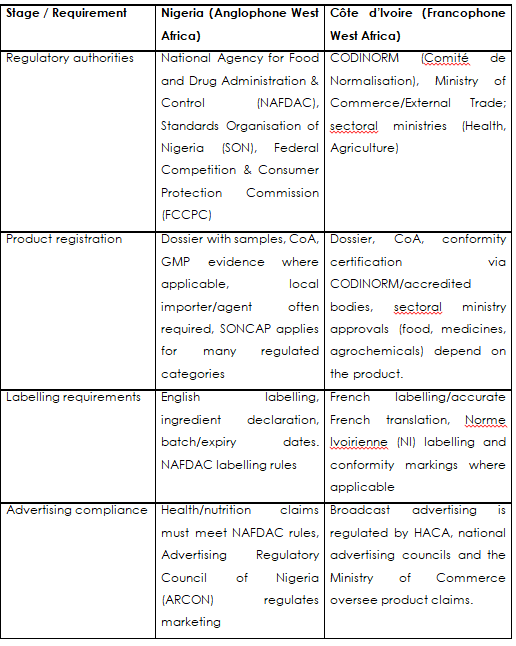
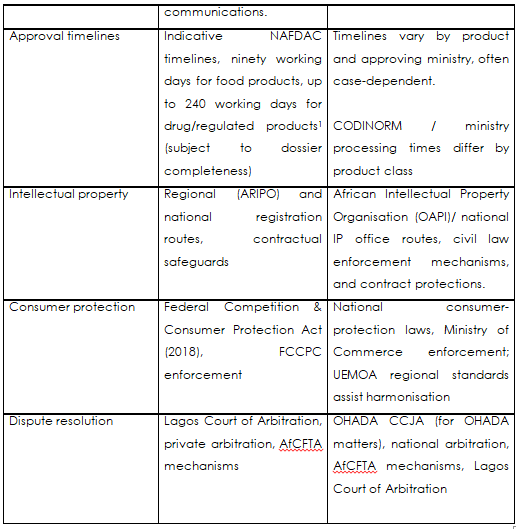
Comparative Procedural Requirements: Nigeria and Côte d’Ivoire
The table below compares the procedural and regulatory requirements for FMCG market entry in Nigeria and Côte d’Ivoire, showing how differences in legal systems affect compliance timelines and obligations:
Strategic Takeaways for Algerian FMCG Market Entry into West Africa
To operationalise AfCFTA opportunities, FMCG exporters should focus on harmonising documentation, ensuring regulatory compliance, protecting Intellectual Property, optimising trade and logistics, and monitoring policy updates.
Conclusion
The AfCFTA is reshaping Africa’s trade landscape, offering new prospects for FMCG growth. Success hinges on regulatory readiness, precise documentation, and strategic alignment across jurisdictions. From Nigeria’s multi-agency compliance environment to Côte d’Ivoire’s OHADA framework, mastering legal nuances is central to sustainable market access. As standards converge under AfCFTA and ECOWAS, strong legal and contractual structures, supported by continuous advisory guidance, will drive compliant and lasting market expansion.
For Nigerian firms and regional partners, this underscores the value of continuous monitoring, legal alignment, and advisory support to ensure that trade liberalisation translates into compliant, enduring market growth, a space where Stren & Blan Partners continues to provide strategic guidance and sector-focused legal insight.
Marvis Oduogu is a Team Lead in the Fast-Moving Consumer Goods (FMCG) Sector at Stren & Blan Partners, Chibudike Anene is a Senior Associate while Chineye Martins, Chidera Nwokeke and Eniola Alayo are Associates in the same sector.
Stren & Blan Partners is a full-service commercial Law Firm that provides legal services to diverse local and international Clientele. The Business Counsel is a weekly column by Stren & Blan Partners that provides thought leadership insight on business and legal matters.
Connect with Stren & Blan Partners:
Website: www.strenandblan.com
LinkedIn: linkedin.com/company/strenandblan
Twitter: twitter.com/Strenandblan
Instagram: instagram.com/strenandblan

Join BusinessDay whatsapp Channel, to stay up to date
Open In Whatsapp