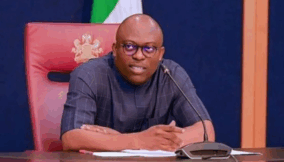
Oladele Bankole-Balogun was on December 7, 2025 appointed the Executive Chairman of the Edo State Internal Revenue Service (EIRS) by Governor Monday Okpebholo. The EIRS Executive Chairman is the Principal Partner of Oladele Bankole-Balogun & Co., as well as the former Federal Commissioner of the Public Complaints Commission, representing Edo State. Bankole-Balogun, in this interview with a few journalists in Benin City, outlined the achievements of the service under his leadership, the challenges, and the future plans of the board. IDRIS UMAR MOMOH brings the excerpts:
The administration of Governor Monday Okpebholo is one year old. As the Executive Chairman of the State Internal Revenue Service, what reforms has the administration brought into the tax collection system in the state?
The administration of Governor Monday Okpebholo has prioritised transparency, efficiency, and technology-driven reforms in revenue administration. Since the assumption of office, we have restructured our tax collection process to align with global best practices by strengthening and upgrading our revenue automation systems, expanding the Edo State Revenue Administration System (ERAS), and integrating all revenue-generating MDAs into this unified digital platform.
We have also reviewed some of our tax policies to reflect fairness and equity, which ensures that every taxable individual or business contributes according to capacity. Taxpayer education has also been intensified, payment channels simplified, and the human interface reduced. All these are in line with Governor Okpebholo’s agenda to build a sustainable, technology-based revenue ecosystem.
How have these reforms contributed to ensuring that taxes are collected seamlessly without issue of double or multiple taxation?
To eliminate the issues of double or multiple taxation, system integration and harmonisation of data is key. Through our digital platform (ERAS), we are able to uniquely identify each taxpayer with a Revenue Identification Number (RIN) and go further to link these numbers to the NIMC database using individual NINs preventing duplications. We have also improved methods of revenue collection to make it seamless and to streamline collection channels, ensuring that levies and taxes are properly categorised, coordinated and accounted for.
Today, I can proudly say that taxpayers in Edo State can transact and remit their taxes through verified electronic channels with e-government receipts issued to them from the comfort of their homes or offices, making the process more seamless, transparent, and accountable.
Leakages are one of the major challenges in revenue generation. Probably on the part of those entrusted with the task of collecting these taxes, it can be state actors or non-state actors. What are your takes on this, and what measures or mechanisms the Service has put in place or intends to put in place to address this?
Leakages are indeed a major concern in revenue generation systems. To tackle this, the EIRS under Governor Okpebholo’s watch has introduced multiple layers of control. These include the automation of collection points, real-time monitoring dashboards, and mandatory reconciliation of all revenue accounts. We have phased out manual receipts, strengthened our internal audit processes, and introduced periodic third-party audits. Additionally, collaboration with law enforcement agencies has been deepened to deter and prosecute offenders. The goal is simple — every kobo due to the Edo State Government must enter the government’s account.
What are the challenges inherent in the processes of tax collection, and how have you addressed address them?
I must say that in every aspect of life, challenges exist, and taxation isn’t exempt from challenges, ranging from taxpayer apathy, current economic realities, and the huge, unregulated, informal sector operations to numerous enforcement bottlenecks. However, our job is not one of complaints, but that of providing solutions. We are doing so by addressing these challenges through sustained public enlightenment, various stakeholders’ engagements, and intense collaboration with professional bodies and various trade unions.
On our part, we are leveraging technology to reduce leakages and strengthen our compliance enforcement processes. Also, it is worth noting that all our operations are guided by law and as such, the administration has been very supportive in providing legal and institutional backing, where necessary, for the Service to operate effectively.
What would you say are the greatest achievements of the Service under the leadership of Governor Okpebholo in the last one year?
I dare to say that the greatest achievements of the Board since the assumption of office of our amiable working Governor, include the steady increase in Internally Generated Revenue (IGR) when compared to the previous year. As of November 11, 2025, to date, the EIRS has generated N93billion. N52.6billion in the first half of 2025. We are on course to achieve for the first time ever a total collection of N100 billion. So, that must be a major achievement.
We are enhancing our digital technology solution to track revenue collections in real-time thereby reducing incidences of revenue leakages to its barest minimum, and the continuous broadening of the tax net to capture more individuals and businesses.
Also, worthy of mention is the enhancement of our very diligent staff welfare and capacity development through continuous training – be it locally or internationally. All thanks to His Excellency’s gracious approval. We have also introduced a stricter compliance monitoring unit to forestall illegal revenue collections in the state, and most importantly, public confidence in the tax system has grown. Taxpayers are beginning to see value for their contributions with the numerous infrastructural developments undertaken by the governor. These I can say are some major milestones.
You said there has been an increase in the internally generated revenue in the state. We would like to know the total number of taxpayers in the state tax net, and how many are expected to be in the net?
Yes. I make bold to say that the Internal Revenue Service, in conjunction with other revenue-generating MDAs in the State, have been able to generate over N86 billion in revenue as of the end of October 2025, and these numbers have been achieved by taxpayers resident in Edo. As of today, Edo State has over 1,009,083 (One million, nine thousand and eighty-three) registered taxpayers in our database, comprising individuals, businesses, and corporate entities. Our target is to expand the net further with High Net-Worth Individuals (HNWIs) before the end of the year to assist largely with the changes that would come into effect by January 1, 2026, with the commencement of the Nigeria Tax Administration Act.
Of the numbers and those not yet in the tax net, how many of them have defaulted in their tax obligations to the state; how many of them were arrested, charged to court and convicted?
I can’t categorically give you a specific figure right now, but we have been able to identify a sizable number of registered defaulters at various levels of non-compliance with the payment or remittances of tax liabilities.
However, our approach has been largely based on persuasion rather than the punitive approach. We have prioritised engagement and education of these defaulting taxpayers to elicit voluntary compliance. Nevertheless, where taxpayers persist in default after all the “carrot” approach, the Service is left with no choice but to invoke relevant provisions of the law by wielding the “stick”.
Between January and September 2025, about 560 default cases have been referred to the Service’s Legal Department for prosecution, out of which several convictions have been secured.
We’ve collected great amount of money this year. There was a company that paid about N48 million, there was another one that paid N70 million and another paid N100 million. We are collecting money for the state government through the civil servants and in the courts.
How many staff or consultants have also violated the laid down rules and regulations of tax collection in the state; how many of them have been penalised and what type of punishment?
Integrity is at the heart of our operations at the Internal Revenue Service. As a matter of fact, it is our foremost core value. That brings me to mentioning that a few cases of varying degrees of misconduct have been reported within the year, involving either internal staff or external agents.
In some cases, disciplinary actions have been meted out, while in others, warnings have been issued in line with our Human Resource Policies and Processes and contractual agreements, depending on the gravity of the offence. I would like to mention that under this Board and in my capacity as Executive Chairman, we maintain a zero-tolerance policy for corruption and unethical conduct.
How much are defaulters owing to the state? That’s the total debt owed by defaulters or tax evaders to the state?
Currently, outstanding liabilities from tax defaulters are at a reasonable level, spanning various tax types — including Pay-As-You-Earn (PAYE), withholding tax, Direct Assessment, and other Revenue heads. However, we have instituted a structured recovery mechanism using technology, field enforcement, and legal prosecution where necessary. The objective is not just to recover funds, but to ensure that we encourage and sustain voluntary compliance going forward.
What is your message to the taxpayers in the state and to the state government on those things that need to be in place to make the revenue generation system seamless?
Every taxpayer must see the need to partner with His Excellency by paying taxes. Paying tax is not a burden — it is our shared way of building the Edo of our dreams. Everyone has a role to play, because you can’t complain about government performance if you don’t contribute your own quota. Under the leadership of His Excellency, Monday Okpebholo, the Government has achieved phenomenal progress within just one year. Imagine what more can be done for the great people of Edo when more citizens join hands and pay their fair share. Together, through our taxes, we can make Edo stronger, better, and truly prosperous for all.

Join BusinessDay whatsapp Channel, to stay up to date
Open In Whatsapp