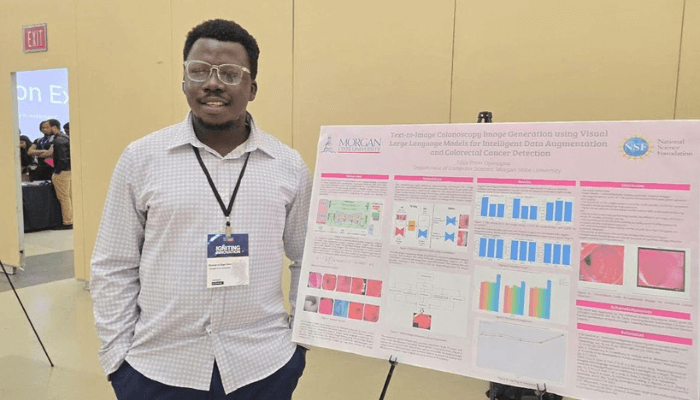
When Ejiga Peter Ojonugwa left Kogi State for graduate research at Morgan State University, United States, few could have predicted how quickly his work would begin attracting attention from academic and professional circles across continents. Today, the Nigerian-born computer scientist is being recognised for groundbreaking research that uses generative artificial intelligence to make medical imaging safer, fairer, and more globally representative.
Mr Ojonugwa’s studies in AI-driven medical data synthesis and multimodal learning are among the earliest by an African-born researcher to bridge text-to-image diffusion models with real-world healthcare applications.
“I’m not just training algorithms; I’m training them to be responsible,” he said in an interview. “Synthetic data can help prevent bias and protect patients while still improving diagnostic accuracy.”
In 2025, he published Text-Guided Synthesis in Medical Multimedia Retrieval in the journal Algorithms (MDPI), introducing a novel pipeline that generates synthetic colonoscopy images from textual medical descriptions. The framework, which integrates Stable Diffusion, LoRA-tuned transformers, and vision architectures such as U-Net and ViT, achieved an Inception Score of 2.36, a strong indicator of realism, and improved classification accuracy in gastrointestinal imaging. Peer reviewers described the study as “an important step toward equitable data representation in medical AI.”
The work has since been cited in multiple biomedical computing forums and is under review for integration into larger clinical AI training datasets, underscoring its influence beyond academia.
At Morgan State University’s Department of Advanced Computing, Mr Ojonugwa collaborates with researchers on projects linking cloud computing, computer vision, and medical diagnostics.
He also leads development efforts for Nigeria-based technology ventures Dathway AI (education technology) and Iduros Logistics (AI-powered delivery systems), reflecting his commitment to translating research into practical innovation. Colleagues describe him as “a researcher whose work merges technical precision with social intent.” Few young scientists manage to combine scientific publication, entrepreneurial leadership, and cross-continental collaboration as effectively.
Beyond the laboratory, Mr Ojonugwa is a member of the Institute of Electrical and Electronics Engineers (IEEE), the American Society for Engineering Education (ASEE), and the Computer Society of Nigeria. He also serves as a peer reviewer for international scientific journals, a role typically reserved for senior researchers, further proof of his recognition and expertise in the field. His conference presentations, from Baltimore to Grenoble and Madrid, highlight an expanding research profile that spans medical vision, explainable AI, and cloud-deployed generative pipelines.
Mr Ojonugwa is currently competing in the ImageCLEFmed-MEDVQA-GI 2025 Challenge, developing a multimodal vision–language system capable of answering clinical questions about gastrointestinal imagery. The project combines BLIP-2 transformers, text-prompt engineering, and synthetic data balancing, positioning him at the frontier of Visual Question Answering (VQA) for medical applications, an area gaining increasing international visibility.
“The next decade of healthcare AI will be multimodal,” he said. “And it must include perspectives from Africa if it’s to work for the world.”
From his early days in Minna to his graduate research in Baltimore, Mr Ojonugwa’s journey reflects more than academic achievement; it is a statement of possibility for young African scientists shaping global technology. For his thesis, he received the Faculty Award for Research Excellence in 2024, an honour typically reserved for projects demonstrating innovation and interdisciplinary impact. His growing list of publications, memberships, and leadership roles point to a clear pattern of exceptional ability in the sciences, the very qualities that distinguish him among emerging innovators in artificial intelligence.

Join BusinessDay whatsapp Channel, to stay up to date
Open In Whatsapp