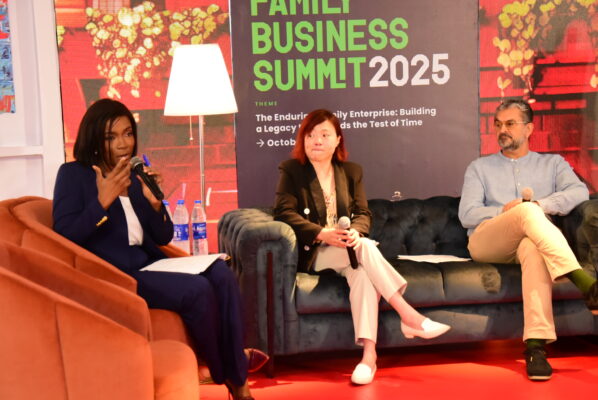
Zipo Lai, head of Family Office, Europe at Invest Hong Kong has emphasised that family offices are far more than financial management entities, but are strategic platforms for cross-border expansion, wealth preservation, and legacy creation.
She noted this during Business Day’s family business summit 2025, themed ‘Wealth Diversification and Resilience in Uncertain Times,’ was convened by Business Day in collaboration with Oghenevwoke Ighure, founder of My Family, My Business. The event brought together wealth advisers and next-generation business leaders to explore how families can build enduring enterprises that transcend generations, and discussions centred on the pillars of dynasty-building, structure, trust, and purpose.
The strategic role of family offices
During the panel session titled ‘Dream to Dynasty: Wealth Creation for Generations and the Role of Family Offices,’ moderated by Kemi Ojenike, chief operating officer of Meristem Family Office, Lai offered a policy and ecosystem perspective on the evolving function of family offices.
She highlighted Hong Kong’s robust financial infrastructure and favourable tax regime, which have positioned the city as a thriving hub for over 2,700 family offices.
“Family offices today serve a much broader purpose than managing capital,” Lai noted, “they underpin inter-generational continuity and facilitate cross-border growth.”
She further explained Invest Hong Kong’s role in promoting foreign direct investment between Hong Kong and global markets, including Africa, “We work with family businesses to establish both operational and wealth structures in Hong Kong,” she said.
Read also: The Third Generation Dilemma: Corporate governance challenges in Nigerian family businesses
Beyond capital, managing legacy and relationships
Angel Chia, executive director of the Hong Kong Academy for Wealth and Legacy, expanded on the multidimensional role of family offices. While they often begin as investment vehicles, their true value lies in managing the human and relational aspects of legacy.
“It’s not just about managing money,” Chia said, “it’s about navigating differences, resolving conflicts, and ensuring continuity, emotional intelligence and conflict resolution are often underestimated in sustaining wealth.”
She emphasised the importance of external expertise in these areas, “It’s not always cost-effective to maintain all specialists in-house, functions like mediation or legacy coaching are best handled externally to ensure neutrality and a broader perspective.”
Read also: 70% of wealth creation driven by family businesses – PwC
From vision to legacy, the founder’s dilemma
Ojenike observed that many entrepreneurs aspire not only to build wealth but to see it endure, “Founders typically desire two things, to build successfully and to ensure what they’ve built lasts, yet translating that dream into a dynasty is not always straightforward.”
Sameer Vaswani, chief operating officer of Assudamal Group, shared the journey of his multigenerational family business, which began in 1928 when his grandfather migrated from India to Hong Kong. Despite the disruptions of World War II, the business survived and expanded to Nigeria in 1971. Today it operates across Hong Kong, Ghana, India, and Dubai, and will mark its centenary in 2028.
Vaswani therefore underscored the importance of governance and structure in sustaining longevity, “Establishing our family office in Hong Kong with PwC’s support helped us remove emotion from wealth management and focus on structure, clear investment principles, defined risk parameters, and a balanced investment committee comprising family members and professionals.”
He added that separating ownership, management, and governance roles has fostered unity and innovation, “Each of us manages our own verticals but remains accountable to a family council, this structure aligns our vision, mission, and values as the business evolves.”
Read also: When running a family business, it’s not your show – Ayo Anibaba
Succession and the psychology of letting go
A recurring theme throughout the panel was the challenge of succession and the reluctance of founders to step aside.
Chia noted that this hesitation often stems from the uncertainty founders faced while building their wealth, “Founders who’ve spent decades navigating volatility often struggle with letting go, the fear of losing control is understandable, but it’s essential to reframe succession, not as relinquishing power, but as entering a new phase of purpose.”
She advocated for a transition from operator to mentor, “The next chapter should inspire founders to become visionary guides rather than active governors.”
Ojenike echoed this sentiment, emphasising that legacy-building requires emotional readiness alongside structural planning, “As Chia said, it’s not just about handing over control, it’s about opening a new field, founders must see themselves as coaches helping the next generation evolve the dream.”
Read also: Preparing the next generation for stewardship: Building a lasting legacy for family businesses
Preparing the next generation
Reflecting on his own experience, Vaswani discussed how the Assudamal Group prepares younger family members for leadership, “Agility is key, each of us manages a vertical independently but we’re united by shared values and a common vision, as new members join we allow evolution to keep our entrepreneurial spirit alive.”
He cautioned against rigid hierarchies that stifle innovation, “Autonomy and adaptability are what keep multigenerational businesses relevant.”
Lai urged African families to begin their wealth-preservation journey early and to seek professional guidance, “The first step is building the right structure, a well-designed family office can serve as a bridge between legacy and opportunity, helping families preserve wealth while creating global impact.”

Join BusinessDay whatsapp Channel, to stay up to date
Open In Whatsapp