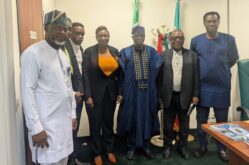
Nigeria and the United Kingdom have reached new agreements to strengthen cooperation on migration, criminal justice, and financial crime during the 2025 Nigeria–UK Migration, Justice, and Home Affairs Dialogue (MJHA) held in Abuja on Wednesday.
Details of the meeting were contained in a joint communiqué signed by Asari Allotey for Nigeria and Asim Hafeez for the United Kingdom, and released to journalists on Friday.
The annual dialogue, co-chaired by senior officials from the Nigerian Ministry of Foreign Affairs and the UK Home Office, is part of an ongoing partnership aimed at promoting secure borders, fair migration, and the rule of law.
A key highlight of the 2025 Dialogue was the reaffirmation of both nations’ commitment to return individuals without legal status in each other’s territories, under the framework of the 2022 Migration Returns Memorandum of Understanding (MoU).
“Returning those that no longer have a legal right to remain in the UK is a top priority for the UK Government,” the communiqué quoted the UK delegation as saying.
Both sides agreed to strengthen operational cooperation to ensure that all returns are conducted safely, humanely, and with respect for human rights.
The UK also announced progress in its electronic visa (e-visa) rollout, promising to extend the system across all visa categories by the time of the next MJHA meeting in 2026.
According to the communiqué, the UK has offered to “support Nigerian business travellers and simplify visit visa applications,” as part of broader efforts to promote trade and investment.
Nigeria, in turn, pledged to share updates on its own Nigeria e-visa project, which is being developed to facilitate easier entry for international visitors, investors, and business partners.
On migration management, both countries agreed to fast-track the signing of a Memorandum of Understanding on Organised Immigration Crime, which will focus on tackling irregular migration and border crimes.
The UK further pledged to expand training programmes for Nigerian immigration officers, particularly in the Organised Immigration Crime Unit, to “enable wider coverage and cascading of knowledge for enhanced responsiveness.”
Nigeria and the UK agreed to collaborate on a Strategic Serious Organised Crime Threat Analysis, the first of its kind in West Africa.
Officials described it as “a historic agreement that demonstrates the solid commitment between the two countries on combating serious organised crime.”
During the meeting, the UK also formally handed over the Brighter Futures PREVENT programme to Nigeria’s National Counter Terrorism Centre (NCTC) under the Office of the National Security Adviser.
The initiative, designed to steer vulnerable youth away from organised crime and extremism, will now be fully run by Nigerian agencies.
Nigeria pledged to sustain the momentum of the programme and provide updates on implementation at both federal and state levels at the next dialogue in 2026, while also calling for “continued UK support beyond March 2026.”
On extradition, both countries agreed to strengthen cooperation to ensure faster processes and prevent offenders from escaping justice in either jurisdiction.
The communiqué noted that the UK would continue to share information with its courts regarding detention conditions in Nigeria, to maintain transparency in extradition cases.
They also resolved to hold quarterly technical meetings to review progress on extradition and broader criminal justice matters.
Discussions also focused on the Prisoner Transfer Agreement, with Nigeria calling for an update to align the document with current domestic laws, including the Nigerian Correctional Services Act 2019. Both countries committed to clarifying the process, timelines, and conditions governing the transfer and detention of prisoners.
To strengthen border and maritime security, the UK and Nigeria agreed to develop a new Memorandum of Understanding on Human Trafficking, while improving inter-agency cooperation on commodities trafficking, especially across the maritime domain.
The communiqué said both nations recognised “the importance of sustaining operational work on illicit commodities,” with collaboration involving the Nigeria Customs Service, Navy, NDLEA, and UK law enforcement agencies.
The UK reaffirmed its commitment to support Nigeria in tackling illicit finance and money laundering, and to help establish a Public-Private Partnership on financial crime to strengthen detection, investigation, and prosecution capacities.
Both countries also vowed to work together on global reforms aimed at reducing illicit financial flows, improving transparency in financial centres, and enhancing the regulation of professionals who enable corruption and kleptocracy.
Nigeria and the United Kingdom are committed to monitoring the implementation of all agreements through ongoing consultations and performance tracking.

Join BusinessDay whatsapp Channel, to stay up to date
Open In Whatsapp