Emerging trend in Nigerian political sphere is suggesting that the Sir Ahmadu Bello Memorial Foundation, established by a pan-northern private organisation for the reimagination of the vision of the first premier of the North, for the region, is fast gaining ground as one of the platforms on which the political future of Nigeria, particularly, as regard 2027 presidential contest, will be determined.
The two-day political engagement organised in Kaduna, the old administrative capital of Northern Nigeria, by the Foundation named after the first premier, of the Northern region, Ahmadu Bello, the Sardauna of Sokoto, gave credence to the fact that the next presidential election, in the region, is going to be an interesting activity.
The recent Kaduna political engagement had in attendance former governors, ex-ministers, traditional rulers, technocrats, civil society actors, and religious leaders—underscoring the seriousness with which the region views its place in the unfolding Nigerian narrative under Tinubu.
Themed, ‘Assessing electoral promises: fostering government -citizens engagement for national unity,’ the two-day session drew participants from across the 19 Northern states and the Federal Capital Territory (FCT).
The two-day meeting, which in order to emphasise the significant of the late leader of the north, was held at ‘Arewa House’, the former residence of the late Premier, provided opportunity for observers of Northern politics, have a firsthand ground issue that will shape the voting behaviour of Northern electorates in 2027.
One of the high-profile participants in the Kaduna meeting, Salisu Indabawa, a CSO activist, confided in BusinessDay that what transpired which reflects in the sharp division of opinion between the Northern Governors` Forum, and that of the leadership of Arewa Constitutive Forum (ACF), as regard the performance of the President Tinubu `administration in the region, was going to determine voting pattern of the electorate in the region, in the next election.
The submission of Inuwa Yahaya, Governor of Gombe State, who is also chairman of Northern States Governors` Forum, at the meeting was that President Tinubu had fulfilled the electioneering promises made to the region during his 2023 election campaign.
While, in a position paper delivered on behalf of the Arewa Constitutive Forum by Bashir M. Dalhatu, a former minister under the General Sani Abacha military junta, who is chairman of the Board of trustees of the group, it argued that the two years’ administration of President Tinubu had entrenched a structured marginalisation of the north.
Tinubu has fulfilled his electioneering promise to the North – NGF
The Northern Governors’ Forum noted that when Tinubu stood before the electorate in the region during the 2023 campaign, he made specific pledges to the region, noting that the North responded with strong support, gave him more than 60% of the votes that secured him his victory.
“Now, we are here not for praise-singing but to assess what has been done since then,” he said. Yahaya disclosed that projects like the Abuja-Kaduna-Kano Expressway, the Kano-Katsina-Maradi rail line, the rehabilitation of the Kaduna Refinery, and the Abuja-Kaduna-Kano Gas Pipeline are receiving renewed attention.
He also cited drilling activities in the Kolmani Oil fields as examples of continued investments in the North, noting that new road networks and the Sokoto-Badagry Superhighway project are improving connections between the North and southern markets.
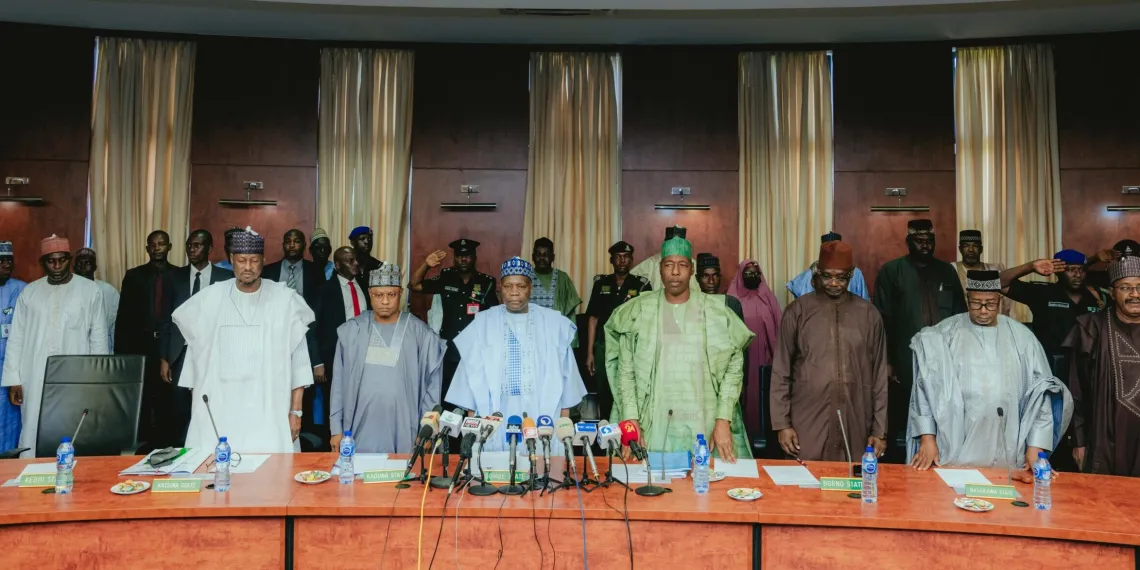
The governor also noted the ongoing efforts to upgrade healthcare facilities and invest in agriculture as further signs of government commitment.
On insecurity, Yahaya claimed that coordinated military operations had led to the killing of over 300 armed leaders across bandit and terrorist groups. “We are not yet where we want to be, but the situation is not what it used to be,” he said.
He described the creation of a Ministry of Livestock Development as a long-overdue response to recurring herder-farmer conflicts and added that federal efforts are now addressing issues such as the Almajiri crisis and the increasing number of out-of-school children.
While acknowledging that Tinubu’s economic reforms—especially the removal of fuel subsidies and the unification of exchange rates—have caused hardship for ordinary Nigerians, Yahaya argued that the long-term benefits will outweigh the short-term pain. “The hardship is visible, but so is the progress,” he added.
He urged the Northern state governments to complement federal projects with their own initiatives and called on traditional rulers, civil society, and business leaders to remain engaged.
According to Yahaya, the region’s support for Tinubu wasn’t merely a political calculation. “The North-Southwest alliance is more than numbers. It’s about keeping the country together,” he said.
His administration has marginalised the North – ACF
In what seems to be a counterargument to success story recounted by the NGF, the ACF`s Chair of the BOT, Bashir. M Dalhatu, who also doubles as the Wazirin Dutse, in Jigawa State, noted that President Tinubu`s administration in the last two years has shortchanged the region.
“Mr. Chairman, please allow me to join you in extending a warm welcome to our distinguished guests from the federal government. As the title of this programme indicates, it is an interactive session between the delegation of senior leaders of the Bola Tinubu administration and ourselves; representatives of the key civil society organisations of the people of Northern Nigeria.
“I recall that it was on the 17th of October, 2022 that this same group in this same hall held an interactive session with the then presidential candidate, Bola Ahmed Tinubu, among other candidates. In that meeting, we presented to Asiwaju Bola Tinubu, a written address containing details of the issues of urgent concern to the people of Northern Nigeria. In turn, he gave us his own written document containing details of the issues he believed were of concern to the North and how he intended to address them.
“But we did not stop there. The ACF, as is its tradition, prepared an extended memorandum giving further details of the critical issues of concern to Northern Nigeria. We then sought and obtained an appointment to visit with the President. At the meeting, which was held on the 30th of May, 2024, the ACF submitted the Memorandum in the presence of many of the leaders who are with us here today.
“It has to be stated, and I hope this is self-evident, that Northern Nigeria has related to Asiwaju Bola Tinubu with enthusiasm, accommodation and good will. Northerners went out en masse on the 25th of February, 2023, and cast their ballots for Bola Tinubu. In the event, 5.6 million out of the total 8.8 million votes he got (or 64%), came from the North.
“And yet, two years into the four-year tenure of President Tinubu, the feeling among the people of the North is, to put it mildly, completely mixed. To our surprise, those who did not support him, did not vote for him and hardly wished him well, have emerged from nowhere and are trying to push a wedge between him and the North.
“Whether or not they are succeeding, we do not know. But we cannot pretend not to observe that President Tinubu’s budget priorities, his infrastructural projects, his appointments and other executive actions, have, over the last two years, largely sidelined Northern Nigeria.
“As far as we can see, nothing or little is being done to address the major issues of concern to the North, details of which were presented to him in writing by various groups over the years. Mr. Chairman, due to the critical importance of this subject matter and for the benefit of our distinguished guests from Abuja, I wish to seek your indulgence to take a few moments in order to mention a few of these issues we have raised repeatedly with Mr. President over the course of our interactions.
“In the area of Insecurity, as to be expected, our biggest concern was and remains insecurity in Northern Nigeria. We stressed the fact that over the last decade, widespread violence, characterised by massacres, bombings, cattle rustling, kidnapping and other manifestations of conflict and insecurity has swept across Northern Nigeria, crippling almost all productive economic activities, to say nothing of social progress.
“Even as we speak, this crisis shows no signs of abating. The insurgent groups continue to multiply, their attacks becoming more deadly. With the possible exception of Kaduna and Bauchi states, the terror level everywhere in the North has continued to rise with each passing day.
“Unless the government takes decisive, strong, audacious and sustained measures, including the ones that address its root causes, particularly joblessness among the youth and deepening poverty, the insecurity crisis in Northern Nigeria can hardly ever be contained. By all means, the President needs to demonstrate to the Northern public that he is truly concerned with the raging conflict and is determined to bring it to an end,” he pointedly said.
Recounting President Tinubu`s performance in the agriculture sector, he noted that agriculture constitutes the backbone of Nigeria’s economy as it contributes some 40% of the GDP.
“The Northern states provide over 75% of Nigeria’s landmass and own 95% of the livestock industry. When agriculture remains one of the more neglected sectors in the economy, it is a cause for great concern to the North. Despite the apparent good intentions of the Tinubu administration, the federal government’s allocation to agriculture in the last two years remains below 5% of the total budget. The target set by the FAO is at least 25%.
“Federal budgetary allocation to agriculture and food security should be scaled up to at least 20% of total. That way, the government could expand its support to farmers. Providing tractors and other mechanical equipment to farmers at subsidised prices, being done at the moment, is an example of a good and helpful policy. But one support urgently needed by many farmers is for the government to offer them guaranteed minimum prices for a select number of key crops including maize, rice, etc.
“The need for this policy should be seen in the context of sustaining the critical policy of food security which comes from self- sufficiency in food production. Reports are showing that the decision of the federal government last year to approve duty free importation of rice, maize, sorghum, beans and other food stuff, although well intended, is already taking a heavy toll on the agro-industrial sector.
“Because the imported rice has already resulted in a glut in the market, most of the mega rice mills set up in the wake of Nigeria’s policy of self-sufficiency in rice are shutting down and workers are being retrenched. Trailer owners, drivers and manual labourers are also becoming jobless,” he argued.
In the Transport Infrastructure, Dalhatu further argued that in sub-sector like Highways, and Water Ways, due to its huge landmass and distance from seaports, Northern Nigeria suffers disproportionately from the lack of access to efficient, integrated transportation infrastructure in the country.
“In addition to its natural disadvantages, Northern Nigeria continued to also suffers from age-old neglect by the federal government in relation to the development of transportation infrastructure in the country. Unlike the Lagos-Ibadan Expressway and the Second Niger Bridge, not one single road of strategic importance to the North has been completed or even properly maintained in the last twenty years.
“For example, this year’s federal budget on roads is N1.013 trillion. But of that, a mere N24 billion (or less than 1%) was allocated to projects in the Northeast, for example. ⁸It is important to invite the attention of the President to start, re-start, expedite or complete the construction of some of the major roads that are of great strategic importance to Northern Nigeria.
“They include: Abuja- Kaduna- Zaria- Kano, Ilorin- Jebba-Tegina- B/Gwari- Kaduna, Abuja- Lokoja- Okene- Auchi, Zaria- Funtua- Gusau- Sokoto- Ilela, Keffi- Akwanga-Jos-Bauchi- Gombe- Yola, Calabar- Ogoja-Wukari- Numan-Biu-Maiduguri, Wudil-Kafin Hausa-Katagum-Potiskum, Kano-Katsina, Enugu-Otukpo-Makurdi, Gombe- Biu- Damaturu- Gashua-Gusau, Lambatta- Lapai-Agaie- Bida- Mokwa, and Birnin Kebbi-Yauri-Kontogora-Makera-Tegina.
“And, in Waterways, an approximately 3,800 of Nigeria’s 10,000 KMs of navigable waterways are open for use in certain times of the year. The waterways provide access to 28 of Nigeria’s 36 states and foster vital connections with 5 neighbouring countries. We should not forget that these river channels were the only means of transporting goods and services across the country during the early colonial period.
“The federal government should be urged to treat the development of Nigeria’s inland waterways with the importance it deserves. For a start, we should make navigation possible from the port of Warri up to Baro in Kogi state. A fully functioning inland port of Baro will be a game-changer for the economy of Northern Nigeria.
“In Electricity Power Supply, it is hard to overstate the enormity of the Electricity Power Supply problems facing Nigeria but especially Northern Nigeria. Development of the electricity power infrastructure stalled over the last 20 years throwing the country into chronic electricity shortages as well as unreliable supplies. Despite the massive injection of billions of dollars to address the problem, it has actually only got worse.
“Mr. The President should be persuaded to declare a state of emergency in the electric power sector. He should review the Power Sector Master Plan and implement the hydroelectric projects on the Upper and Lower Benue Rivers.
“The Construction of the Mambilla Hydroelectric Dam should begin without further delay. The construction of the Gas Transmission Pipelines including the Abuja-Kaduna-Kano (AKK), designed to deliver gas to thermal plants and industries in this part of the North should be completed by the end of this year as originally planned. The North does not stand a dog’s chance of economic development without adequate electricity power infrastructure.
In the area of Education, much has been said and written about the deep crisis of education in Northern Nigeria. Indeed, the most recent World Bank estimates put the number of out-of-school children at 20 million, 80% of whom are in the North.
“There is no question that education stands in great need of special, ambitious and bold initiatives. For one, it is grossly underfunded. And this should be corrected. And there is also a need to take other strong measures: We must upscale the training of teachers and improve their welfare in order to recruit and retain the best brains available.
“We must make the implementation of the UBE scheme more efficient and ensure that all children of school-going-age do actually go to school including the children of nomadic herdsmen, fishermen and other itinerant tradesmen. As a matter of fact, the President should be advised to Relaunch the UBE Scheme and commit the country to a Comprehensive, Free and Compulsory Basic Education in Nigeria,” he further stated.
In the area of Functional Healthcare System, the group noted that in general, health interventions have become progressively poorer, inadequate and ineffective. Some 70-75% of the disease burden in Nigeria is still dominated by long standing and preventable infectious diseases such as measles, meningitis, typhoid, whooping cough, cholera, HIV/AIDS etc.
“In some cases, there is an increasing re-emergence of diseases like tuberculosis and leprosy. Drug abuse has also become increasingly a major problem in the North. In all: Government must tackle more vigorously the root causes of the disease burden; chiefly through the supply of safe drinking water, especially to the rural dwellers and the urban poor.
“The war against fake and expired drugs should be intensified. This includes the war against drug peddling and abuse. In the light of the withdrawal of American aids, all current programmes of addressing HIV/AIDS, tuberculosis, leprosy and malaria should be reviewed.
On Ajaokuta Iron & Steel Project, the observed that since Nigeria’s independence in 1960, the Ajaokuta Iron & Steel Mill has been one of the largest industrial projects it has undertaken. Begun in 1979, the Ajaokuta steel project sits on 24,000 hectares of land and is expected to give 10,00 direct and 500,000 indirect jobs when operational.
“We recall that President Bola Tinubu pledged to continue with this vital project from where President Buhari had stopped. In line with this, the President established a Ministry of Steel Development with a mandate to resuscitate and complete the project during his first tenure.
“Sadly, however, there is little evidence that actual actions of the President are matching his earlier pledges. We note that budgetary provisions, to say nothing of releases to this project, have so far been meagre. Indeed, these days, the talk is about concessioning the various units to private investors and of raising all sorts of loans to complete even the smallest units, like the rod-producing Light Section. Then there are more discussions about converting Ajaokuta’s 24,000 hectares land area into a Free Trade Zone. Even the 110MGW power plant remains comatose. Increasingly, the new attitude of the Tinubu administration appears to favor a Private-Public-Partnership model rather than government financing of the project.
“Experts have estimated that some two billion dollars is all that is needed to get the Ajaokuta project up and running. This is entirely within the capacity of the federal government if there is a political will, while, in Oil & HydroCarbon Exploration in Northern Nigeria.
“After many years of exploration and prospecting, it has become abundantly clear that oil and gas deposits exist in large, commercial quantities in many parts of Northern Nigeria including in the Chad and Sokoto Basins as well as the Benue and Bida troughs. Studies have confirmed that Northern Nigeria is sitting atop a vast ocean of gas, some 206 trillion cubic feet, making Nigeria capable of becoming the 8th biggest producer of this commodity in the world.
“Recent efforts at actual drilling for oil in parts of the North, especially along the Kolmani River in Gombe and Bauchi states as well as in the Kuzari and Keana arrears of Nasarawa state have produced considerable gas.
“Political will is a precondition for sustaining the exploration of oil and gas in Northern Nigeria. In the circumstances, we are pleading with Mr. President to follow through with the oil and gas programme in the North as he had promised”, the group further observed.
While, commenting on the issue of Federal Budgets and Economic Development Plans, the group noted that from early into our independence, successive governments in Nigeria prepared budgets with a clear focus on national interests and an avowed sensitivity to the needs of the various parts of the country. Unfortunately, since 1999, this fine principle seems to have been totally abandoned. In recent years, the federal government’s budget priorities, infrastructural projects, investments and even social services have been openly skewed against Northern Nigeria.
“Sadly, these days, this discriminatory practice is not done secretly; no, it is splashed directly into our face – openly and frankly and without the need for apology. Evidence of this regrettable situation abound everywhere but I will cite as an example the, the press statement published by the Federal Ministry of Works on the 5th of May, 2025:
“President Tinubu has approved the allocation of N787.14 billion and $651.7 million for road projects: Southwest- N1.394 trillion, Southeast – N205 billion, Northwest – N105 billion Northeast – N30 billion This should be read together with the figures the federal government had earlier allocated as follows: Lagos – Calabar Highway – N15 trillion, Lagos-Ibadan Expressway – N195 Billion, Lekki Corridor ($651.7m) – N978B, Outer Marina Shoreline – N176.5 B, Second Niger Bridge – N148 B, Delta State Section – N470.9 B, Enugu-Onitsha – N150 B, Benin – Lokoja – N305B, Maiduguri- Monguno – N21 billion, Abuja-Kaduna-Kano – N242 billion, Sokoto-Zamfara-Katsina-Kaduna – N105 billion, Wusasa – Jos – N18 billion, and Cham- Numan-N9.3bn,” the group said.
In conclusion, ACF submitted that President Bola Tinubu is Insensitivity to the aspiration add development of the north, as the details of the skewed budget allocations and the one-sided selection of infrastructure projects being executed by his administration, as shown in the paragraph above, leaves all fair-minded people puzzled. It’s out there in the open.
“An unhealthy mixture of sectionalism, partisanship and cronyism follows most of President Tinubu’s actions and policies. It is true in policy decisions as it is true in appointment and deployment of personnel in the departments of the federal government.
“Over the last two years, since President Tinubu has been in power, the ACF has released a number of press statements criticising some of his actions or lack of them. But we have also acknowledged and commended some decisions we felt would serve Nigeria well. Clearly, our criticisms are not borne out of mischief. The Hausa say that: “Gyara kayanka bai yi sauke mu raba ba.”
“Indeed, we can go further to say that many of the issues arising between President Tinubu and the North, can be attributed to inadequate communications. This is why we welcome and commend today’s interactive conference.
“As you can see, many of the issues we raised here and in many of our press statements were raised with the President when we paid him a visit on the 30th of May 2024.
“ACF-FGN Contact Committee. Regrettably, that Committee failed to take off. Perhaps, this interactive conference could and should transition into such a Standing Committee considering its obvious benefits,” the group submitted conclusively.

Join BusinessDay whatsapp Channel, to stay up to date
Open In Whatsapp