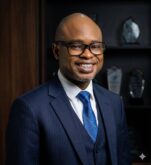
Adesola Kazeem Adeduntan is executive director/chief financial officer, First Bank Nigeria Limited. Recently, he spoke with Iheanyi Nwachukwu, in Lagos, among other selected journalists. Excerpt:
Recently, Afrinvest launched a banking report that shows banks with high exposure to oil and gas and telecoms. What is your bank doing to ensure that what happened in the past that led to crash in the banking system does not repeat itself?
First Bank is a bank that is managed very prudently. We do have a very strong governance structure, starting with our board of directors, which we have a very strong and knowledgeable people. We also have a strong executive management team under the leadership of our group managing director. What that does is that we have the platform and we have the knowledge and the technical base to be able to embark on those kinds of lending that we have embarked upon.
We do have a very robust credit risk management system and framework, where upfront we do have our credit strategy, we also do have a pro-active credit risk management policy that limit our expose by business sector, by geography, by products and by customers.
And all these policies and framework and what they do is that they essentially cap our exposures within sectors, within sub sectors and to certain categories of obligors. What I am saying in essence is that even though we are the largest bank in Nigeria, those exposures that you are seeing they have been prudently determined, evaluated and they all fall within our internal benchmarks for those sectors.
It is also very important to highlight the fact that a bank cannot exist in a vacuum. The balance sheet of a bank would be a reflection of the opportunities that are available in domestic economy. So, for example, you should be surprise if you suddenly see First Bank lending into sector that is non-existing in Nigeria; suddenly, you have 5 percent exposure to Diamond, and Diamond is not something that is existing in the country. But if you look at all the sectors you have mentioned, according to the report, they are critical sectors of the economy.
Oil and gas is the backbone of our country, telecoms in the last 10 to 12 years has become one of the most dominant sectors of the economy and one of the sectors that has demonstrated the potential growth opportunity that is possible in this economy, if we continue to pursue the kind of transformation agenda that the current government has been pursuing.
The same thing is with the manufacturing sector. The success story of Nigeria is the re-emergence of the middle-class, and for the middle-class the most important thing is that they have the disposable income and because they have the disposable income they also need to have goods and services. So, manufacturing, what are we manufacturing? Cement, fast moving consumer goods and because of the critical mass, looking at the population of the country, that is why manufacturing would continue to be a key sector and as the leading bank in Nigeria, we can’t but continue to lend to the manufacturing sector because that is part of the bedrock of the economy.
What is your bank doing in terms of increased regulatory headwinds?
The first critical point I would like to make is the fact that regulation is a key component of banking all over the world.
The ability of financial institution to survive and to survive very well depends significantly on the ability to manage regulatory issues, regulatory pronouncement and be able to ramp their business strategy around exploiting such regulatory pronouncement and challenges.
So, in our own case, it is true that there has been significant regulatory headwinds over the past three months, but we have responded by tinkering with our business model and we have reposition our business in such a way and manner that enables us to continue to grow despite all those regulatory challenges.
One of those regulatory pronouncements by the CBN is the re-introduction of ATM charges, what is your take on this?
First and foremost, let me explain to you that withdrawal by customers from the ATMs owned by their banks continues to be free. That key point is very important. If you are a customer of First Bank you can come and make withdrawals from our ATMs as many times as possible and there will be no charge. But where the challenges set in is when they go to other banks’ ATMs to make withdrawal then they will be charged. But even at that it is only when they withdraw more than three times that they will be charged. The way it works is that your bank get charged each time you make withdrawal from another banks’ ATMs. So, somebody needed to be compensated for that.
But the fundamental thing is that when you withdraw from the ATMs belonging to your own bank it is actually free, and when you withdraw up to a certain limit even from other banks’ ATMs it is also free. What the CBN has done is not to reverse as claimed but most importantly to prevent abuses. People just go in frequently to take N500, and N500, etc. There is a cost of service and to maintain the machine also cost money. Really, the fundamental message that I would like to convey is that the usage of ATM remains essentially free when you use the ATM of your own bank. And even when you are in location where the nearest ATM is not the one from of your own bank, it is still free up to a certain number of times. So, I think that is the most important thing.
What has been the impact to your bank in terms of withdrawal by customers since the re-introduction of the ATM charge?
It is very early days. As you probably know, First Bank is truly the leader as far as ATMs is concern. We actually own about 25 percent of the ATM machines in the entire network. Truly speaking, for our own customers they are able to access our machines at virtually all the critical locations and we were very strategic when we position our ATM from the world go such that in most cases, we expect our customers to have an ATMs relatively close to where ever it is to withdraw cash.
Let me also highlight that in addition to ATM, this bank in line with modern trend has also embark on providing alternative channels to most of our customers. We have online banking, mobile banking that enables people to sit in the in the comfort of their homes, shops or offices and they are able to execute transactions.
Again, in line with development of technology, people also need not physically visit either the bank’s branch or ATM for them to carry out banking transactions. This is fully in line with the cashless policy of the CBN, and we as the largest financial institution in Nigeria are fully working with the central bank to promote this particular agenda because it makes the economy to be more efficient and more effective.
Iheanyi Nwachukwu

Join BusinessDay whatsapp Channel, to stay up to date
Open In Whatsapp