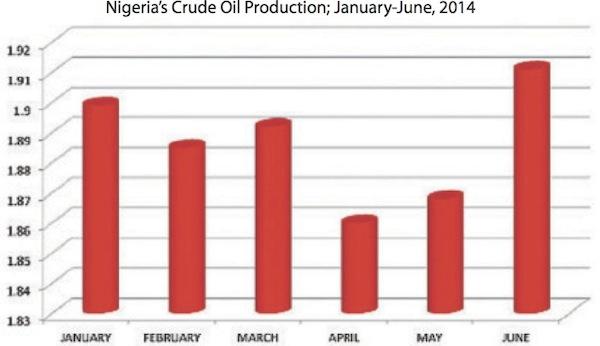
Nigeria’s crude oil output increased by 43 barrels per day or 2.3 percent to 1.911 million barrels per day (mbpd) in June, from 1.868 mbpd recorded in May, based on secondary sources from the Organisation of Petroleum Exporting Countries (OPEC) report for the month of July.
This represents 80 percent of projected production of 2.39 mbpd in 2014 budget as shown in the Medium Term Expenditure and Fiscal Strategy Paper of the Federal Government for the period 2014-2016.
The success story was attributed to the government’s efforts in tackling the problems of oil theft, illegal bunkering and production shut-ins in recent times.
It is hoped that these efforts by government would yield further results in the medium term; hence production is estimated at 2.50 mbpd and 2.55 mbpd for 2015 and 2016, respectively.
According to OPEC report, other countries that witnessed significant increase in crude oil production include Saudi Arabia, with an increase of 48 barrels per day (bpd); Angola 8 bpd; Libya 8 bpd; and United Arab Emirates, Ecuador and Venezuela with an increase of 2 bpd each.
The report stated that total OPEC crude oil production averaged 29.71 mbpd in June, a decrease of 80 bpd over the previous month, with the largest decrease from Iraq due to supply disruption caused by the ongoing crisis. Other countries that experienced shortfall include Algeria, Iran and Kuwait.
According to the report, oil production in Qatar was more or less unchanged, adding that OPEC crude oil production – not including Iraq – stood at 26.54 mbpd in June, an increase of 90 tbpd over the 26.45 mbpd recorded in May.
“Africa’s oil supply is forecast to average 2.47 mbpd in 2014, an increase of 60 tbpd from 2013. Oil supplies from Chad, Equatorial Guinea and the Sudan are expected to increase in 2014,” OPEC stated.
“It is projected that oil supply from Egypt will decline by 20 tbpd this year while oil production in Congo, Gabon, South Africa and ‘other Africa countries’ will remain steady. Output from South Sudan and Sudan is expected to increase by 50 tbpd in 2014 to average 0.29 mbpd on the assumption that the delicate agreement reached recently on oil transit will continue with possible interruptions. Political risk factors could bring a significant change to the supply forecast, especially from South Sudan and Sudan,” it said.
The report also disclosed that global oil supply averaged 90.66 mbpd in June, down by 0.26 mbpd from the previous month.
The decline in the month of June was driven both by OPEC crude oil output and non-OPEC supply. OPEC crude is estimated to have a 32.8 percent share of global supply, unchanged from the previous month. The estimate is based on preliminary data from non-OPEC supply, while estimates for OPEC NGLs and OPEC production are derived from secondary sources.
However, non-OPEC oil supply is estimated to have averaged 55.65 mbpd in 2014, an increase of 1.47 mbpd over a year earlier with an upward revision of 30 tbpd from the previous Monthly Oil Market Report (MOMR), with OECD Americas being the main driver for growth.
Olowa Peter

Join BusinessDay whatsapp Channel, to stay up to date
Open In Whatsapp