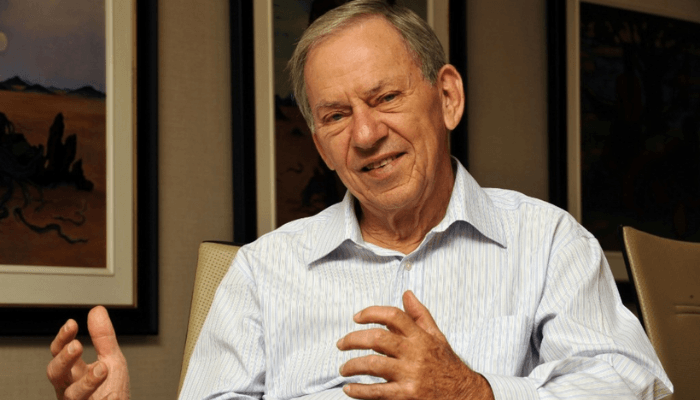
In the mid 1980s, Natie Kirsh watched the empire he had spent years building slip from his hands.
The South African businessman controlled one of the country’s largest retail and distribution groups. His companies employed more than 40,000 people, owned some of South Africa’s best known retail brands and accounted for a significant share of the consumer goods market.
Then it unravelled.
A combination of debt, a worsening economic crisis and a corporate structure that ultimately favoured his partner, Sanlam, stripped him of control. The fortune disappeared. So did the influence.
“I lost my fortune and the stature that came with controlling the country’s largest trading operation,” Kirsh later recalled.
Read also: Africa’s richest man adds billions as fortune nears $40bn
Most business careers do not recover from losses of that scale.
Kirsh’s did.
Four decades later, the 94-year-old businessman has emerged as Africa’s fourth richest person, with a fortune estimated at $15.2 billion as of June 8, 2026 by the Bloomberg Billionaires Index. The increase has been dramatic. His wealth has risen by 46 percent from February to June 8, the highest in the continent, driven largely by the revaluation of Jetro Restaurant Depot, the American wholesale food business that became the foundation of his second act.
The surge follows a deal announced in March that valued Jetro Restaurant Depot at about $29.1 billion, including debt, in a transaction involving US food distribution giant Sysco.
The valuation transformed Kirsh from one of Africa’s wealthiest businessmen into one of the biggest gainers on Bloomberg’s global rich list this year.
But the real story is not the billions.
It is how he made them.
The £1,200 inheritance
Kirsh was born on January 6, 1932, in Potchefstroom, South Africa, to Lithuanian Jewish immigrants.
His father built a malt manufacturing business and expected his son to join it after university. After earning a commerce degree from the University of the Witwatersrand in 1952, Kirsh did exactly that.
The turning point came after his father’s death.
Using an inheritance of £1,200 and financial support from business contacts, the young entrepreneur crossed into neighbouring Swaziland, now Eswatini, to establish a corn milling and malt operation.
The venture arrived at the right moment.
Colonial authorities granted the business exclusive rights that effectively made it the country’s sole importer of corn while also requiring it to purchase all locally grown production. The arrangement provided a foundation for growth and allowed Kirsh to build one of the country’s most important industrial groups.
“He made his first fortune in his native Swaziland, where he launched a corn milling business in 1958 and expanded into wholesale food distribution in apartheid South Africa, and then into supermarkets and commercial property development,” Forbes said.
His influence extended beyond business.
For more than two decades, he chaired Eswatini’s electricity board, helped expand the country’s power infrastructure and became closely connected to the monarchy.
Years later, he would describe the country as his “fourth child”.
The apartheid era opportunity
By 1970, Kirsh was looking beyond Eswatini.
He acquired South African wholesaler Moshal Gevisser and spotted an opportunity others overlooked.
Apartheid restrictions prevented many established white owned retailers from operating directly in black townships. Kirsh instead supplied independent black traders who were increasingly serving fast growing township economies.
The model proved highly profitable.
What started as a wholesale operation evolved into a retail and distribution powerhouse. Through acquisitions, Kirsh assembled a portfolio that included Checkers, Dion, Union Wine and Russell’s. At its peak, businesses linked to him controlled more than 12 percent of South Africa’s consumer goods market.
He was not merely building companies.
He was building one of the country’s most powerful commercial empires.
Losing everything
The expansion came at a cost.
In 1984, Kirsh partnered with Sanlam to create a new holding structure known as Sanki. He retained a majority stake, but the agreement contained provisions that would later prove disastrous.
As economic conditions deteriorated and debt pressures mounted, Sanlam gained the upper hand.
The businessman who had spent years consolidating South African retail assets found himself pushed out of the empire he had created.
What remained was a relatively obscure American business that few investors regarded as particularly significant.
That business was Jetro.
The warehouse that changed everything
Kirsh had opened the first Jetro warehouse in Brooklyn in the 1970s.
Read also: South African Kirsh dethrones Rabiu as Africa’s fastest-growing billionaire in 2026
Unlike traditional food distributors, Jetro targeted customers that larger companies often ignored.
Its customers were independent restaurant owners, pizzeria operators, caterers, deli owners and corner shop operators.
There were no sales representatives. No delivery fleets. No credit facilities.
Customers arrived with a business licence, selected their own stock and paid immediately.
The simplicity of the model became its competitive advantage.
By eliminating delivery costs and credit risk, Jetro could sell products at prices competitors struggled to match.
The business expanded steadily rather than spectacularly.
Kirsh kept it private, avoided publicity and resisted pressure to pursue rapid expansion at the expense of profitability.
In 1994, he acquired Restaurant Depot, broadening the customer base and deepening the company’s presence in the food service industry.
The formula rarely changed.
Serve small businesses better than anyone else.
The second empire
While public attention focused on technology billionaires and Wall Street dealmakers, Kirsh quietly built one of America’s largest privately owned wholesale food businesses.
By 2025, Jetro Restaurant Depot operated 166 locations across 35 states, generated approximately $16 billion in annual revenue and produced around $2.1 billion in EBITDA.
The company achieved 30 consecutive years of EBITDA growth, navigating recessions, the global financial crisis and the pandemic without breaking its upward trajectory.
The scale of that achievement became clear in March 2026 when Sysco agreed to acquire the business in a deal valued at $29.1 billion.
For Bloomberg’s wealth analysts, the transaction provided a fresh benchmark for valuing Kirsh’s stake.
The result was immediate.
His net worth jumped by roughly $5 billion almost overnight.
Read also:How Swiss billionaire heiress Nina Flohr is reshaping African eco-tourism
More than a retailer
Although Jetro remains the crown jewel of his fortune, Kirsh’s wealth extends far beyond wholesale food distribution.
Through Ki Corporation, he controls major property interests in Australia, Britain and elsewhere.
His assets include Tower 42, London’s first skyscraper and one of the most recognisable buildings in the City’s financial district. In Australia, he holds significant interests in Abacus Property Group and Abacus Storage King, as well as Birkenhead Point, a major Sydney retail destination.
The property investments reflect a philosophy Kirsh has repeated for years.
“It is the only sector where stupid people can make money.”
The billionaire who never sought attention
Modern billionaires often cultivate celebrity.
Kirsh chose the opposite approach.
He rarely grants interviews, keeps his businesses private and has largely avoided the public profile associated with great wealth.
Yet his story ranks among the most remarkable in global business.
He built one empire in southern Africa and lost it.
Then, from a single warehouse in Brooklyn, he built another.
The second one turned out to be worth far more than the first.

Join BusinessDay whatsapp Channel, to stay up to date
Open In Whatsapp